General Relativity and Balloon Relativity,
example for badly defined coordinate systems
Gy. Szondy
HOME, Budapest, Hungary
gyorgy_szondy@hotmail.com
23. Oct. 2001.
Abstract
Definition of the directions and units of coordinate axis is essential in case of building up a space-time description. Definition of coordinate axis means the definition of time and distance in space.
Definition is more or less arbitrary and usually the result is a mathematically correct description. However the usability varies depending on how lucky or bad the definition is.
This example intended to show how complicated a description could be if basic definitions are badly selected.
Description
|
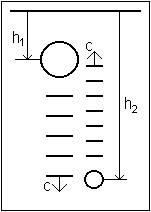
Balloons are all the same: they are spherical and contain the same amount of air. They are living under the see: there is no light, just sound waves propagating by the same velocity to all directions.
Balloons have their own internal clock: the frequency of the spherical wave, which wavelength is the radius of the balloon multiplied with PI. Balloons are using sonic radar and their internal clock to measure distance.
We are external observers, so we see that the deeper they are the more compressed they are. And so their internal clock is put out of tune: its frequency increases.
Balloons are accelerated upwards by buoyancy. I there was no drag, it would be quite easy to describe their movement. Balloons released at the same time in the same depth are moving together as they are accelerated by the same effect.
In this description we are using Descartes co-ordinate system and global time. |
|
Balloon-Centric description
The approach of balloons is quite different and so their interpretation of phenomenon of physics is different from ours too.
They defined time being measurable by their internal frequency without external calibration.
They recognized that the field, which accelerates balloons upwards effects the sound waves too. Sound waves propagating downwards are red-shifted.
They also recognized that free falling balloons are moving together just like there is no force at all, disregarding the so called tidal effect caused by the small difference in the location of the balloons. They decided to consider free falling balloons not accelerating but moving along geodesic lines of space-time.
They also recognized, that space-time is not Euclidean: it becomes wider as they get deeper.
Their description is correct, well developed but balloon-physicists are still not succeeded in unifying field theories because of the non-linearity of this particular field.
Definitions in General Relativity
General Relativity is also based on definitions of phenomenon like time, distance and movement.
Time measurement is derived from the frequency of a selected transition for a non-perturbed atom or molecule, without external calibration. [8]
The frequency of the light is increasing while approaching to the source of the gravitation field, and decreasing while we moving away. This phenomenon is called gravitational red-shift. [6]
General Relativity describes free falling particle to be moving along geodesic lines (time-line) of space-time. The Einstein Equivalence Principle – the basic principle of General Relativity – also states that free falling system is equivalent with an inertial system. [6]
Physicists are still not able to unify this gravitation theory with other field theories that are already unified in the theory of Super Symmetry. The main reason is the non-linearity of General Relativity.
Summary
This example shows that description of space-time can become overcomplicated even in a simple case if basic properties –like time – are badly defined.
Any resemblance of Balloon Relativity to General Relativity is not accidental: It seems that we –users of General Relativity – are adding the same complication to the theory of gravitation assuming that rest mass of particle is constant. This assumption prevents us from correct synchronization, summarizing mass or energy even if the underlying field is static. Moreover, gravitation is much more complicated than this example.
For me, it seems that we are still balloons of space-time.
References
|
1. |
Gy Szondy, 2001, Linear Relativity as the Result of Unit Transformation, pysics/0109038 |
|
2. |
C. Brans and R. H. Dicke, Mach’s Principle and a Relativistiv Theory of Gravitation, Phys. Rev. 124-925 (1961) |
|
3. |
R. H. Dicke, Mach’s Principle and Invariance under Transformation of Units, Phys. Rev. 125-2163 (1962) |
|
4. |
Gy. Szondy, 2000, Space-time Measurements and Relativity (Hungarian),
http://www.oocities.org/gyorgy_szondy/grav-rel2.html |
|
5. |
Gy. Szondy, 2001, Correct Measurements in Space-time (Hungarian), |
|
6. |
Landau, Lifsic, Classical Fields, Theoretical Physics II. (1972) |
|
7. |
J. Kovalevsky, 2000, Celestial Refernce Systems – An Overview, Proceedings of IAU Colloquium 180 http://aa.usno.navy.mil/colloq180/Proceedings |
|
8. |
B. Guinot, 2000, Time and Standards – An Overview, Proceedings of IAU Colloquium 180 |
|
9. |
S. Klioner, 2000, Relativity in Modern Astronometry and CelestialMechanics – An Overview, Proceedings of IAU Colloquium 180 |