
U.S.
Law
"Fair Use"
Original Author Objections
Reverse Plagiarism?
So is fan fiction legal? The rough, blunt answer is no. However, it is a "no" followed by quite a few "buts."
 Most
traditionally published works are covered by copyright. Harry Potter
and Lord of the Rings have the double whammy of being copyrighted
and trademarked. According to the Chilling
Effects Clearinghouse, copyright holders have the right to "stop
someone else from (1) copying, (2) distributing, (3) performing, or (4)
displaying the characters without the permission of the owner. The owner
also can stop someone from (5) creating 'derivative works.' ...a trademark
owner has the right to use exclusively, or to license the name or likeness
of his character to avoid customer confusion and to prevent others from
profiting off of the owner's intellectual property" (Chilling
Effects).
Most
traditionally published works are covered by copyright. Harry Potter
and Lord of the Rings have the double whammy of being copyrighted
and trademarked. According to the Chilling
Effects Clearinghouse, copyright holders have the right to "stop
someone else from (1) copying, (2) distributing, (3) performing, or (4)
displaying the characters without the permission of the owner. The owner
also can stop someone from (5) creating 'derivative works.' ...a trademark
owner has the right to use exclusively, or to license the name or likeness
of his character to avoid customer confusion and to prevent others from
profiting off of the owner's intellectual property" (Chilling
Effects).
 Rowling
has a historical precedent in Charles Dickens when it comes to derivative
works. Dickens, somewhat like Rowling, published his work in serial form
and had his characters strewn all over the place by imitators. In Fiction
for the Working Man, Louis James tracks some of Dickens' "plagiarists"
who could easily be called fan fiction writers. With one exception, however,
the modern day fan fiction writer does not attempt to make money from
his or usually her writing. James writes that, like Rowling and Tolkien's
work, Dickens' The Pickwick Papers "created a set of characters
that became common property. Dickens's greatest characters can exist independently
of the novels partly because of their pictorial conception in the tradition
of portraying comic types" (48). If Dickens' characters
are comic types, one could argue that Rowling and Tolkien's are heroic
types and therefore unsurprisingly subject to the same kind of public
appropriation. The widespread popularity of these characters has made
them iconic. They have become pop culture currency.
Rowling
has a historical precedent in Charles Dickens when it comes to derivative
works. Dickens, somewhat like Rowling, published his work in serial form
and had his characters strewn all over the place by imitators. In Fiction
for the Working Man, Louis James tracks some of Dickens' "plagiarists"
who could easily be called fan fiction writers. With one exception, however,
the modern day fan fiction writer does not attempt to make money from
his or usually her writing. James writes that, like Rowling and Tolkien's
work, Dickens' The Pickwick Papers "created a set of characters
that became common property. Dickens's greatest characters can exist independently
of the novels partly because of their pictorial conception in the tradition
of portraying comic types" (48). If Dickens' characters
are comic types, one could argue that Rowling and Tolkien's are heroic
types and therefore unsurprisingly subject to the same kind of public
appropriation. The widespread popularity of these characters has made
them iconic. They have become pop culture currency.
Ironically, what made these characters so "copyrightable" and "trademarkable" also makes it easy to violate that copyright or trademark. Many fan fiction authors are generally aware of copyright and what it means--that they can be legally sued for their hobby. Nearly every piece of fan fiction on the internet comes with some kind of disclaimer, "these aren't my characters. They belong to J. K. Rowling/J. R. R. Tolkien. I'm not making money off this. This is just for fun." It's basically a blatant plea not to be sued for copyright violation. However, this disclaimer is legally meaningless. In fact, such disclaimers are an admission that the writer is aware of copyright law and is ignoring it.
 This
doesn't mean that fan fiction writers will all be hauled into court by
copyright holders. The sheer number of fan fiction writers in every corner
of the internet makes this implausible. Many of these writers are teenagers
who have no assets, and, as their disclaimers attest, aren't making money.
Suing them would be futile. In the case of Harry Potter, J. K.
Rowling owns the copyright and Warner Brothers owns the trademark, and
it is difficult to imagine such wealthy, powerful entities dragging an
intermediate school student to court for poem about Ron Weasley. A 2003
Boston Globe article points out, "fan fiction can act like
a pair of golden handcuffs, a loving tribute from an author's most ardent
fans that's also something of a veiled threat. Any attempt by a writer
of Rowling's stature to shut down fan fiction would probably backfire
into a public-relations disaster that would only serve to draw more attention
to the disputed material" (Mayor). There are also economic practicalities
involved with letting fan fiction flourish, "and Rowling and the
various companies that make money off the Potter franchise can ill afford
to alienate the most lucrative segment of their audience" (Mayor).
This
doesn't mean that fan fiction writers will all be hauled into court by
copyright holders. The sheer number of fan fiction writers in every corner
of the internet makes this implausible. Many of these writers are teenagers
who have no assets, and, as their disclaimers attest, aren't making money.
Suing them would be futile. In the case of Harry Potter, J. K.
Rowling owns the copyright and Warner Brothers owns the trademark, and
it is difficult to imagine such wealthy, powerful entities dragging an
intermediate school student to court for poem about Ron Weasley. A 2003
Boston Globe article points out, "fan fiction can act like
a pair of golden handcuffs, a loving tribute from an author's most ardent
fans that's also something of a veiled threat. Any attempt by a writer
of Rowling's stature to shut down fan fiction would probably backfire
into a public-relations disaster that would only serve to draw more attention
to the disputed material" (Mayor). There are also economic practicalities
involved with letting fan fiction flourish, "and Rowling and the
various companies that make money off the Potter franchise can ill afford
to alienate the most lucrative segment of their audience" (Mayor).
 In
fact, in 2000, in anticipation of the release of the film of Harry
Potter and the Sorcerer's Stone, Warner Bros. attorneys sent cease-and-desist
letters to several fan-operated Harry Potter sites in the U.S. and U.K.
According to a SFGate.com article, "a public relations meltdown followed,
and the studio was pilloried in the press and shamed by a sweet-faced
16-year-old fan from Virginia. She organized a boycott and gave a Warner
Bros. VP a thorough drubbing on MSNBC's Hardball" (Noxon).
The claims were dropped, the boycott ended, and Harry Potter and the
Sorcerer/Philosopher's Stone made $976,475,550 at the worldwide box
office (Box
Office Mojo).
In
fact, in 2000, in anticipation of the release of the film of Harry
Potter and the Sorcerer's Stone, Warner Bros. attorneys sent cease-and-desist
letters to several fan-operated Harry Potter sites in the U.S. and U.K.
According to a SFGate.com article, "a public relations meltdown followed,
and the studio was pilloried in the press and shamed by a sweet-faced
16-year-old fan from Virginia. She organized a boycott and gave a Warner
Bros. VP a thorough drubbing on MSNBC's Hardball" (Noxon).
The claims were dropped, the boycott ended, and Harry Potter and the
Sorcerer/Philosopher's Stone made $976,475,550 at the worldwide box
office (Box
Office Mojo).
So, Rowling has given her blessing to fan fiction writers. According to a 2004 BBC report, Rowling through her spokesperson said she was "flattered people wanted to write their own stories....Her concern would be to make sure that it remains a non-commercial activity to ensure fans are not exploited" (Waters). Rowling also wanted to be sure the stories were not obscene and were credited to the fan fiction author.
 This
does not, however, give Potter fans a free ride to do as they
wish with the boy wizard and his pals. According to Chilling Effects,
cease
and desist letters have been sent to fan fiction authors regarding
their online work. These sites contained what Rowling's solicitor and
Warner Bros. considered inappropriate, adult content. The letter did,
however, affirm that other types of fan fiction were well tolerated, "for
the avoidance of doubt, our clients make no complaint about fan fiction
written by genuine Harry Potter fans" (Chilling
Effects). A cease and desist letter has, up until this point, been
enough to remove the material from the internet or send it somewhere else.
There has yet to be a landmark intellectual property case involving fan
fiction.
This
does not, however, give Potter fans a free ride to do as they
wish with the boy wizard and his pals. According to Chilling Effects,
cease
and desist letters have been sent to fan fiction authors regarding
their online work. These sites contained what Rowling's solicitor and
Warner Bros. considered inappropriate, adult content. The letter did,
however, affirm that other types of fan fiction were well tolerated, "for
the avoidance of doubt, our clients make no complaint about fan fiction
written by genuine Harry Potter fans" (Chilling
Effects). A cease and desist letter has, up until this point, been
enough to remove the material from the internet or send it somewhere else.
There has yet to be a landmark intellectual property case involving fan
fiction.
 Some fans, however, claim fair use in the writing of their
fan fiction. The
Stanford University Libraries website says, "the difficulty in
claiming fair use is that there is no predictable way to guarantee that
your use will actually qualify as a fair use. You may believe that your
use qualifies--but, if the copyright owner disagrees, you may have to
resolve the dispute in a courtroom. Even if you ultimately persuade the
court that your use was in fact a fair use, the expense and time involved
in litigation may well outweigh any benefit of using the material in the
first place" (Stanford).
Fair use, as defined by The U.S. Copyright
Office is:
Some fans, however, claim fair use in the writing of their
fan fiction. The
Stanford University Libraries website says, "the difficulty in
claiming fair use is that there is no predictable way to guarantee that
your use will actually qualify as a fair use. You may believe that your
use qualifies--but, if the copyright owner disagrees, you may have to
resolve the dispute in a courtroom. Even if you ultimately persuade the
court that your use was in fact a fair use, the expense and time involved
in litigation may well outweigh any benefit of using the material in the
first place" (Stanford).
Fair use, as defined by The U.S. Copyright
Office is:
| the fair use
of a copyrighted work, including such use by reproduction in copies
or phonorecords or by any other means specified by that section, for
purposes such as criticism, comment, news reporting, teaching (including
multiple copies for classroom use), scholarship, or research, is not
an infringement of copyright. In determining whether the use made
of a work in any particular case is a fair use the factors to be considered
shall include — (1) the purpose and character of the use, including whether such use is of a commercial nature or is for nonprofit educational purposes; (2) the nature of the copyrighted work; (3) the amount and substantiality of the portion used in relation to the copyrighted work as a whole; and (4) the effect of the use upon the potential market for or value of the copyrighted work. The fact that a work is unpublished shall not itself bar a finding of fair use if such finding is made upon consideration of all the above factors (copyright.gov) |
While there are pieces like "Happy Pothead and the Fornicating Phoenix" that are written as a critical/creative response to "moral"/religious fundamentalist" critics of Harry Potter, few fan fictions fall into the category of "educational" or "criticism," and many make extensive use of copyrighted material. However, many, if not all fan fictions are nonprofit and have little or no effect on the potential market for the copyrighted work. Certain works fall into the category of parody as well. Stanford defines parody as "a work that ridicules another, usually well-known work, by imitating it in a comic way. Judges understand that by its nature, parody demands some taking from the original work being parodied. Unlike other forms of fair use, a fairly extensive use of the original work is permitted in a parody in order to 'conjure up' the original" (Stanford). Works such as Hand Puppet Movie Theatre, which condenses the movie versions in a humorous way, can be considered parodies.
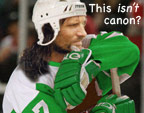 Sites
like The
Most Boring Life of Master Erestor and the Dom-Land
Caribou are a little harder to categorize. These sites use the characters
from Lord of the Rings and Harry Potter but tells new
stories with them in an attempt at humor. Can humor alone legally protect
a fan fiction? Even when Legolas has been turned into a figure skater
and Gandalf into a New York Yankee? Until a case comes to court, the legal
limitations of "fair use" will remain quite vague, and fan fiction
authors will remain quite free.
Sites
like The
Most Boring Life of Master Erestor and the Dom-Land
Caribou are a little harder to categorize. These sites use the characters
from Lord of the Rings and Harry Potter but tells new
stories with them in an attempt at humor. Can humor alone legally protect
a fan fiction? Even when Legolas has been turned into a figure skater
and Gandalf into a New York Yankee? Until a case comes to court, the legal
limitations of "fair use" will remain quite vague, and fan fiction
authors will remain quite free.
 Unless
that fan fiction author chooses to use the work of certain authors who
have not given their blessing. Anne Rice is one of the notable authors
who has requested that fans honor her copyright. On her website,
she posts, "I do not allow fan fiction. The characters are copyrighted.
It upsets me terribly to even think about fan fiction with my characters.
I advise my readers to write your own original stories with your own characters.
It is absolutely essential that you respect my wishes" (annerice.com).
Rice as well as other authors have contacted fanfiction.net about upholding
their copyright. Fanfiction.net therefore has a section in their Terms
of Service for copyright holders such as Rice. Xing Li, editor of
fanfiction.net, said in a BBC
article, "It is our long standing policy of fanfiction.net to respect
the wishes of original writers and will remove or ban fan fiction categories
at their request" (Waters).
Unless
that fan fiction author chooses to use the work of certain authors who
have not given their blessing. Anne Rice is one of the notable authors
who has requested that fans honor her copyright. On her website,
she posts, "I do not allow fan fiction. The characters are copyrighted.
It upsets me terribly to even think about fan fiction with my characters.
I advise my readers to write your own original stories with your own characters.
It is absolutely essential that you respect my wishes" (annerice.com).
Rice as well as other authors have contacted fanfiction.net about upholding
their copyright. Fanfiction.net therefore has a section in their Terms
of Service for copyright holders such as Rice. Xing Li, editor of
fanfiction.net, said in a BBC
article, "It is our long standing policy of fanfiction.net to respect
the wishes of original writers and will remove or ban fan fiction categories
at their request" (Waters).
Whether or not fan fiction authors adhere to these requests on sites other than fanfiction.net is hard to monitor. Some fans choose to disregard the original author's requests, which doesn't really make them sound like nice fans. This does, however, underscore the idea that certain entertainment media become public intellectual property by virtue of their popularity.
Copyright courtesy is extended, to some extent, to fan fiction authors at fanfiction.net. Another section of the Terms of Service called Domestic Copyright outlines a fan fiction author's rights to copyright and what to do if the author believe that copyright has been violated within fanfiction.net. The fact that fan fiction can have an informal copyright on a formal website demonstrates that fan fiction authors take their writing just as seriously as "real" writers, just without attorneys. Interestingly, in the world of internet fan fiction, plagiarism is heavily frowned upon, and violators can be mocked in internet forums for years.
But at least they can't be sued. Yet.
So has an established author ever "borrowed" from his or her fans' fan fiction? This enters another legal area where established writers may have problems with fan fiction. One could argue that the little disclaimer fan fiction authors hope protects them from prosecution also gives the original author or creator an unlimited smorgasbord of creativity from which to choose. Here is another reason for writers to discourage fan fiction. Writers University has a list of authors, and other media entities, and their stance on fan fiction based on their works. This list is based on internet sources and does not seem to be up to date. At least one listing is inaccurate*. However, the site does give some background into the reasoning behind why some authors are adamantly against fan fiction.
 No
writer wants to be branded a plagiarist, even if the work they're using
was based on their original work. One of the reasons cited for discouraging
fan fiction is the threat of lawsuits by the fan fiction authors. In the
case of Marion Zimmer Bradley, a fan apparently accused the author for
plagiarizing her fan fiction based on the universe created by Bradley.
Writers University has the somewhat spotty online
documentation of this case that took place in the early 90s. The incident
apparently caused Bradley to put a moratorium on fan fiction based on
her work.
No
writer wants to be branded a plagiarist, even if the work they're using
was based on their original work. One of the reasons cited for discouraging
fan fiction is the threat of lawsuits by the fan fiction authors. In the
case of Marion Zimmer Bradley, a fan apparently accused the author for
plagiarizing her fan fiction based on the universe created by Bradley.
Writers University has the somewhat spotty online
documentation of this case that took place in the early 90s. The incident
apparently caused Bradley to put a moratorium on fan fiction based on
her work.
The logistics for proving that an established author plagiarized a fan fiction must be atrocious. Established authors and the creators of other entertainment media sometimes give their fans insider information, previews or even fan tributes into stories or episodes. The writers for the X-Files created the character of Leyla Harrison as a tribute to the real Leyla Harrison, an ardent fan and fan fiction writer who passed away.
 With
original authors and creators paying fan service, and a fan base that
knows every detail of every corner of the fandom, it is not surprising
that fan fiction often unintentionally mirrors the original source before
that source even exists. So if two people come up with the same storyline,
or draw similar conclusions with the identical evidence, who "gets
dibs?" More importantly, can fans claim they deserve a share of the
profits from the original creators? Most fans are good enough to respect
the original author or creator's copyright. Most fans also don't have
the legal means of addressing intellectual property. However, with the
sheer numbers of fandoms and fan fictions out there, there's bound to
be some crossover situation egregious enough to cause a legal battle someday.
With
original authors and creators paying fan service, and a fan base that
knows every detail of every corner of the fandom, it is not surprising
that fan fiction often unintentionally mirrors the original source before
that source even exists. So if two people come up with the same storyline,
or draw similar conclusions with the identical evidence, who "gets
dibs?" More importantly, can fans claim they deserve a share of the
profits from the original creators? Most fans are good enough to respect
the original author or creator's copyright. Most fans also don't have
the legal means of addressing intellectual property. However, with the
sheer numbers of fandoms and fan fictions out there, there's bound to
be some crossover situation egregious enough to cause a legal battle someday.
Again, until some fan fiction author wins a landmark case, the law is with the copyright holder, most of whom are backed by corporations and their lawyers.
Established authors in the 21st century have to be careful with derivative works for a myriad of legal reasons or they may face a situation similar to Dickens in the 19th century. Of the one time he went after someone who had written an "adaptation" of his work, Dickens wrote, "I shall not easily forget the experience, and anxiety and horrible injustice of the Carol case, wherein, in asserting the plainest right upon earth, I was really treated as the robber instead of the robbed" (James 47).
*In case you were wondering, Wendy and Richard Pini of Elfquest are okay with fan fiction despite their listing at Writers University. They have an official fan fiction mailing list off their site. You can't get much more okay with fan fiction than that.
To email me, click the penguin

handsqueeziedeath@yahoo.com
© 2004 F.B. Pendergast
Last updated 12/19/2004