Hawks and doves is a non-zero sum game, and thus may or may
not have an equilibrium point. In standard game theory, equilibrium is
reached by the fully rational, knowledgeable players deciding what would be the
best strategy to use. Each player knows that the other player is also
rational and can assume what the other player will or will not do in some
cases. However, in evolutionary game theory, large populations are
playing against each other without full knowledge and play by trial and error
more than rationality. The main process that helps the population reach
equilibrium is selection. Successful strategies will remain while
unsuccessful strategies will die off.
In the hawk-dove game, there is a certain mixed strategy that will maintain and equilibrium. This ratio can be found by comparing the payoffs in the matrix and by using the concept of expected value. Think for example if a population was 90% doves and 10% hawks. If a player was introduced into the population, it could take advantage of this imbalance:
The expected value per encounter if the player decides to play a pure hawk strategy would be E(x) = 0.1(-25) + 0.9(50) = 42.5
The expected value per encounter if the player decides to play a pure dove strategy would be E(x) = 0.1(0) + 0.9(15) = 13.5
Thus we see that the expected value of being a hawk is much higher and the population can be taken advantage of. So in order to find the right mix of hawks and doves, we set up an equation to make the expected value of both hawks and doves the same.
p = probability of encountering a hawk
1-p = probability of encountering a dove
Hawks: E(x) = p(-25) + (1-p)(50)
Doves: E(x) = p(0) + (1-p)(15)
We set the equations equal to each other: p(-25) + (1-p)(50) = p(0) + (1-p)(15)
When we solve for p, we get p = 7/12
Thus, (1-p) = 5/12
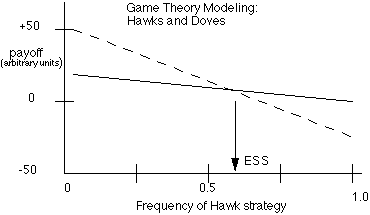
So in order to maintain equilibrium, the population should have 7/12 hawks and 5/12 doves. This, of course, is the result using these arbitrary numbers. The same procedure can be done to find the mixed strategy for different payoffs. The following is a graph of the payoffs to both hawks and doves depending on the frequency of hawks. We see the point where the lines cross is the equilibrium point we just calculated:
If we include the other strategies, the same procedure can be done by assigning p to the probability of hawk, q to the probability of dove, r to the probability of bully, and (1-p-q-r) to the probability of retaliator.
If we examine how the population reaches this equilibrium, we must examine the long-term trends of the hawk-dove game. If we start with a higher percentage of hawks, the likelihood of a hawk encountering another hawk increases. In each of these increased encounters, the hawks will loose 25 points every time. If a certain number of negative points is indicative of death, the hawks will begin to die off until equilibrium is reached. On the other hand, if doves are high in number, the doves will surely increase at a steady pace because of the relatively high frequency of contact with other doves. However, the hawks will also have a higher probability of encountering a dove, and their fitness points will increase more rapidly than those of the doves. The hawk population will then grow until it reaches equilibrium. Sometimes, the population of hawks or doves may overshoot its equilibrium target when changing from an unstable state. The population may fluctuate around the equilibrium until the populations evens out and stabilizes.
If a population consisted of 100% hawks or 100% doves, it is inherently unstable. A 100% hawk population will die out unless doves are present. If several hawks are introduced to a dove population, the hawks will do extremely well and reproduce rapidly and sooner or later reach equilibrium.
We can also take into consideration the two other strategies present. When just the hawk, dove and bully strategies are present, we can see from the matrix that the bully strategy is dominant to the dove strategy. Thus, the bullies will grow much more rapidly than the dove population eliminating them. Thus from a 3x3 matrix, we end up with a 2x2 matrix with hawks and bullies. If we do the calculations we see that the equilibrium point is 50% hawks, 50% bullies.
If we have a matrix with all four strategies, a different equilibrium will be reached. This time, no strategy strictly dominates any other, because doves now have a higher payoff than bullies when retaliators come into contact. The only weakly stable strategy is the retaliator strategy. If a population of only retaliators came into contact with doves, both could coexist at any ratio due to the equal payoffs to all members of the population. If hawks were introduced into a purely retaliator population, the hawks would die off first because they lose points when they come into contact with their own kind while retaliators gain 15 points when they come into contact with another retaliator. When bullies are introduced to a retaliator population, the retaliators are strictly dominant and will grow faster than the bullies. However, if any mixture of these strategies are introduced to the population, the retaliators are not dominant and the population ratio is not stable. Thus, the strategy is only weakly stable.