Shackelford Family History
The Shackelfords
by Margaret Shackelford. Mason
 It was 1901.
Brothers Wilton and Leland were hiding behind the barn on the family farm near
the small West Florida town of Kynesville. They were smoking cigars stolen from
their father, Hinton Edward Shackelford. Their father came around the corner
of the barn and said "Boys, come join the rest of the family on the front porch,
and bring your smokes" The two boys followed their father to the front steps,
where he had them smoke the entire cigars. Wilton was so sick afterwards, that
he vowed he would never smoke again! And he never did. Lelena continued to smoke
after he was grown. He died at age 47, leaving wife, Lola, and 7 children. their
oldest brother, Edward Hinton had already left home, married and had two daughters;
Mildred and Frances. the girls were babies when he was killed dynamining fish.
It was 1901.
Brothers Wilton and Leland were hiding behind the barn on the family farm near
the small West Florida town of Kynesville. They were smoking cigars stolen from
their father, Hinton Edward Shackelford. Their father came around the corner
of the barn and said "Boys, come join the rest of the family on the front porch,
and bring your smokes" The two boys followed their father to the front steps,
where he had them smoke the entire cigars. Wilton was so sick afterwards, that
he vowed he would never smoke again! And he never did. Lelena continued to smoke
after he was grown. He died at age 47, leaving wife, Lola, and 7 children. their
oldest brother, Edward Hinton had already left home, married and had two daughters;
Mildred and Frances. the girls were babies when he was killed dynamining fish.
Wilton and Leland were growing into manhood, helping their father on the farm. Their mother, with the help of Bessie, a pre-teenaged daughter, kept house and cooked for the family. Others in the family were two younger boys, Lonnie and Abner.
The mother, Ella Hare Shackelford, was expecting a new baby soon. She had sent for her sister, Jennie Sellers, to come and help out when the baby arrived. Jennie lived in Wauchula, Florida. Her husband, Riley Sellars was a kind and generous man. He sent her by train to Mariana, when elle's time was near. He and Jennie did not have any children.
Soon after Jennie's arrival the new baby girl, Ruth, was born. Happily the
new baby was fine and healthy. Sadly, Ella died giving birth. Ella was buried
in a cemetery by a small Baptist church near Kynesville.
When Jennie returned to Wauchula, she took Bessie, age 5, Abner, 4, Lonnie, age 2, and the new baby Ruth. She and Riley made a good home and raised the children as their own. Wilton and Leland stayed on at the farm and helped their father with the crops.
Later the two young men moved to Fort Meade. While there they worked in a Phosphate mine, and lived in a boarding house operated by their Aund Dade Whatley. Hinton came to Wauchula and stayed with family members there. He got an ingrown toenail that got infected and he died of gangrene. He was buried in New Hope Baptist Cemetery in Wauchula.
Leland soon married Lola Davis and they lived near Jennie and the other children.
They had seven children: Orion, Idell, L.M., Rufur, Armand, Lawrence, and Lamar,
who died at age 2. All of these, except Orion and Idell died of smoking related
illnesses.
Lonnie married Annie Laurie Terrell. They had four boys: Hinton, Elmer Clyde,
Terry and Charles. Abner married Lee Davis (Lola's sister). They had no children
of their own, but raised Edith, a daughter of Lee's by a previous marriage.
Bessie married a Moore-- they had several children, Roy and Margie among them.
Ruth married Hoyt Terrel. They had two children-- Delores and Edward. Wilton
joined the Army at the onset of World War I. He was sent to Camp Jackson N.C.
He was always mechanical minded, so the Army put him working on trucks and other
military equipment. Then he was chosen by the supply officer to drive his truck
all through the North Carolina country, looking for food sources. One of the
farms he visited near Seven Springs, NC was owned by Daniel Lee Hines, who had
several orchards -- peaches, pears, and apples. He also raised tobacco, and
corn. It was a great find for the officer to supply food to the camp.
D.L. Hines was married to Nancy Tessa Hines-- they were not kin. Tessa's mother
had died in Alabama when she was born. Her father brought her to North Carolina
by train to his sister in North Carolina to rais her. He bought a whole bold
of white material before leaving. As the baby needed a dry diaper, he tore off
a piece of cloth, and tossed the soiled one out the train window.
"Mr. Dan'l", or "Mr. D" is what peoople in the area called
him. He was a good farmer, and could predict the weather. He also was a Justice
of the Peace. Often when people would have arguments, fights, etc., a group
would come to the house for Mr. Dan'l to hear and settle their problem. He would
hold court sessions on the long front porch, pulling a table up to the swing
where he sat to listen as each side presented their side or plead their case.
They always accepted his judgement, and left peaceably for their homes.
Daniel and Tessa had nine children:
- Ida Helen Hines, called Sis, married Matthew Zadok Gurley-- they had two
daughters - Helena, who married Bill Gibbons, and Doris Ann, who married Bill
Watson.
- William Daniel (Will) married Ebbie Herrin. They had no children.
- Nannie Tess, Married Wilton Baker Shackelford. They had four children. Their
story is told in the Stories of Lex, Bill & Margaret
Shackelford growing up.
- Wesley, who married Blanche. They had one daughter, Pat M. Trainer.
- Leslie Hines, a boy who died in infancy
- Nora Elvira Hines, married Louis, one son, Forest Lee Price who was a pilot
in the USAF. His plane was shot down over Korea. He was MIA until declared
dead seven years later. Nora always thought he would return.
- Walter Hines married three times: Monica, Sterling, and Rannie. The story
is told that Sterling once took off her wooden leg and beat him severely.
Rannie was an elementary school teacher, very sweet and kind. She was good
to him and for him-- he adored her. They did not have any children.
- Nellie Hines was a beautiful girl with curly hair and fair skin. At age
nine she had an ailment that caused her hair to fall out and her mind never
developed any more. She remained a nine-year-old in an adult body.
- Norman Dee Hines was the youngest. He was very bright. When he finished
the fourth grade in the country school, the teacher asked his parents to try
to get him to town for further schooling. There will be more on him later.
He married Avalon Hone of Indianapolis, Indiana. They had five children: Linda
Jane, Deanne, Marsha, Susie, and Norman Dee.
Wilton Shackelford came to the Hines farm often with the Army trucks to get
produce for Camp Jackson. He often saw the pretty 16 year old Nannie Hines.
Before long, when he could get leave he came visiting. Being from Florida, Wilton
was accustomed to eating Grits. He found some, but could find no one who knew
how to cook them. So he attempted to prepare them himself. He put too many grits
in the pot and had to keep putting them in larger and larger pots. Tessa laughed
for years about Wilton cooking the grits in her kitchen.
Wilton had a friend from the camp whose wife lived nearby so they came together
often. The friend's wife was a nurse and had a home nursing job near the Hines
farm. Wilton asked Nannie to marry him before he left for overseas. "Sis"
was sewing a light blue wedding dress for Nannie. The nurse's job was over and
when Wilton and friend arrived the next weekend, they persuaded Nannie to go
back with them and get married in Goldsboro on the way. She agreed and got married
that night in her everyday dress, instead of the beautiful dress Ida was making.
The four young people shared a room in a boarding house, with a curtain dividing
the room.
The two girls were alone most of the week, but occasionally the guys came for
dinner. Other days the girls would ride the street car to the camp and eat in
the mess hall with the men.
Time came for the men's army unit to leave for France. They took the girls
to the train. Nannie going one way, her friend the opposite way to her parents'
home. They never saw each other again.
Wilton had asked Nannie to go see his family in Florida while he was overseas.
She had mailed them a picture of herself. They had written for her to come and
a date was picked. Nanie thought that Florida looked so desolate with so many
scrub oaks and palmettos. She was accustomed to the North Carolina countryside,
full of crops of tobacco, corn, cotton and a lot of orchards of fruit.
When she arrived at the Wauchula depot, no one was there to meet her. She asked
the station agent and he said that Lonnie Shackelford, who was about 12 years
old, was there earlier with the horse and wagon. The mail carrier offered to
take Nannie and her trunk on his route and deliver her to Jennie and Riley's
house. The family teased Lonnie for years; Nannie arrived wearing a hat, and
Lonnie said she didn ot look like the picture. She was so tired from the long
train ride, when Riley called her before light the next morning, she told him
she would like to sleep a while longer. Jennie's rule was that if you did not
get up for breakfast you must be sick. She sent Riley back with a big spoonful
of Castor Oil. Nannie swallowed it, but she never asked to sleep late again.
When Wilton returned from overseas, they settled in North Carolina. He and
Lewis Price built two houses across the street from each other in Seven Springs.
Nora always said she and Lewis ran out of money after the walls were up and
before partitions were in place. So Lewis borrowed money from a man. Within
a year their house was finished, the money was repaid and they never borrowed
money again the rest of their lives.Wilton was in the same situation, but he
was able to close in one room, the kitchen. They had a stove, table chairs and
a bed in it. Wilton and Dee, who was living with them in order to go to school
in town, slept in the open unfinished area. Nannie and their first child, Lexton
Travis, slept in the bed in the kitchen. Wilton was a good carpenter and he
made them a good living building homes for ex-soldiers.
They sold the home and moved to a farm with a large house. They were there
when the second child was born. Nannie told everyone that his name was Arnold
Ray and he was called "Ray" until he was a senior in High School.
Wilton had applied for government insurance and had listed children and birth
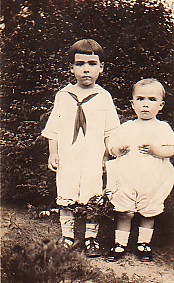
dates. The reply came that a William Jasper Shackelford was born in January
2, 1922; thus they learned that tessa, Nannie's mother, who was there at his
birth had told the doctor that William Jasper was his name. So this is what
was on the birth certificate.
 Wilton
was also a good mechanic. The family moved to Goldsboro, where he worked in
the garage of a Chevrolet agency. The owner sent Wilton to Detroit, to the General
Motors Corporation Mechanics School. He returned to his work as foreman of the
shop. While in the army in Germany he got poison gas on his hands. While working
as a mechanic the grease and oil aggravated his hands-- he would break out in
a rash. He was treated at several VA Hospitals, but never got any relief. he
got a small VA disability pension. (At his death, Nannie got $50.40 a month
until her death.) Because working as a mechanic bothered him so much he had
to quit the job he loved. He bought a combination store and filling station.
Wilton
was also a good mechanic. The family moved to Goldsboro, where he worked in
the garage of a Chevrolet agency. The owner sent Wilton to Detroit, to the General
Motors Corporation Mechanics School. He returned to his work as foreman of the
shop. While in the army in Germany he got poison gas on his hands. While working
as a mechanic the grease and oil aggravated his hands-- he would break out in
a rash. He was treated at several VA Hospitals, but never got any relief. he
got a small VA disability pension. (At his death, Nannie got $50.40 a month
until her death.) Because working as a mechanic bothered him so much he had
to quit the job he loved. He bought a combination store and filling station.
The third child, a girl was born. Tessa did it again! Nannie named the girl
Margaret Ann. Tessa knew a woman named Ann that she didn't like, so she had
Altha put on the birth certificate. When Margaret was in the first grade, two
other girls had that name, so she quickly said that her name was Margaret ANN.
She used that name through her graduation from High School. After that she was
listed as Margaret A. and signed her name that way only.
A fourth baby arrived, named James Wesley. He only lived to be about one year
old.
The family moved from Ash street in Goldsboro to the edge of town. They could
see the store across the field. One night Wilton got a call that his store was
burning. He went over there fast while the crying family watched the flames
across the field. Everything seemed to pile up after the fire. The family had
a terrible time in an extremely cold winter. Lex and Bill had diptheria. Margaret
had pneumonia. The doctor did not expect her to live.
All the family had gathered at the house: Tessa, Daniel, Ebbie, Will, Nora
and Ida. Nora loved to tell how she got Margaret's pongee dress out of the trunk
to press so that she could be buried in it. But Ebbie saved the day! She talked
Margaret into taking a spoonful of whiskey. Bribery did work-- Ebbie promised
all the ice cream she could eat out of Will's store! During the night her feber
broke, she was going to get well. At first she could not walk. To teach her
how to walk again, wilton put her little feet on his shoes as he walked to give
her the motion.
Then the final blow came! All three children and Nannie had the mumps. Wilton
had to stay home and take care of them all. When spring came, Wilton Nannie
had decided to move to Florida. By now Dee was ready for college and no longer
living with the family. They sold the house, and took household furnishings
to Tessa, Ida, and Nora's homes.
They went to Wauchula, traveling in a 1927 touring car. The sides were open
but had canvas curtains that snapped on to keep out the rain. Household supplies
packed in the floor of the back seat. Trunks and suit cases were tied to the
back and sides. Linens, quilts, etc. were on top of the household supplies.
The three children rode on top of all this. They rented an apartment from a
Mrs. Harvey in her home. The two boys were enrolled in school. Wilton got a
job at a Chevrolet business in Bartow. Nannie and Margaret kept house. Things
were looking up for them.
Then one day when Mrs. Harvey was going to get her laundry, she asked Margaret
and Nannie to ride with her. She ran a stop sign and was hit by another car.
She was not hurt, but Margaret hit the windshield and broke her nose. Nannie
got the worst. Her knee hit the dashboard and was broken in seven pieces. The
wreck was in front of a doctor's office. Seeing how bad her break was, he called
a retired orthopedic doctor who lived in Arcadia who agreed to treat her, so
the ambulance took her to the hospital there. The doctor drilled holes in each
piece of the kneecap and wired them together.
A couple, May and Pat Smith lived in another of Mrs. Harvey's apartments. They
had become good friends and they kept Ray and Lex with them so that they could
go to school. Margaret went to Ruth's, where she had Delores to play with. (insert
billlexsm)
Soon after the accident, Wilton got a job at a brand new Chevrolet Agency--
Turnipseed Motor Company. He was again shop foreman thanks to his GMC training.
Being foreman, he checked cars in and out and assigned jobs to the mechanics.
With this type of job he met many people and was so well liked because of his
politeness, and pleasing personality. This was certainly an accomplishment for
a person with only a fourth grade education. At his death in 1954, Margaret,
the only family member still living in Ocala, received 25 cards and letters
praising him for being a reliable and dependable person. Wilton looked long
and hard for an apartment with no stairs or a house, so the family could be
moved when Nannie got out of the hospital. First Nannie was moved to Lola's
house, still in a cast and still on crutches. Margaret moved there, too. She
was happy to have Rufus to play with. Nannie was under the care of the Wauchula
doctor. She was leaving the house one day on her crutches-- Lola was going to
drive her to the doctor's office. Rufus and Margaret in tow. The doctor drove
into the yard and said he had a call to make, so would save her a trip to his
office. He took the crutches from Nannie and threw them into the back of his
car. He said, "You'll never learn to walk again if you depend on these."
Then he drove off. Nannie was in tears, with Lola on one side, Rufus and Margaret
on the other. They got as far as the steps, Nannie sat down and scooted up backwards.
(insert bill) Bad luck struck one more time before they could get moved
to Ocala. Ray got diptheria again and was confined to a room by himself. Margaret
climbed in the window to visit him. Then she got diptheria. Finally all were
well and Wilton found an apartment on the first floor in Ocala. He had seen
this apartment earlier. It was in the home of Paul and Maude Durand. They had
refused to rent it to him because they didn not want anyone with children. When
he went back and pleaded with them saying his children were good, etc., they
finally agreed with the understanding that he would stay only until he could
find another place. The family lived there seven years, when Wilton bought a
home on the edge of town. The Durands cried when the Shackelfords moved. It
was ironic that years later Margaret married Paul Durand's great nephew.
Wilton worked at Turnipseeds until the late '30s. Then he opened his own business--
Shackelford body works. His employees repaired dents and painted cars. Two boys
who were classmates of Margaret told her years later that when they dented the
fender of one of the boys' father's brand new car Wilton reparied it, didn not
charge them, and did not tell on them. But he suggested that if it happened
again, tell their father! The children were growing up. Lex graduated from Ocala
High School in 1938. He was radio operator for a CCC camp in the forest. Then
he went to Radio School in Port Arthur, Texas. Bill graduated in 1939. He went
one year to University of Florida. Then he joined the Army Air Corps. He served
through the war as did Lex who was in the Maritime commission. Margaret graduated
in 1942. She then went to Mars Hill College, NC and graduated from Florida State
University.
Once again, Nannie and Wilton sold their home and moved. He worked in shipyards
in Florida, teaching carpentry to others, first in Jacksonville, and then in
St. Petersburg. They took a trailer to North Carolina after the war and spent
some time there. Then they bought a farm in Quincy, Florida. In 1947 they sold
the farm and bought an orange grove and farm house in Donna, Texas with Dee
and Avalon Hines. The orange grove froze, so they raised cotton. In February
1954 Wilton had hemmorhoid surgery. A blood clot formed and hit his heart--
he died instantly. He was sitting in a chair, joking with his nurse.
Bill and his wife Dawn flew to Houston from Illinois, where he was teaching
at the University of Southern Illinois. Margaret flew to Houston from Ocala.
Dee drove them to Donna for the funeral. Lex and his wife Gracie were already
there. He was buried in Houston. Bill came back during his spring holiday and
sold the farm and equipment. Nannie packed two trunks and sent them to Margaret.
The she jam packed her 1951 Chevy with clothes and personal items she wanted
to keep. Lex took the train down and drove her car to Houston. The car stayed
in Lex's garage until school was out. Margaret flew out and drove it back to
Ocala. They stayed in her apartment while Nannie was looking for a house to
buy.
Ray Mason, (who Margaret later married) was the real estate agent showing places
to her. One day while Margaret went to spend the day with friends at Lake Weir,
Nannie called Ray to go back to see the red house. She made and offer and it
was accepted by the time Margaret got home. By the time the family vacated it,
Nannie already made curtains. Margaret got two rooms painted before school started.
Nannie bought all new furniture. Margaret and Ray were married about two years
later, in 1956. Their only child, Ellen Celeste, was born August 6, 1958. In
1962 Nannie sold her house as did the Masons. They built a house in Eastwood
Subdivision in Ocala, with an apartment for Nannie and a swimming pool. In 1974
they bought a two bedroom cabin at Little Lake Weir. In 1977 they sold the Ocala
house and enlarged and remodelled the cabin to include an apartment for Nannie.
Nannie died in 1995 at the age of 96. She outlived Wilton by 41 years and her
oldest son, Lex, by 4 years. So ends the story of a sixteen year old, barefoot
pig-tailed North Carolina farm girl and the army truck driver. They moved often
in their years of marriage, always to better the lives of their children. All
three children had college education, which was no small job during those years,
and had successful lives in their chosen occupations. Although Wilton only knew
the two oldest grandchildren, he would have loved all seven of them, as well
as his eleven great grandchildren.
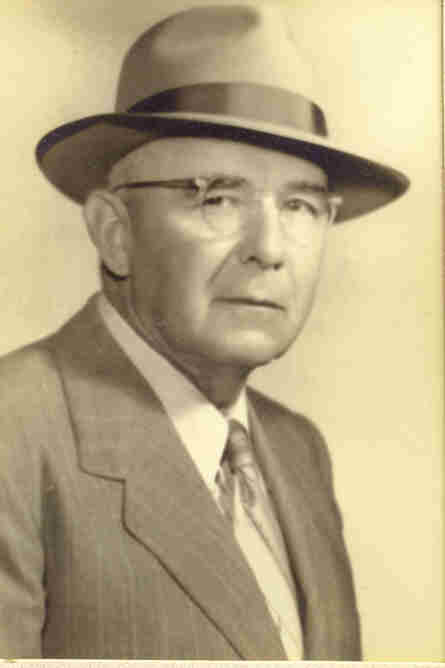
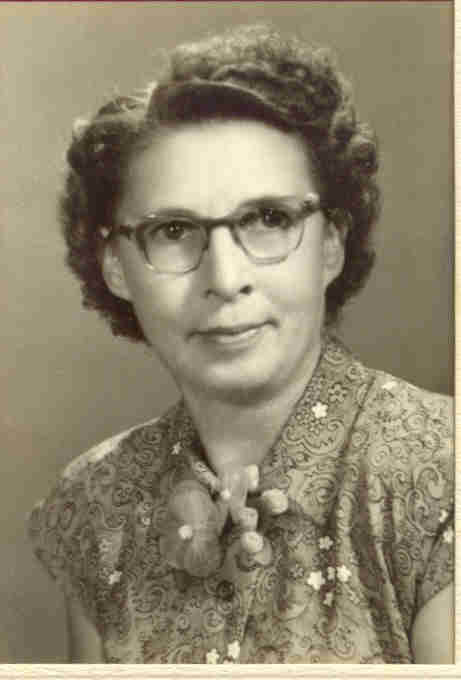
(ed. note: The above two pictures were always in my grandmother's
room, sitting in a double hinged frame. They were taken in the early forties.)
More Shackelford History