

When you book match a piece of wood, you're cutting it in such a fashion that you end up with two pieces that are mirror images of each other. Basically, you split the piece of wood and open it up as if you were opening a book.
It's a common practice when building dulcimers and nearly all dulcimers have book matched tops and bottoms and should have book matched sides.
Book matching does several very important things. Of course the most obvious thing is appearance. The instrument takes on a balanced look that's attractive to the eye.
Just as important is the sound quality book matching creates. The grain and grain pattern of the wood effects the voice of the instrument. By having both sides of the instrument matched, it tends to balance the voice.
Often overlooked but yet extremely important from a construction stand point is book matching the sides.
When we bend the sides for a dulcimer, we're forcing them to take a shape that nature never had intended for them. Just as soon as the bending process ends, the sides immediately start to try to return to their natural shape. The first sign of this is quite obvious as we usually have to over bend sides just a bit to allow for that little bit they tend to spring back.
If you take a bent side and just leave it lay for an extended period of time, you'll notice that it will slowly start to straighten inself. It may never be completely straight again but it'll try working it's way that direction.
If a side is properly bent, this is not a problem as it takes very little force to keep it in the bent position. Just simply having the top and back glued in place is more than enough force to keep the bent sides bent.
Even if the bend is held securely in place, it still exerts a slight pressure trying to straighten itself. If the sides are book matched and both sides of the dulcimer are mirror images of each other, these internal pressures are close to being balanced. The over all structure of the instrument is more stable.
It's almost like slicing cheese on a slicer. Each piece that's sliced off has a matching partner. We do the same thing except we slice wood with a saw.
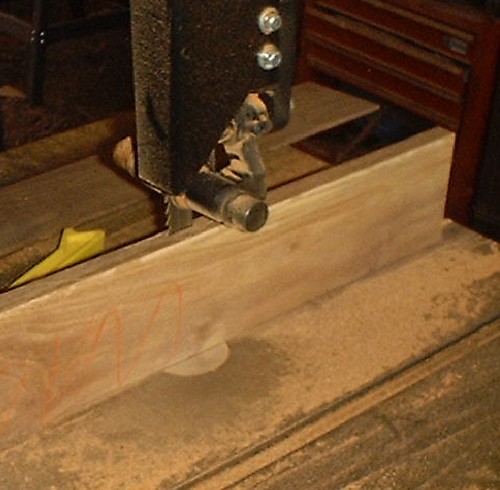
In this case, I chose a resonably high character piece of plane sawn walnut in hopes the grain will stand out more clearly so you can see the mirror image.
The proper term for what we're doing is called resawing. That's were you take a larger piece of wood and "resaw" it down to a smaller piece. In this case, we're resawing it down into two matching pieces.
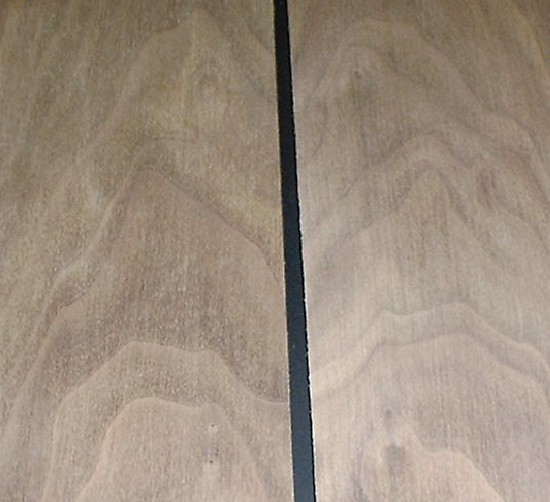
It's not a perfect match but it's also a high character piece of wood. The more diverse the grain pattern, the greater the difference between the two matched pieces. A straight grained quartersawn piese of wood can often be matched so closely that it's often hard to tell when one piece of wood ends and the other begins.
Using a band saw as I did helps. The blade is extremely thin so very little wood is cut away. In the tree, these two pieces of wood were well less than 1/8" from facing each other.
