In the last number of this magazine there appeared a very able and interesting historical sketch of the town, the people, and the neighborhood, of old Dorchester. The author, Mr. Henry A. M. Smith, has spared no pains to make a complete study of his subject. It is to be hoped that more papers of the same thorough research and critical method may be found in the contents of the Magazine for the future.
Some description of the fort has been given in the article referred to; but it has been thought that additional particulars concerning its size, shape, and present condition, would interest further the readers of Mr. Smith's article.
On a visit to Summerville about two years ago, the writer accompanied and assisted by Mr. W. Russell Dehon, examined the site of the old town of Dorchester and its fort, chiefly for the purpose of taking bearings and measurements of the latter. These were considered accurate enough, though made with only an excellent pocket-compass and a tape-line.
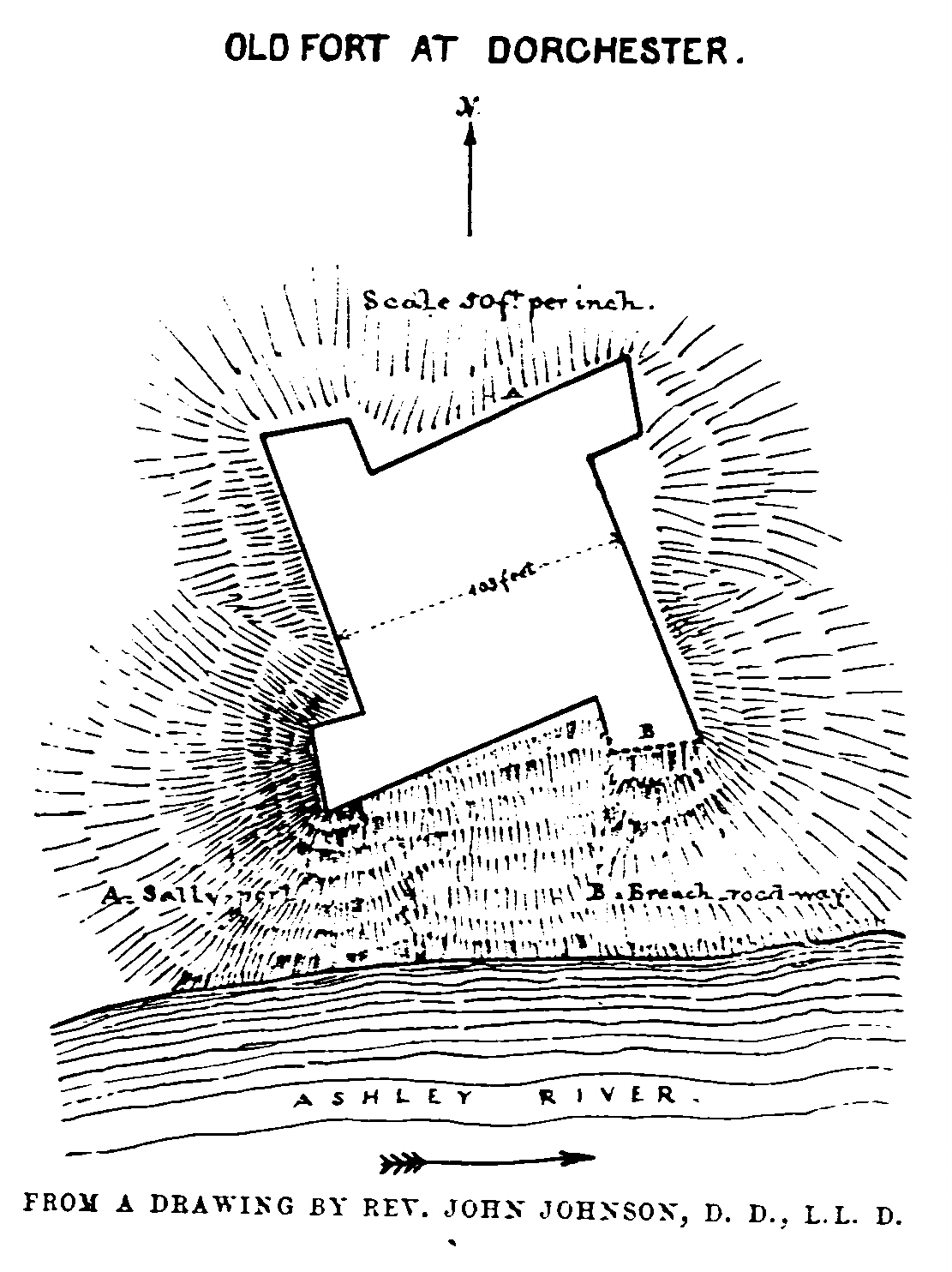
Situated on the left bank of the Ashley River, overlooking the stream, on ground fifty feet distant from, and about fifteen feet above, the water, the little fort remains to this day in good preservation. This is limited, however, to its plan, profile, and material of construction. Its interior, partly filled with earth and debris of brick-work, is grown up with trees, bushes, and cities. Its plan is that of a square redoubt with half-bastions at each of the four angles, which were probably once armed with swivels or light field-pieces. Its profile shows, now, an enclosing wall, from three to four feet thick, the base covered by debris, the top from seven to eight feet above the average level of the interior. The trace of the enclosing wall is unbroken with two exceptions - a sally-port, three feet wide, on the face farthest from the river, and a breach in the half-bastion nearest to the river, where the wall has been levelled to the around. Here, a drive-way for carts and wagons seems to have been made in recent years, to facilitate the removal of bricks from the interior for direct transportation on the river, close at hand. The material used for the walls was a concrete of broken oyster-shells and lime called "tabby", always found, when well made, to be close, firm, and durable. Brick was used also in some places for a coping of the parapet, and, no doubt, for magazines and other structures: these latter have all been demolished, but the coping of brick-work is still to be seen on the western wall.
Mr. Smith's judgment as to the date of the building of the present fort - 1775 - is entirely supported by the facts and conditions of the case. No such work would have been built in the time of the Indian wars: the early settlers could protect themselves with stockades and block-houses.
The illustration appended to these notes will serve to show the form, bearings, and dimensions of the fort at Dorchester. It was only a little more than one hundred feet square on the interior lines. On the river side, it commanded the approach to the town for perhaps a half-mile, with its small cannon. On the land side, an infantry fire, delivered over the parapet from a banquette, could be very effective.
Charleston, S. C., 25 May, 1905. John Johnson
In the sketch of the history of Dorchester published in the April Number of the Magazine, the writer stated that he could find no documentary proof of the existence of the old fort at Dorchester prior to the fortification constructed in 1775 under the orders of the Provincial Council of Safety.
Since then Mr. Langdon Cheves has called my attention to the following extract from the will of John Skerie, of St. George's, Esq. The will is dated 1 June 1768, and is recorded in the Probate Court for Charleston County in book 1767-1770. John Skene owned and resided upon a plantation of 3000 acres in St George's Parish on the south side of Ashley River and just opposite the town of Dorchester. This plantation was part of the original 12000 acre barony of the Earl of Shaftesbury.
*** "Item: I give to the commisioners of Fortification all my Great Guns for the use of the Magazine and Fort at Dorchester, reserving to the officers (for the time being) of the St. Georges Troop, the Liberty of using them on any Public Day, especially on his Majestys Birth Day and the 23d of April.
Item: I give my large silver cup to the church wardens of St. Georges Parish. Also my large Bible wiht Brass clasps, my other large Bible to the Parish library" ***
Henry A. M. Smith
Review of History of the Midway Congreqational Church, Liberty County, Georgia, by James Stacy, Pastor Presbyterian Church, Newnan, Georgia.
This volume is interesting to the student of South Carolina history, because the founders of Midway and the Midway Congregational Church moved there from Dorchester, South Carolina, and their moving broke up that once flourishing village about which so many interesting traditions cling like the vines that cover the old brick remains of the Congregational church that once flourished there, and which was founded by New England people, from Dorchester, Mass. - Ed.
In the January number of this Magazine, page 94, (Review History of Midway Congregational Church) "the old brick remains of the Congregational Church that once flourished" at Dorchester were referred to. The ruin right at Dorchester is that of the church of St. George's Parish, of the Church of England, as then established in South Carolina, and was built under Act of Assembly 1717. (See Dalcho's Church History.) The Congregational Church was not in Dorchester. The Independent or Congregational Church, called the "White Meeting," was over a mile away.
1 |
2 |
3 |
4
Supplemental information from other issues