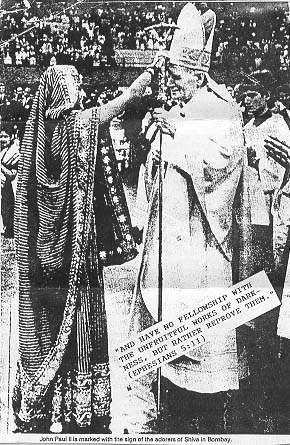
 Years ago, a “schismatic group” of the Society of St. Pius X, from Cleveland, sent me a picture of Pope
John Paul II receiving a mark on his forehead. Along with the picture, we received pages from a book
called Peter, Lovest Thou Me with the following quote and its source:
Years ago, a “schismatic group” of the Society of St. Pius X, from Cleveland, sent me a picture of Pope
John Paul II receiving a mark on his forehead. Along with the picture, we received pages from a book
called Peter, Lovest Thou Me with the following quote and its source:
"Still at Madras on February 5, 1986, 'A sugarcane, fashioned into the form of a cross, signifying a Hindu offering to a carnal god, was brought into the presence of the Pope. A little later, during the offertory procession, a coconut was carried to the altar, a typical Hindu offering, which they offer to their idols. Finally, a man placed sacred ashes on his forehead. IT WAS NOT A MATTER OF TILAC BUT OF SACRED ASHES OR VIBHUTI. (*164) THREE DAYS EARLIER, ON FEBRUARY 2, HE HAD RECEIVED ON HIS FOREHEAD THE TILAC OR TIKA, THE RED POWDERY PASTE OF THE HINDUS, THE SIGN OF THE ADORERS OF SHIVA. (*165) *164 ‘Msgr.’ Lefebvre, op. cit. p.177. *165 La Croix of February 6, and 'I' Express' of February 7/13, 1986, with photo."
This quote proves that the pope received a mark on his forehead on more than one occasion. What kind of message is this sending to the world? Revelation 13:16-18 warns us that the false prophet
“...causeth all, both small and great, rich and poor, free and bond, to receive a mark in their right hand, or in their foreheads: And that no man might buy or sell, save he that had the mark, or the name of the beast, or the number of his name. Here is wisdom. Let him that hath understanding count the number of the beast: for it is the number of a man; and his number is Six hundred threescore and six.”
There is a serious problem when the leader of a religious system with over 900 million followers openly receives any “mark” on his forehead. Unknown to the Catholic people, there is a reason why the pope would take such a mark, a dark plan. According to Bill Lambert, Director of the House of Theosophy (New age occultic group started in 1875 by Madam Blavatsky):
“Sometime between 1985-2010, the following scenario will unfold, depending only on the right set of circumstances: The Moslem and Jewish areas in Jerusalem will be combined with Christian to create the New Jerusalem Covenant. At the proper moment in history, the Pope will visit the combined Jewish/Christian/ Moslem sector of Jerusalem to announce that all religions should be combined into one. This action will then finally break the Middle East logjam" (The Cutting Edge Ministries, David Bay, “The Pope Is Declared To Be A ‘Proper Receptor To The New Age Christ [Antichrist]” Subtitle: The Director of the House of Theosophy, Bill Lambert, declares that the Roman Catholic Pope is going to be a "proper receptor" to the Antichrist and will be the Supreme Leader of the new global religion of the Antichrist. This part of the New World Order Plan labels the Pope as the Biblical False Prophet. cuttingedge.org).
David Bay, in his article, went on to comment about Lambert’s attitude towards the pope:
“Please understand that Lambert was presenting this information in a very positive way. He fully supported this part of the New World Order Plan to place the Pope in the top religious leadership role in the new global religion. Lambert was not trying to defame the Pope in any way; indeed, in Lambert's mind, getting this top religious leadership role is a great honor. But, to anyone who knows their Bible prophecy and takes it literally, this news is devastating, because it labels the Roman Catholic Pope as the Biblical False Prophet. Listen to the specific prophecy which is being fulfilled here, to understand how completely the Roman Catholic Pope will fulfill it.”
Catholicism has made a vain attempt to cover the pope’s actions as meaningless. Just listen to what archbishop Foley says when confronted by a Catholic:
“Q: Someone in the schismatic group the Society of St. Pius X told me that when the pope was in India he had his forehead anointed by a Hindu "priestess of Shiva" and that there is a photo to prove it. Is this true?
A: There is a photo of the pope having his forehead anointed by an Indian woman, but she was a Catholic, not a Hindu priestess! She was giving the pope a traditional Indian form of greeting known as "Aarti," which has no more religious significance than a handshake in western culture or giving someone a wreath of flowers as a welcome in Hawaii. A letter dated November 22, 1994 from the Pontifical Council for Social Communications explains the custom and its role in Indian society: ‘Indian Catholics . . . use 'Aarti' when a child returns home after receiving First Holy Communion, and when a newly married couple are received by their respective families. Nowadays, “Aarti” is often performed to greet the principal celebrant at an important liturgical event, as it was on the occasion shown in the photograph. On such occasions, 'Aarti' is usually offered by a Catholic married lady, and certainly not by a 'priestess of Shiva' as has been alleged.’ The letter, by Archbishop John P. Foley, president of the pontifical council, went on to note: Use of the 'Aarti' ceremonial by Indian Catholics is no more the worship of a heathen deity than is the decoration of a Christmas tree by American Christians a return to the pagan rituals of Northern Europe. Your schismatic friend in the Society of St. Pius X should check his facts before spreading such malicious gossip about the holy father (cf. Acts 23:1-5). He was simply about to say Mass and received the traditional Indian form of greeting for the celebrant.”
As proven, the pope took another mark, the “sacred ashes or Vibhuti” “three days earlier”. It seems the pope has no problem marking his forehead in either case!
It was the response of Archbishop Foley that I specifically found interesting. He feels that the actions of the pope is “no more the worship of a heathen deity than is the decoration of a Christmas tree by American Christians a return to the pagan rituals of Northern Europe”. The interesting part is that the archbishop, knowing full well that it was Rome who instituted the pagan practice of worshipping God by the putting up of a Christmas tree. He also knows that Christianity has polluted herself with the same pagan practices. The archbishop must have felt pretty safe that no one would dare speak out against a Christmas tree without condemning himself, therefore they could not speak out against receiving a mark either. This kind of trickery is common of Rome! But we here at FCFC have already shown that the Christmas tree is indeed a return to the paganism of Northern Europe. According to The Solstice Evergreen: The History, Folklore and Origins of the Christmas Tree:
“Worship around a tree is common worldwide. Even within the sacred groves, worship often centered around one special tree which may or may not have represented a higher deity. In either case it was usually larger than all others or set apart in some other way. Ceremonies honoring the tree involved sacrifices and holy offerings which were placed on the ground beneath it or in its branches. When the Spanish journeyed to the New World they found an ancient cypress in Mexico revered by the Mayans, which had offerings of teeth and locks of hair attached to its boughs. In China sacred trees bore red banners with words of praise and thanksgiving painted on them in black. Greek and Roman goddesses and gods each had their special trees which were draped in cloth or garlands of flowers. Little masks of Bacchus [another one of Santa’s predecessors] called ‘oscilla’ were placed on the branches so they twirled in the wind. By honoring the popular agricultural god, the faces were supposed to encourage growth and fertility in whatever part of the tree they faced. Another ritual in this vein performed at the winter solstice, was recorded by early missionaries in Finland, who quickly modified the custom for the celebration of Christmas. Each year the Lapps collected a sampling of all the foods eaten at the solstice feast. These were put into a small birch bark trough shaped like a tiny sailing boat, complete with masts, sails and oars. The boat was placed in the branches of a special pine tree which was marked with sacred symbols on all four sides. They also slaughtered a reindeer and put offerings of the animal’s internal organs in another pine, which was then smeared with reindeer blood. The tree worship of the Druids in Europe is well known. Their special tree was the Oak, but they revered the fir, the rowan and the hazel...During the winter solstice they [Vikings] tied apples to the branches of oaks and pines to thank the god Odin for blessing them with fruitfulness. They also made offerings of cakes shaped like fish, birds and other animals. Lighted candles, honoring the sun god Balder, were placed in the boughs. The connection between the Christmas tree and the sacred tree is quite clear” (23-24) (For more information, read: “Christmas: the Ecumenical Feast of the Beast” in Sept. /Oct. 1997 issue).
The tree is not the only item Rome has dubbed “Christian”. In Montano’s book Behind the Purple Curtain, page 26, we read:
“Impartial authorities have stated that in the past, the Roman Catholic Church's secret for conquering the natives for the Catholic faith has been her clever method of using the same temples, statues, and objects used by the pagans. With a magic touch the priests appropriated and baptized the old images into new purposes and new worship. The natives were told by the religious leaders that this was only a mere retouch - that they were not losing their old images nor their way of worshiping them, so they would continue coming to the old places, practicing their ceremonies and worshiping their idols with the same or even more interest than before.”
Dr. Conyers Middleton, a Cambridge University scholar and principle librarian, visited Rome and wrote a letter to his friends in England called "A Letter Shewing the Exact Conformity Between Popery and Paganism: or the Religion of the Present Romans to be Derived Entirely from That of Their Heathen Ancestors." This letter filled seventy pages and was printed at the West End of Saint Paul's, London, 1729.
“Middleton had come to Rome to study its classical treasures, but ecclesiastical Rome constantly intruded upon his attention. ‘ITS CEREMONIES APPEARED PLAINLY TO HAVE BEEN COPIED FROM THE RITUALS OF PRIMITIVE PAGANISM AS IF HANDED DOWN BY AN UNINTERRUPTED SUCCESSION FROM THE PRIESTS OF OLD TO THE PRIESTS OF NEW ROME.’ They recalled passages in the classics, so that whenever present in their churches he saw himself looking ‘at some solemn act of idolatry in old Rome’” (Behind the Purple Curtain, Montano, 29) (Emphasis mine).
One example of pagan ceremonies being passed down is the use of “holy water”:
“The holy water stoup at the entrance of Catholic churches was also an appurtenance of the heathen temple. This aquaminarium, according to Pére Montfaucon, was a vase of holy water at the entrance of pagan temples from which those entering sprinkled themselves. Croesus presented two such to the temple of Apollo at Delphi, one of gold, the other of silver. The custom of sprinkling themselves was so necessary a part of all pagan religious offices that pagan excommunication seems to have been a prohibition of the use of holy water. The holy water of pagan, as of papal Rome, contained salt. The sprinkling brush, aspersorium, of the older days resembles that of today, as coins and basreliefs show. The apostate Emperor Julian in his hatred of Christianity had the food in the markets sprinkled with pagan holy water, knowing well that Christians would starve rather than touch it. Middleton, in speaking of the virtues and miracles ascribed to holy water by modern Romans, aptly quotes from Ovid's Fasti:
‘O easy fools, to think that a whole flood Of water e'er can purge the stain of blood,’
and compares the sprinkling of horses in the Circensian Games to the benediction of horses at the Convent of Saint Anthony in Rome in the month of January, when priests in surplices at the church door sprinkle hundreds of horses with a brush and holy water. We do not need to go to Rome to observe these things. The daily papers in Los Angeles, California, are continuously printing pictures of priests in their sacred ornaments blessing donkeys, cows, and other animals” (Behind the Purple Curtain, Montano, 30).
Another pagan practice is the burning of candles before images.
“‘They light up candles to God,’ wrote the church father, Lactantius, of the heathen, ‘as if He lived in the dark. Do not they deserve to pass for madmen who offer lamps to the author and giver of light?’ In the collections of old inscriptions we find many instances of donation from private persons of lamps and candlesticks for the altars of the gods. The old heathen altars were hung with votive objects and pictures representing cures and answered prayers.
‘Now goddess, help, for thou canst help bestow, As, all these pictures round thy altars show,’
quotes Middleton from Tibullus. Especially crowded with such objects were the shrines of Aesculapius, the god of medicine. Polydore Virgil says of this practice, ‘In the same manner do we now offer up in our churches little images of wax, and as oft as any part of the body is hurt we presently make a vow to one of the saints to whom, on our recovery, we make an offering of that hand or foot in wax. A scrupulous man will question whether in this we imitate the superstitions of our ancestors.’ Middleton found so many of these pictures dedicated to the Virgin in Catholic churches that he applied, to those who paint for Catholic shrines, Juvenal's remarks concerning the debt painters of such pagan votive offerings owed to Isis:
‘As once to Isis, now it may be said That painters to the Virgin owe their bread.’
Middleton declares that Rome makes idolatry, which the first Christians looked upon as the most criminal part of paganism, the principal part of its worship. He describes the holy image of Loretto: ‘Its face is as black as a Negro's, therein resembling the idols of pagan antiquity which...classical writers described as black with the perpetual smoke of lamps and incense’” (Behind the Purple Curtain, Montano, 31-32).
Not only does Rome practice the religion of paganism, she has adopted their gods as her “saints”.
“Pagan deities have been baptized into the church and appear as Christian saints. ‘In the church of Saint Agnes they shewed me an antique statue of a young Bacchus which, with a new name and some little change of draping, stands now worshiped under the title of a female saint.’ The Pantheon, dedicated to Jove and all the gods, was piously reconsecrated by Boniface IV to the Virgin and all the saints. The little temple of Vesta, mentioned by Horace, is now possessed by the Madonna of the Sun; that of Fortuna Virilis by Mary the Egyptian; that of Saturn by Saint Adrian; that of Romulus and Remus in the Via Sacra by Cosmas and Damianus. At the foot of Mount Palatine between the Forum and Circus Maximus, on the spot where Romulus was said to have been suckled by the wolf, stands a little round temple. In this stood the statue of the wolf and the sucklings, and in pagan days it was visited by mothers and nurses with sickly infants moved by the conviction that there health and vigor were to be found. When this temple was transformed into the church of Theodorus, the custom of presenting children at the shrine continued on through the centuries, and Middleton says: ‘As oft as I looked into this church, ten or a dozen women could be seen, each with a child in her lap, sitting with silent reverence before the altar of the saint in expectation of his miraculous influence on the health of the infant.’ These changes of name were made with as little abruptness as possible. A Roman temple to Apollo is supplanted by a church of Saint Apollinaris. The temple of the Bona Dea, or Good Goddess, is now dedicated to the Madonna. Where once was a temple of Mars now stands a church dedicated to Martina with the inscription:
‘Mars hence expelled; Martina, martyred maid, Claims now that worship which to him was paid.’
An altar to St. Baccho and others to saints with such names as Quirinus, Romula and Redempta, Nymphia, Mercurius, and the like, suggest the easy passage from pagan Rome to papal Rome. A monastery on Mount Soracte gets its appropriate name of S. Oreste ("S" being the abbreviation for Saint). Thus this holy mountain stands under the protection of a patron whose being is just as imaginary as that of its old guardian, Apollo. Various illustrations are given as to how saints are made. In Spain a Saint Viar attained at one time great popularity. When search was made for the reason a stone was produced with the antique lettering "S Viar," which the antiquaries readily saw to be a small fragment of some old Roman inscription in memory of one who had been PraefectuS VIARum, or overseer of the highway. So in Catholic England the Saint Amphibolus, who was supposed to be a companion saint to Saint Albans, was traced to amphibolus, a name used to signify a rough shaggy coat which ecclesiastical persons wore in that age. Saint Amphibolus, then, instead of being a co-worker of Saint Albans, was that worthy's ulster. So Saint Veronica's name can be resolved into vera icon , or true picture. Veronica was the lengendary woman whose handkerchief relieved the bloody sweat of our Lord on the way to Golgotha and retained the true picture of his face. Two of these cloths exist in two different Roman churches, but the saint herself disappears in two words, vera icon. Old Rome had its gods of the street and highway; worshiped at wayside shrines. These, too, were rebaptized and the old Hecate in triviis became the Maria in Triviis, a church observed by Middleton. Huge wooden crosses by the roadside, covered with wreaths and votive offerings, replace the old tree trunks such as the one Ovid mentions,
"With ribbons, garlands, pictures covered o'er, The fruit of pious vows from rich and poor."
...To H. G. Wells' criticism: a considerable amount of a sort of theocrasia seems to have gone on between the Christian cult and the almost equally popular and wholly diffused Mithraic cult, and the cult of Serapis-Isis-Horus and the abundant use of candles in religious ceremonies....’ Many Catholic authorities acknowledge that their religion is an adaptation of paganism for the purpose of reaching the heathen more easily. Said Cardinal Baronius: ‘It is permitted the Church use for purposes of piety the ceremonies which the pagans used for purposes of impiety in a superstitious religion, after having first expiated them by consecrations, to the end that the devil might receive a greater affront from employing in honor of Jesus Christ that which His enemy had destined for his own service’” (ibid. 33-34). Cardinal Newman in his essay, The Development of Christian Doctrine, wrote:
“The power of Christianity to resist the infection of evil, and to transmute the very instruments and appendages of demon worship to an evangelical use."
He also claimed that Constantine “...in order to recommend the new religion to the heathen, transferred into it the outward ornaments to which they had been accustomed in their own.”
“Romanism is simply the old Roman paganism revived under Christian names. Romanism and paganism bear to each other the most exact and extraordinary resemblance" (ROMANISM AND THE REFORMATION, H. Grattan Guinness).
The truth is Rome believes that all she has to do is sanctify a pagan practice and it automatically becomes “Christian”. Does this include the pope receiving a mark on his forehead? Can the pope take the “red-powdery paste of the Hindus, the sign of the adorers of Shiva” and dub it “Christian” as well?
“O ye sons of men, how long will ye turn my glory into shame? how long will ye love vanity, and seek after leasing?”(Psa. 4:2)
By adopting paganism, Rome did not do away with it, but instead gave it a pseudo-Christian veneer. And what effect did this monstrous hybrid have? Did she truly reach the heathen she stooped so low to convert? Let’s take a look:
“In Mexico, Cortes, disregarding Montezuma's opposition, tore down the golden marks of Tezcatlipoca and Huitzilapochtli and put the cross on the principal temple of Mexico. But the Indians were never reconciled to the new images nor did they accept the new names for their temples. While they were looking at the Virgin of Guadalupe, their minds and hearts would be directed to Tezcatlipoca. While they bowed their heads to San Isidro, their souls were worshipping Quetzalcoatl, the god of the wind and of the evening star, the feathered serpent that at times would be Kukulcan and other times would act as Tezcatlipoca. The supposed conversion of Indians followed the same pattern. Carleton Beals says that those mass conversions by the millions were very mechanical acts that the Indians accepted stoically, without understanding them, since accepting them was preferable to dying, burned in fire. This, of course, contributed to a good report to Spain. Father Sahagun reports proudly how they ‘have demolished, in a short time, all the Aztec temples, big and small, to the point that no vestige of them was left.’ Father Motolinia was praising himself as he reported that in five days he and other priests ‘baptized 14,000 Indians.’ ‘During those days,’ he says, ‘one priest alone could baptize four, five, or six thousand Indians in one day.’ In Xochimilco, two priests baptized over 15,000 Indians in one day. In fifteen years - he reports - he baptized 9,000,000 Indians. Underneath the picture of Father Juan Diaz, at the church of Santa Maria, Atlihuitzan in Tlaxcala there is an inscription which reads: ‘Hernán Cortés' Confessor; he baptized in these parts 1,100,000 souls.’ No scruples were shown in converting the natives to Christianity and multitudes were baptized who were, entirely ignorant of the doctrine they professed to embrace. In the course of a few years, after the reduction of the Mexican empire, more than four million of the Mexicans were nominally converted, one missionary baptizing five thousand in one day and stopping only when he had become so exhausted as to be unable to lift his hands. The way that those mass conversions were made is indicated by Torquemada's instructions: ‘The first sermons must point to heaven to show that God is there; then bring the eyes down to the earth to indicate hell.’ Immediately the Indians were considered converted and received baptism. In Nicaragua, Gil González baptized 32,000 Indians in the twinkling of the eye. The church considered them as part of her spiritual conquest. But time has proved that these Indians were never in reality conquered. Even today, when they do not have Incas or Emperors to rule and guide them, they may show an external submission to priests, judges, and landlords, but their souls are not sold to them. When they are alone, amongst themselves they ridicule their exploiters. In churches or processions, while they pretend to worship the Virgin, their hearts and minds are fixed on the sun, for they have never given up the God of their forefathers. The thirty-three million Indians of the Western Hemisphere constitute a big interrogation in the coming events of the liberation of the masses. Catholics only in name, cruelly forced to obey the church's rituals, pretending to worship the saints, the modern Incas, Mayas and Aztecs are happy to remain pagans at heart. During festival days men and women are seen at the footsteps of the country church in the most awful condition of drunkenness, a vice never reproved by the dignitaries. When they feel better and the priest disappears, they go to their old customs where their hearts are set: they worship the sun, the moon, the stars, the rivers, and the mountains, with the same blind devotion that their forefathers did” (Behind the Purple Curtain, Montano, 36-38).
All of those efforts, and the heathen’s heart had not been changed. Her excuse for adopting paganism fails to accomplish that which Rome set out to use it for. Her “wisdom” was not from God, and therefore was not blessed. Instead, we can see today the roots of Catholicism are not biblical at all, but totally pagan in all aspects. We have included a few pictures of some of the paganistic symbolism that the Catholic church has incorporated into her worship and that will soon be judged by the very God she mocks.
“Therefore shall her plagues come in one day, death, and mourning, and famine; and she shall be utterly burned with fire: for strong is the Lord God who judgeth her.” (Rev.18:8)
by Rebecca A. Sexton