CATHOLICISM AND MASONRY: SAME FOUNDATION
“There are still old ladies, male and female, about the country, who will tell you, with grim gravity that, if you trace up Masonry, through all its Orders, till you come to the grand tip-top, head Mason of the World, you will discover that the dread individual and the Chief of the Society of Jesus [Jesuits] are one and the same person!” (James Parton, 1855, an American Historian, The life of Horace Greely)
I was raised Catholic, so you can imagine the shock of such a statement to someone who was told that Roman Catholicism condemned Freemasonry. In the book, My Catholic Faith, by Morrow, page 151, we read:
“Catholics who join Masonry, or marry before a non-Catholic minister, are automatically excommunicated, if they knew the serious nature of their actions.”
Excommunication from the Catholic church means that one is cut off from membership in the church and is excluded from the sacraments. If that person remains in this condition, according to Rome, he is damned to hell. The only way that person can become a member of good standing is to be given absolution by a bishop. Now, you’d think that an organization as powerful and influential as the Catholic Jesuits would be aware of such a doctrine. After all, aren’t they the teachers of these doctrines? Why then was it discovered that hundreds of cardinals and bishops were secretly Masons? Is this why Vatican changed their minds about the Masons in 1974? Avro Manhattan, in his book, Vatican Billions noted:
“Freemasonry, to the Catholic Church, had always been one of the greatest aberrations of society, worse than atheism or Bolshevism. Catholics were forbidden to sympathize, support or join it in any way or form. Had they done so, they were ipso facto, excommunicated. Papal fulminations had seen to it that the prohibition was maintained. Punishment to any Catholic who disobeyed was precise: exclusion from the communion of the Church here on earth; hell in the next world. Then one day in 1974, the Vatican dropped a bombshell. It gave official permission for Catholics to join a Masonic lodge, in particular cases, that is. The permission was used in certain quarters in Italy, Switzerland and in the U.S.A. Or rather, it had already been used by Catholics, prior to the official permission, simply because many of them had been dealing with sundry financial affairs of the Vatican Bank.”
We know from history that Pope Clement V, in 1312, abolished the Knights Templars, but it was revived in 1717 in England under a new name, “Freemasonry”. It’s purpose was to restore the pro-Jesuit Stuart Dynasty to the throne of England.
“This occult, Luciferian religion of Freemasonry, grounded in the pagan, phallic, sex-worshipping mysteries of ancient Babylon [as is the Roman Catholic religion], was intended to create a universal religious and political Empire. Its doctrines would be in accord with the Council of Trent and its political agenda subject to the Jesuit General. Therefore, we are not surprised in discovering that he Jesuit Order – the creator of modern communism — has written all the rites of Scottish Rite Freemasonry” (Vatican Assassins, Phelps, 284)
Charles Sotheran, in a letter addressed to the New York Press Club in 1877, said:
“It is curious to note too that most of the bodies which work these, such as the Ancient and Accepted Scottish Rite, the Rite of Avignon, the Order of the Temple, Fesslor’s Rite, the ‘Grand Council of the Emperors of the East and West Sovereign Prince Masons’, etc., etc., are nearly all the offspring of the sons of Ignatius Loyola. The Baron Hundt, Chevalier Ramsey, Tschoudy, Zinnendorf, and numerous others, who founded the grades in these rites, worked under the instructions from the General of the Jesuits. The rest here these high degrees were hatched, and no Masonic rite is free from their baleful influence more or less, was the Jesuit College of Clermont Paris” (Isis Unveiled, Blavatsky, 390).
I decided to do some research on this matter. To better understand the influence of the Jesuits on the Masons, I went to their book, MORALS AND DOGMA: ANCIENT AND ACCEPTED RITE, by Albert Pike, 1871 [Entered according to Act of Congress, 1906, by the SUPREME COUNCIL OF THE SOUTHERN JURISDICTION, A.A.S.R.,U.S.A.] It was soon evident that the Jesuits were truly the founders of the Masons and their rites. I was shocked at how many of the Roman Catholic’s “church fathers” were being quoted in this book. Why would Masons rely on Rome’s church fathers? What was even more amazing was the content of these quotes. It was becoming more and more evident that the reason Roman Catholicism chose these men as their “fathers” was because they held to the mystery religion of Mithras, just as the Masons.
The god Mithras (or Mithra) was a major influence in Rome and as equally influencial within apostate Christianity. That’s why there are so many parallels between Roman Catholicism and Mithraism.
“Mithra [was the] Persian savior, whose cult was the leading rival of Christianity in Rome, and more successful than Christianity for the first four centuries of the "Christian" era. In 307, A.D., the emperor officially designated Mithra ‘Protector of the Empire.’ Christians copied many details of the Mithraic mystery-religion...Some resemblance's between Christianity and Mithraism were so close that even St. Augustine declared the priests of Mithra worshipped the same deity as he did” (The World Of Myth An Anthology, David Adams, 197).
Augustine, one of Rome’s most prominent “church fathers” claims that he worshipped the same deity as the priests of Mithra! Is it any wonder why Rome uses Augustine’s teachings to support their own doctrines?
“Mithra was born on the 25th of December, called, "Birthday of the Unconquered Sun," which was finally taken over by the Christians in the 4th century A.D. as the birthday of Christ. Some said Mithra sprang from an incestuous union between the sun god and his own mother, just as Jesus, who was God, was born of the Mother of God. Some claimed Mithra's mother was a mortal virgin. Others said Mithra had no mother, but was miraculously born of a female Rock, the petra genetrix, fertilized by the Heavenly Father's phallic lightning. Mithra's birth was witnessed by shepherds and by Magi who brought gifts to his sacred birth-cave of the Rock [unlike the Biblical account of the wise men going to Jesus‘ house when He was a young child]. Mithra performed the usual assortment of miracles: raising the dead, healing the sick, making the blind see and the lame walk, casting out devils. As a Peter, son of the petra, he carried the keys of the kingdom of heaven. His triumph and ascension to heaven were celebrated at the spring equinox (Easter), when the sun rises toward its apogee. Before returning to heaven, Mithra celebrated a Last Supper with his twelve disciples, who represented the twelve signs of the zodiac. In memory of this, his worshippers partook of a sacramental meal of bread marked with a cross. This was one of seven Mithraic sacraments, the models for the Christians' seven sacraments...Its [Mithraism] priesthood consisted of celibate men only” (The World Of Myth An Anthology, David Adams, 198-99).
The word “sacraments” cannot be found in the Bible. Rome attained all her sacraments and her celibate priesthood from the Mithraic religion and not from God. Seeing then that Roman Catholicism has her foundation in the ancient mystery religions, as does the Masonic lodge, let’s further examine what the Masonic bible has to say about Mithraism and Christianity.
“Everything was in common among them; their property, their joys, and their sorrows. In the silence of night they met for instruction and to pray together. Their love-feasts, or fraternal repasts, ended these reunions, in which all differences in social position and rank were effaced in the presence of a paternal Divinity. Their sole object was to make men better, by bringing them back to a simple worship, of which universal morality was the basis; and to end those numerous and cruel sacrifices which everywhere inundated with blood the altars of the gods. Thus did Christianity reform the world, and obey the teachings of its founder. It gave to woman her proper rank and influence; it regulated domestic life; and by admitting the slaves to the love-feasts, it by degrees raised them above that oppression under which half of mankind had groaned for ages. This, in its purity, as taught by Christ Himself, was the true primitive religion, as communicated by God to the Patriarchs. It was no new religion, but the reproduction of the oldest of all ; and its true and perfect morality is the morality of Masonry, as is the morality of every creed of antiquity. In the early days of Christianity, there was an initiation like those of the pagans. Persons were admitted on special conditions only. To arrive at a complete knowledge of the doctrine, they had to pass three degrees of instruction. The initiates were consequently divided into three classes; the first, Auditors, the second, Catechumens [there is a cultic movement within RCC today called Catechumenate. It also talks about initiating men into secret knowledge], and the third, the faithful. The Auditors were a sort of novices, who were prepared by certain ceremonies and certain instruction to receive the dogmas of Christianity. A portion of these dogmas was made known to the Catechumens; who, after particular purifications, received baptism, or the initiation of the theogenesis (divine generation); but in the grand mysteries of that religion, the incarnation, nativity, passion, and resurrection of Christ, none were initiated but the Faith f ul. These doctrines, and the celebration of the Holy Sacraments, particularly the Eucharist, were kept with profound secrecy. These Mysteries were divided into two parts; the first styled the Mass of the Catechumens; the second, the Mass of the Faithful. The celebration of the Mysteries of Mithras was also styled a mass; and the ceremonies used were the same. There were found all the sacraments of the Catholic Church, even the breath of confirmation. The Priest of Mithras promised the Initiates deliverance from sin, by means of confession and baptism, and a future life of happiness or misery. He celebrated the oblation of bread, image of the resurrection. The baptism of newly-born children, extreme unction, confession of sins, —–all belonged to the Mithriac rites. The candidate was purified by a species of baptism, a mark was impressed upon his forehead, he offered bread and water, pronouncing certain mysterious words.” (Morals and Dogma, Pike, 541-542).
Anyone familiar with Roman Catholicism knows that these very doctrines of Mithra are indeed taught to every Catholic. When confronting Rome about the similarities, she boasts that it was “her wisdom” to incorporate pagan elements into Christianity. Of course, it was Rome’s own wisdom, and not the wisdom of God that corrupted her. Had Catholicism obeyed God’s word, they would have heeded the warnings in Deut.12:29-32:
“When the LORD thy God shall cut off the nations from before thee, whither thou goest to possess them, and thou succeedest them, and dwellest in their land; Take heed to thyself that thou be not snared by following them, after that they be destroyed from before thee; and that thou enquire not after their gods, saying, How did these nations serve their gods? even so will I do likewise. Thou shalt not do so unto the LORD thy God: for every abomination to the LORD, which he hateth, have they done unto their gods; for even their sons and their daughters they have burnt in the fire to their gods. What thing soever I command you, observe to do it: thou shalt not add thereto, nor diminish from it.”
When the early Christians were being persecuted, they took refuge in the vast catacombs which stretched for miles in every direction under the city of Rome, and are supposed to have been of Etruscan origin. Many of these people were not really Christian. They still clung to the pagan religion of their ancestors. The Jesuits, through their Masonic bible explains:
“There, amid labyrinthine windings; deep caverns, hidden chambers, chapels, and tombs, the persecuted fugitives found refuge, and there they performed the ceremonies of the Mysteries. The Basilideans, a sect of Christians that arose soon after the time of the Apostles, practised the Mysteries, with the old Egyptian legend. They symbolized Osiris by the Sun, Isis by the Moon, and Typhon by Scorpio; and wore crystals bearing these emblems, as amulets or talismans to protect them from danger; upon which were also a brilliant star and the serpent. They were copied from the talismans of Persia and Arabia, and given to every candidate at his initiation. Irenaeus tells us that the Simonians, one of the earliest sects of the Gnostics, had a Priesthood of the Mysteries. Tertullian tells us that the Valentinians, the most celebrated of all the Gnostic schools, imitated, or rather perverted, the Mysteries of Eleusis. Ireneus informs us, in several curious chapters, of the Mysteries practised by the Marcosians; and Origen gives much information as to the Mysteries of the Ophites ; and there is no doubt that all the Gnostic sects had Mysteries and an initiation. They all claimed to possess a secret doctrine, coming to them directly from Jesus Christ, different from that of the Gospels and Epistles, and superior to those communications, which in their eyes, were merely exoteric” (Morals and Dogma, Pike, 542-543).
Did you notice that all these initiatives possessed “secret doctrine, coming to them directly from Jesus” and they were all “different from that of the gospels and epistles”? This accurately describes Roman Catholicism! They have put their traditions above the word of God, claiming that special knowledge is given to them by their apparitions of “Mary and Jesus”! They put the words of these apparitions and their “church fathers” above the word of God. According to The Catechism of the Catholic Church, #82, "...Both Scripture and Tradition must be accepted and honored with equal sentiments of devotion and reverence." The Question Box Column, Brooklyn Tablet, Nov. 8, 1958, even went so far as to say, “Tradition as a source of Faith would suffice without Scripture”. Let’s continue looking at what the Jesuit written Masonic bible has to say:
“This secret doctrine they did not communicate to every one [Paul said that he did "not shun to declare the whole council of God"...it is evident that their “secret doctrines” were not Biblical doctrines]; and among the extensive sect of the Basilideans hardly one in a thousand knew it, as we learn from Irenaeus. We know the name of only the highest class of their Initiates. They were styled Elect or Elus...and Strangers to the World. They had at least three Degrees-the Material, the Intellectual, and the Spiritual, and the lesser and greater Mysteries; and the number of those who attained the highest Degree was quite small. Baptism was one of their most important ceremonies; and the Basilideans celebrated the 10th of January, as the anniversary of the day on which Christ was baptized in Jordan. They had the ceremony of laying on of hands, by way of purification; and that of the mystic banquet, emblem of that to which they believed the Heavenly Wisdom would one day admit them, in the fullness of things. Their ceremonies were much more like those of the Christians than those of Greece; but they mingled with them much that was borrowed from the Orient and Egypt: and taught the primitive truths, mixed with a multitude of fantastic errors and fictions. The discipline of the secret was the concealment (occultatio) of certain tenets and ceremonies. So says Clemens of Alexandria. To avoid persecution, the early Christians were compelled to use great precaution, and to hold meetings of the Faithful [of the Household of Faith] in private places, under concealment by darkness. They assembled in the night, and they guarded against the intrusion of false brethren and profane persons, spies who might cause their arrest. They conversed together figuratively, and by the use of symbols, lest cowans and eavesdroppers might overhear: and there existed among them a favored class, or Order, who were initiated into certain Mysteries which they were bound by solemn promise not to disclose, or even converse about, except with such as had received them under the same sanction. They were called Brethren; the Faithful, Stewards of the Mysteries, Superintendents, Devotees of the Secret, and ARCHITECTS. In the Hierarchiae, attributed to St. Dionysius the Areopagite, the first Bishop of Athens, the tradition of the sacrament is said to have been divided into three Degrees, or grades, purification, initiation, and accomplishment or perfection; and it mentions also, as part of the ceremony, the bringing to sight. The Apostolic Constitutions [now an admitted forgery], attributed to Clemens, Bishop of Rome, describe the early church, and say: "These regulations must on no account be communicated to all sorts of persons, because of the Mysteries contained in them." They speak of the Deacon's duty to keep the doors, that none uninitiated should enter at the oblation. Ostiarii, or doorkeepers, kept guard, and gave notice of the time of prayer and church-assemblies; and also by private signal, in times of persecution, gave notice to those within, to enable them to avoid danger. The Mysteries were open to the Pideles or Faithful only; and no spectators were allowed at the communion” (Morals and Dogma, Pike, 543-544).
Just as the “spectators” of the mystery rites were forbidden to partake in their communion, neither can spectators of the Roman Catholic Mass partake in their communion. It was also an abomination for the Egyptian to allow a Hebrew to eat of his bread, so the practice is very old in the ancient mystery religions.
“...because the Egyptians might not eat bread with the Hebrews; for that is an abomination unto the Egyptians.” (Gen.43:32)
Tertullian, one of Catholicism’s most honored “father”, in his Apology said:
“None are admitted to the religious Mysteries without an oath of secrecy. We appeal to your Thracian and Eleusinian Mysteries ; and we are especially bound to this caution, because if we prove faithless, we should not only provoke Heaven, but draw upon our heads the utmost rigor of human displeasure. And should strangers betray us? They know nothing but by report and hear-say. Far hence, ye Profane! is the prohibition from all holy Mysteries” (Morals and Dogma, Pike, 544)
Another one of Rome’s church fathers, namely Clemens, Bishop of Alexandria, in his Stromata, said that he cannot explain the Mysteries, because he should thereby, “according to the old proverb, put a sword into the hands of a child”. We have often heard this proverb used by Roman Catholic apologists concerning the Bible. When asked by Christians why Roman Catholicism has kept the word of God from the people, even to the point of putting the Bible on the forbidden book list, she answers:
“It is said that we deprive the Faithful of he word of God, which is the soul’s daily bread. We may answer this falsehood by stating that whole indeed the Scriptures is our soul’s daily bread, Mother church purportions it to our needs. Just as parents do not give the whole loaf to their children, or a knife with which to cut it lest they injure themselves, so it is the duty of the Church, of the priest or the preacher, to distribute the spiritual bread of the word of God to the people in portions suited to their requirements. It is said that the word of God is the light of the world. Well indeed do we admit this truth. But we do not place a lighted candle in a child’s hands, lest he burn himself” (The Priest, His Dignity and Obligations, by “St.” John Eudes, 99).
It’s nice to know that their doctrine can be found in the Masonic bible! Clemens frequently compares the Discipline of the secret with the heathen Mysteries, as to their internal and recondite wisdom.
“Origen, born A. D. 134 or 135, answering Celsus, who had objected that the Christians had a concealed doctrine said: ‘Inasmuch as the essential and important doctrines and principles of Christianity are openly taught, it is foolish to object that there are other things that are recondite; for this is common to Christian discipline with that of those philosophers in whose teaching some things were exoteric and some esoteric: and it is enough to say that it was so with some of the disciples of Pythagoras’” (Morals and Dogma, Pike, 544)
It seems that Archelaus, Bishop of Cascara in Mesopotamia, who, in the year 278, conducted a controversy with the Manichaeans, said:
“These Mysteries the church now communicates to him who has passed through the introductory Degree. They are not explained to the Gentiles at all; nor are they taught openly in the hearing of Catechumens; but much that is spoken is in disguised terms that the Faithful...who possess the knowledge, may be still more informed, and those who are not acquainted with it, may suffer no disadvantage” (ibid., 545)
For those who “advanced beyond the class of Catechumens”, the mysteries were revealed. Of course, this is not scriptural in the least. Paul says:
“For ye see your calling, brethren, how that not many wise men after the flesh, not many mighty, not many noble, are called: But God hath chosen the foolish things of the world to confound the wise; and God hath chosen the weak things of the world to confound the things which are mighty; And the base things of the world and things which are despised, hath God chosen….” (1Cor.1:26-28)
And again, Paul says:
“Therefore let no man glory in men, For ALL THINGS ARE YOURS; Whether Paul, or Apollos, or Cephas, or the world, or life, or death, or things present, or things to come; all are yours; and ye are Christ’s; and Christ is God’s.” (1Cor.3:21-23)
The claim that the church fathers have special knowledge and special privileges because they were “initiated” is just plain foolishness. Yet, all of Rome’s early “church fathers” have something to say about this subject contrary to God’s word.
“Cyril, Bishop of Jerusalem, was born in the year 315, and died in 386. In his Catechesis he says: "The Lord spake in parables to His hearers in general; but to His disciples He explained in private the parables and allegories which He spoke in public. The splendor of glory is for those who are early enlightened: obscurity and darkness are the portion of the unbelievers and ignorant. Just so the church discovers its Mysteries to those who have advanced beyond the class of Catechumens: we employ obscure terms with others" (Morals and Dogma, Pike, 545) (Emphasis mine).
“St. Basil, the Great Bishop of Caesarea, born in the year 326, and dying in the year 376, says : ‘We receive the dogmas transmitted to us by writing, and those which have descended to us from the Apostles, beneath the mystery of oral tradition: for several things have been handed to us without writing, lest the vulgar, too familiar with our dogmas, should lose a due respect for them?” This is what the uninitiated are not permitted to contemplate; and how should it ever be proper to write and circulate among the people an account of them?’” (ibid., 545)
“St. Gregory Nazianzen, Bishop of Constantinople, A. D. 379, says : ‘You have heard as much of the Mystery as we are allowed to speak openly 'in the ears of all ; the rest will be communicated to you in private; and that you must retain within yourself...Our Mysteries are not to be made known to strangers’” (ibid., 545).
“St. Ambrose, Archbishop of Milan, who was born in 340, and died in 393, says in his work De Mysteriis: ‘All the Mystery should be kept concealed, guarded by faithful silence, lest it should be inconsiderately divulged to the ears of the Profane...It is not given to all to contemplate the depths of our Mysteries...that they may not be seen by those who ought not to behold them; nor received by those who cannot preserve them.’ And in another work: ‘He sins against God, who divulges to the unworthy the Mysteries confided to him. The danger is not merely in violating truth; but in telling truth, if he allow himself to give hints of them to those from whom they ought to be concealed.....Beware of casting pearls before swine!....Every Mystery ought to be kept secret; and, as it were, to be covered over by silence, lest it should rashly be divulged to the ears of the Profane. Take heed that you do not incautiously reveal the Mysteries!’” (ibid., 545-546)
“St. Augustine, Bishop of Hippo, who was born in 347, and died in 430, says in one of his discourses: ‘Having dismissed the Catechumens, we have retained you only to be our hearers ; because, besides those things which belong to all Christians in common, we are now to discourse to you of sublime Mysteries, which none are qualified to hear, but those who, by the Master's favor, are made partakers of them...To have taught them openly, would have been to betray them’” (ibid., 546).
“St. Chrysostom and St. Augustine speak of initiation more than fifty times. St. Ambrose writes to those who are initiated; and initiation was not merely baptism, or admission into the church, but it referred to initiation into the Mysteries. To the baptized and initiated the Mysteries of religion were unveiled ; they were kept secret from the Catechumens; who were permitted to hear the Scriptures read and the ordinary discourses delivered, .in which the Mysteries, reserved for the Faithful, were never treated of: When the services and prayers were ended, the Catechumens and spectators all withdrew.” (ibid., 546)
“Chrysostom, Bishop of Constantinople, was born in 354, and died in 417. He says: ‘I wish to speak openly - but I dare not on account of those who are not initiated. I shall therefore avail myself of disguised terms, discoursing in a shadowy manner...Where the holy Mysteries are celebrated, we drive away all uninitiated persons, and then close the doors.’ He mentions the acclamations of the initiated; ‘which,’ he says, ‘I here pass over in silence; for it is forbidden to disclose such things to the Profane’” (ibid., 546).
The gospel was to be preached to every creature. The mystery of God has been revealed! Yet Rome’s fathers as well as the Mason’s fathers teach and preach otherwise.
“Palldius, in his life of Chrysostom, records, as a great outrage, that, a tumult having been excited against him by his enemies, they forced their way into the penetralia, where the uninitiated beheld what was not proper for them to see; and Chrysostom mentions the same circumstance in his epistle to Pope Innocent. St. Cyril of Alexandria, who was made Bishop in 412, and died in 444, says in his 7th Book against Julian: "These Mysteries are so profound and, so exalted, that they can be comprehended by those only who are enlightened. I shall not, therefore, attempt to speak of what is so admirable in them, lest by discovering them to the uninitiated, I should offend against the injunction not to give what is holy to the impure, nor cast pearls before such as cannot estimate their worth...I should say much more, if I were not afraid of being heard by those who are uninitiated: because men are apt to deride what they do not understand. And the ignorant, not being aware of the weakness of their minds, condemn what they ought most to venerate’” (ibid., 547).
“Theodoret, Bishop of Cyropolis in Syria, was born in 353, and made Bishop in 420. In one of his three Dialogues, called the Immutable, he introduces Orthodoxus, speaking thus: ‘Answer me, if you please, in mystical or obscure terms : for perhaps there are some persons present who are not initiated into the Mysteries.’ And in his preface to Ezekiel, tracing up the secret discipline to the commencement of the Christian era, he says: ‘These Mysteries are so august, that we ought to keep them with the greatest caution’” (ibid., 547).
There are enough quotes here from early Catholic “church fathers” in the Masonic bible to show that there is indeed a connection between the mystery religion of Rome and the Masonic mysteries. So...why did the Jesuits set up the Freemasons? According to Vatican Assassins, by Eric Phelps, the Jesuit General, since 1815, has used Shriner Freemasonry for three purposes:
“1. To maintain the Order’s death grip over the Pope, the College of Cardinals and thus the Papacy.
2 To destroy the Protestant Reformation while restoring and maintaining the Temporal Power of the Order’s ‘infallible’ Pope over every nation.
3. To gain possession of Jerusalem in order to rebuild Solomon’s Temple, for the pope, after which every Masonic Lodge is patterned.” (page 182)
The Jesuits have succeeded in gaining control over the papacy. They have been very successful in tearing Protestantism down with the ecumenical movement. But this is only one aspect of their destructive plan. They have one for the churches and one for the government. In 1825, the Jesuits held a secret meeting where they laid out their long term plan for domination. One young Jesuit, Leone (who later became General of the Order) took notes of that meeting which was later published by a Frenchman. In 1848, the book was translated into the English tongue. It was called, The Secret Plan. It has been authenticated and can be read in the Library of the British Museum. Within this plan. The plan of the Jesuits is as follows (only the pertinent ones dealing with the subject are noted here):
“A. Long Term Plan for World Government: The first generation will not belong to us; the second will nearly belong to us; the third will entirely belong to us. You well know that what we aim at, is the Empire of the World.
B. Working in Secret and Using Duplicity: Let us prefer a Secret War, let us shun too much light. Every Bishop must vigorously act upon this principle, be gentle but inflexible — Let him know how to assume the demeanor of a lamb...which will win all hearts; but let him also know how to act with the fierceness of a raging lion when he is called upon to defend the rights of the Church...Nothing ought in fact to distinguish us in appearance from other men. Yes, the Catholic exterior maybe sociable but let him not the less cherish with in him concentrated rage and unconquerable antipathy.
H. Hatred for Protestants: All will go well for us provided we can obtain that the Catholic from his childhood shall abhor even the breath of a heretic. Catholics shall be imbued with hatred for heretics. Whoever they may be and that this hatred shall constantly increase and bind them closely to each other. That it be nevertheless dissembled so as not to transpire until the day when it shall be appointed to break forth. That this SECRET HATE be combined with great activity in endeavouring to detach the faithful from every government inimical to us and to employ them when they shall form a detached body to strike deadly blows at heresy.
I. Destroying Protestantism: We cherish at the bottom of our hearts this principle — that whatever does not unity with us MUST BE ANNIHILATED and we hold ourselves ready to make as soon as we shall have the means and energetic application of these principles. Protestantism is already wearing out and sinking to decay. Yes we are destined to insult its last agonies, to march over its broken skeleton and scattered bones. O let us hasten this dissolution by our strong and united efforts. Protestantism is becoming decomposed; it is falling to pieces. We are beginning to gain from it men or note and there are even high personage whom we have succeeded in convincing that if they continue to uphold Protestantism, they are lost.
J. View of the Bible: Then the Bible [The Authorized King James Version of 1611], that serpent which with head erect and eyes flashing threatens us ith its venom while it trails along the ground, shall be changed into a rod as soon as we are able to seize it [The English Revised Version as well as the many succeeding versions) completed in 1881, based on a corrupt, pro-Latin Vulgate Greek Text pursuant to the Council of Trent, and hailed by the Jesuits in Dublin, Ireland as ‘the death knell of Protestantism’]...for three centuries past this cruel asp has left us no repose. You well know with what folds it entwines us and with what fangs it gnaws us” (Vatican Assassins, Phelps, 364-367).
By their own admission, their hate for Protestantism has driven them to plot and plan for her destruction and the destruction of the King James Bible. All the new bible versions are just one example of the success story of the Jesuits. Knowingly or unknowingly, the Masons are the pawns of the Jesuits to destroy the Protestant religions and the King James Bible! They often put on the pretense that the Masons were their sworn enemies, but it was always quite the opposite. All one has to do is compare the rites of Freemasons with those of the Jesuits. The mark is the give-away! What mark? The mark of the first Jesuit General, Ignatius Loyola, the creator of the “IHS”.
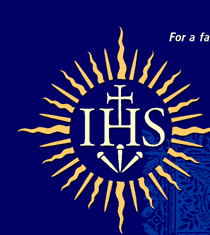 Where ever this mark is displayed, the Jesuits are in control. On December 24th at midnight Mass, the Pope read from the Missal that was being supported by that very symbol., “IHS” . That was a signal to Jesuits world-wide that the Jesuits are in control and the pope is their man. Don’t be surprised if you see this symbol in Protestant churches, the evil National Council and World Council of Churches.
In the book, Light on Free Masonry, written by David Bernard, gives us a detailed account of the Masonic rite called “The Holy and Thrice Illustrious Order of the Cross”:
Where ever this mark is displayed, the Jesuits are in control. On December 24th at midnight Mass, the Pope read from the Missal that was being supported by that very symbol., “IHS” . That was a signal to Jesuits world-wide that the Jesuits are in control and the pope is their man. Don’t be surprised if you see this symbol in Protestant churches, the evil National Council and World Council of Churches.
In the book, Light on Free Masonry, written by David Bernard, gives us a detailed account of the Masonic rite called “The Holy and Thrice Illustrious Order of the Cross”:
“...we have confirmed the Induction of the Knight Templar Mason into the Councils of the said Order of Knighthood...and hoping confiding that he will ever so demean himself as to conduct to the glory of I.H.S. the Most Holy and Almighty GOD, and to the honor of his MARK, we do recommend….”
The initiation proceeds with questions from superiors and answers from the initiate:
“…‘what therein becomes you duty?’
‘To receive the commands of my superiors in the order, and pay obedience thereto’…
‘By what right do you claim this duty?’…
‘By the right of a sign and the mark of a sign’…
Thereupon he produces his mark in his left hand, and with the forefinger of his right on the letter S, on the cross, asks,
‘What’s that?’…
‘Lisha’…(he) puts his finger on the letter H, and asks,
‘What’s is this?’
‘Sha.’ …(he) then puts his finger on the letter I, and asks,
‘What is this?’
‘Sha.’ …(he) then puts his finger on the letter I, and asks,
‘What is this?’
‘Baal.’
‘What then is your mark?’
‘Baal, Sha-Lisha; [I.H.S.] I am the Lord.’
[The initiative then takes his Jesuitical oath:]
‘To all this, and every part thereof, I do now, as before, by the honor and power of the mark, as by an ...awful oath...solemnly...bind and obligate my soul...I become the silent and mute subject...of the Illustrious Order...and for a breach of silence...that I shall die the infamous death of a traitor...bearing testimony, even in death, of the power of the mark of the Holy and Illustrious Cross before I. H. S. our Thrice Illustrious Counselor…’”
In a diploma titled “The Ancient Council of the Trinity, by their Successors in the United States of America”, we read:
“To every Knight Companion of the Holy and Thrice Illustrious ORDER OF THE CROSS:...we have confirmed the induction of the Knight Templar Mason into the Councils of the said order of Knighthood, ...and hoping and confiding that he will ever so demean himself as to conduct to the glory of I.H.S., the Most Holy and Almighty God, and the honor of his MARK, we do recommend and submit him to the confidence of all those throughout the world…” (Light On Free Masonry, Bernard, 343)
In Ian Paisley’s book, The Jesuits, page 5, we read:
“When the original group in the crypt of Notre-Dave de Montmarte rose from their knees, Ignatius pinted to the letters on the altar I.H.S. ‘These’, he said, ‘stand for ‘Jesus Hominum Slavator’ (Jesus the Saviour of Mankind), and they shall henceforth be the motto of our institution’. I.H.S. is the design of the Jesuits. These letters do not stand for what Ignatius affirmed. They are in fact the pagan mystical symbol of the Egyptian trinity Isis, Horus, Seb – the Mother, Child and Father of the Gods. No honest person could imagine that this double sense is accidental. I.H.S. pays the semblance of a tribute to Christianity, but they are in reality the substance of devil worship. The cloven hoof is upon them.”
The end conclusion?
“Therefore, the Almighty God of Freemasonry, the ‘Thrice Illustrious Counselor’, to which every Shriner Freemason ultimately owes silent and mute obedience, is the same god of the Society of Jesus [Jesuits] -- the Black Pope — as he serves his master, Satan, deceptively called Lucifer! His servants bear his mark –
I.H.S.” (Vatican Assassins, Phelps, 286)
For anyone doubting the ability of the Roman Catholic Jesuits to infiltrate and destroy only need to study their history. I highly recommend Vatican Assassins, by Eric Phelps. He does an excellent job of laying out their dirty deeds in such a way that there is no denying their intent and purpose is to destroy all those who love God and follow His word. To remain a Catholic or a Mason is to serve the Jesuits and their god, Satan.
“And I heard another voice from heaven, saying Come out of her, my people, that aye be not partakers of her sins, and the that ye receive not of her plagues. For her sins have reached unto heaven and God hath remembered her iniquities.”
By Rebecca A. Sexton