Grosse Pointe, Michigan • August 2, 2001
A Rivard Rendezvous
Detroit's 300th birthday gives family reason to celebrate,
investigate its past
By Bonnie Caprara
Staff Writer
 |
|
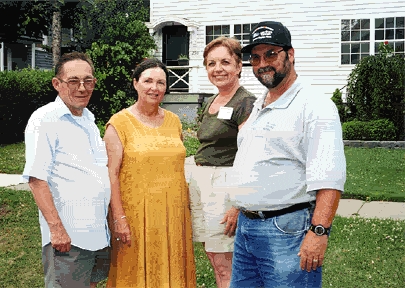
Charles Rivard and Bette Rivard Nebel,
left, own the house in the background which sits on a small piece of what
used to be the strip farm acquired by Jean-Baptiste Rivard in 1762.
With Rivard and Nebel are distant cousins Mary Ann Mickey and Tom DuFour. |
In the middle of the 17th century, Nicholas Rivard (dit Lavigne)
and Robert Rivard (dit Loranger) set out from France to settle in New France
in what is now Batiscan, Quebec.Three grandsons of Nicholas Rivard ‹ Francois,
Pierre and Nicholas ‹ were three of the first Rivards to emigrate to the
French territory of Detroit.
It is only fitting that a small number of descendants of Nicholas
and Robert Rivard chose to come to Detroit for a family reunion during
the Detroit 300 celebration.
On a hazy, balmy Friday evening, some 70 Rivard family members met,
some of them for the first time, on a balcony of Cleary Conference Center
balcony in Windsor overlooking the Detroit River and the tall ships docked
at ports below. From babes in arms to seniors in their 90s, they introduced
themselves as either Lavignes or Lorangers.
Most of them are members of the Rivard Forum, an Internet-based group
of about 300 Rivards from more than 20 different states and provinces in
North America.
Some had met last year at the first Rivard Forum reunion in Three
Rivers, Quebec. For many, the Detroit reunion was a chance to meet the
people they have been exchanging e-mail with for months and years ‹ topics
ranging from family anecdotes to historical documentation.
About 150 family members attended the five-day event, coming from
Arkansas, New York, Indiana, Texas, Wisconsin, Florida and Virginia in
the United States; and from Ontario, Quebec and New Brunswick in Canada.
The Michigan contingency came from Saginaw, Ray, Pinconning, Flushing,
Avoca, Yale, Wolverine and Grand Blanc as well as from Detroit and the
Grosse Pointes.
Just as exciting as it was for forum members to meet each other was
meeting other Rivards who had heard about the reunion through other sources.
"We found out about this reunion when we went on a French history
tour this week," said Shirley Rivard Brown of Roseville, who came to the
reunion with her sister, Sharon Rivard Andromalos and their husbands. "We
had no idea our family extended this far."
The long weekend was full of not only Detroit 300 celebration events
like touring the tall ships and watching the reenactment of Antoine Cadillac's
landing, but some serious time rooting through family records at the Mount
Clemens and Monroe public libraries and the Burton Collection at the main
branch of the Detroit Public Library.
"With a database of 39,000 names, there's a lot of research to do,"
said Mary Ann Mickey of Saginaw, a forum member and one of the reunion
organizers.
Of course, a trip to Detroit for any Rivard would have to include
a visit to the Grosse Pointes.
Jean Baptiste Rivard, son of the Nicholas Rivard who came to settle
in Detroit, was granted two of the first private claims in the area called
Grosse Pointe by France in 1762. He was 33 .
Jean Baptiste Rivard's private claims 299 and 300 were bordered by
Lake St. Clair and what is now known as Fisher and Rivard roads and Mack
Avenue. The original land grant of 273.12 acres was reduced to 11.75 acres
by the United States government in the early 19th century. It was one of
the area's first strip farms.
Like many of his New France and Rivard contemporaries of the time,
Jean Baptiste Rivard was a trapper first, a farmer second. He often left
his wife, Mary Catherine Yax Rivard, who he married when she was 15 in
1762, to tend to the land and fight off the Indians.
Records from St. Paul Catholic Church, which was only a log cabin
church at the time, show the Jean Baptiste Rivard family as the eleventh
to join the parish.
Not only did a few members of the Rivard clan come to Grosse Pointe
to visit St. Paul Catholic Church, the family church and cemetery, but
also to visit and share time with the last Rivards who live on the last
bit of the old homestead.
Charles Rivard, great-great-grandson of Jean Baptiste Rivard, lives
in a country blue frame duplex just a stone's throw from Jefferson. His
sister and one of his five siblings, Elizabeth Louise "Bette" Rivard Nebel
of Harrison Township, plans to move into the other half of the house soon.
Charles Rivard's and Bette Nebel's grandparents, Charles Napoleon
and Louise Aura Rivard, lived in the house from 1905 to 1920. The house
sits on property Charles Napoleon Rivard subdivided along the east side
of Rivard Road from Jefferson to Charles Street (now Charles Court) before
the turn of the 19th century.
Nebel started dabbling in her family history in 1962, but put it
off after her children were born. Charles Rivard discovered the Rivard
Forum a few years ago while surfing the Internet.
Both were excited to meet and learn from the extended family they
had been in touch with only electronically over the past few years.
"It's amazing seeing the roots outside of this area," Nebel said.
"We didn't realize our family extended outside Michigan and Quebec."
Mickey, in turn, put Nebel and Charles Rivard in charge of being
the forum contact and archivists of the Grosse Pointe Rivards for the forum.
Like many of the New France settlers of 1600s and 1700s, the Rivards
were fur traders. The other Rivards from Quebec headed for points west
where fur and water transportation resources were plentiful: Minnesota,
Missouri, Mississippi and northern Michigan.
Around the dinner tables the first night of the reunion, no matter
where a Rivard came from, many of their family stories were strikingly
similar: large families and even larger Christmas Eve and Christmas Day
meals, wines their grandfathers made, similar French expressions their
grandmothers used, even similar recipes their grandmothers had. Some of
the Rivards even share occupations in common.
"We have a lot of engineers and people working for DaimlerChrysler,"
Mickey said. "There's another group that's in medicine."
"It's tough finding the histories behind some of these families,"
said Tom DuFour of McGregor, Ontario, also a forum member and reunion organizer.
"The males who lived into their 60s and 70s, were on their fourth or fifth
wives and they had 15 or 16 kids. They would marry young, the wife would
have eight or nine children and die in childbirth and they'd marry another
one.
"Now those 15 or 16 kids would marry and have another 15 or 16 kids;
then the grandkids would have 15 or 16 kids. When the grandfathers look
around, they don't know any of them. Looking back on even three generations
of the family, it's easy to lose track of them."
"They had to go where the land was," Mickey said.
The next reunion, possibly next year, will be held in another part
of the country where there is a large contingent of Rivards. St. Louis,
Mo., is a possibility.
"We have a significant historical puzzle to solve there," Mickey
said.
"There was a Joseph Revard who traveled from Three Rivers to the
Oklahoma/Kansas/Missouri region between 1740 and 1760," Mickey continued.
"Intermarriage between the French and the Indians was common and we know
that his family's cultural heritage is more closely tied with the Osage
Indians."
Yet Detroit was an important stop on the journey of investigating
the history of the Rivard family.
"We got more out of this trip than we did in Quebec last year," DuFour
said. "It was about meeting new cousins, collecting new data, finding orphans
and connecting links. This is the history that should be taught in
the schools. This is the meat and potatoes stuff."
"I feel like I'm part of history. I feel like I know where I am in
relation to it," Mickey said.
For more information on the Rivard family, contact http://www.rivards.org/.
Back
to Reunion Page