 Hunters judge the rider and horse. Placings are based on the overall performance
of the horse/rider combination. Judges look at both the rider's and horse's
form around a course of jumps more conservative than those found on jumper
courses. Hunters have classes for jumping and also for flat work, where
either the horse or rider are judged while performing the basic gaits,
depending on the class.
Hunters judge the rider and horse. Placings are based on the overall performance
of the horse/rider combination. Judges look at both the rider's and horse's
form around a course of jumps more conservative than those found on jumper
courses. Hunters have classes for jumping and also for flat work, where
either the horse or rider are judged while performing the basic gaits,
depending on the class.
Show jumping is an exciting event.
Horse/rider combinations are timed over courses of varying difficulty and
length. The jumps in some classes do not exceed 3' 6'', while others 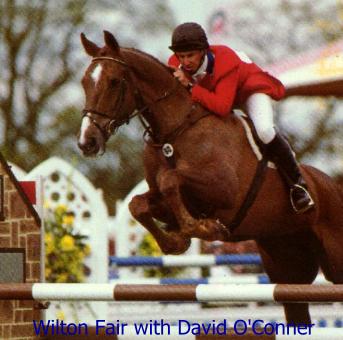 on
the Grand Prix level have jumps going up to 5' 6''. Most classes have a
time limit that the course must be completed within. If a horse exceeds
the time allowed, faults are added to their score. Faults are also given
for other mistakes on the course. Generally, faults go something like this:
4 faults for each fence knocked down, and often 3 faults or less are added
for a refusal. 3 refusals can mean elimination, as can a fall. There are
many different kinds of jumping events, but the most common is probably
where there is a first round and then a jumpoff if needed. In the first
round, riders focus on finishing within the time allowed and jumping "clear,"
meaning with no faults. The jumpoff occurs when more than one rider jumps
clear in the first round. The course for a jumpoff is more demanding but
shorter than the first round. The fences are raised, and tighter turns
are required. A fast time and a clear round in the jumpoff is usually what
wins the class, but if there are no clear jumpoff rounds the first place
ribbon
on
the Grand Prix level have jumps going up to 5' 6''. Most classes have a
time limit that the course must be completed within. If a horse exceeds
the time allowed, faults are added to their score. Faults are also given
for other mistakes on the course. Generally, faults go something like this:
4 faults for each fence knocked down, and often 3 faults or less are added
for a refusal. 3 refusals can mean elimination, as can a fall. There are
many different kinds of jumping events, but the most common is probably
where there is a first round and then a jumpoff if needed. In the first
round, riders focus on finishing within the time allowed and jumping "clear,"
meaning with no faults. The jumpoff occurs when more than one rider jumps
clear in the first round. The course for a jumpoff is more demanding but
shorter than the first round. The fences are raised, and tighter turns
are required. A fast time and a clear round in the jumpoff is usually what
wins the class, but if there are no clear jumpoff rounds the first place
ribbon 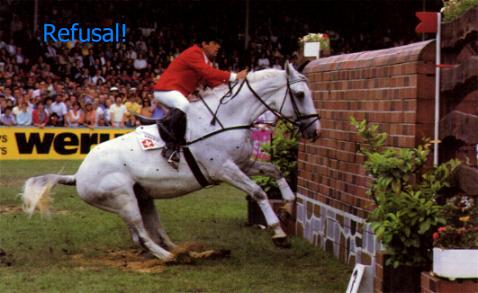 goes
to the horse and rider with the fewest faults and the fastest time. Jumpers
are not judged at all, so form of both horse and rider does not affect
their placing.
goes
to the horse and rider with the fewest faults and the fastest time. Jumpers
are not judged at all, so form of both horse and rider does not affect
their placing.
LINKS: