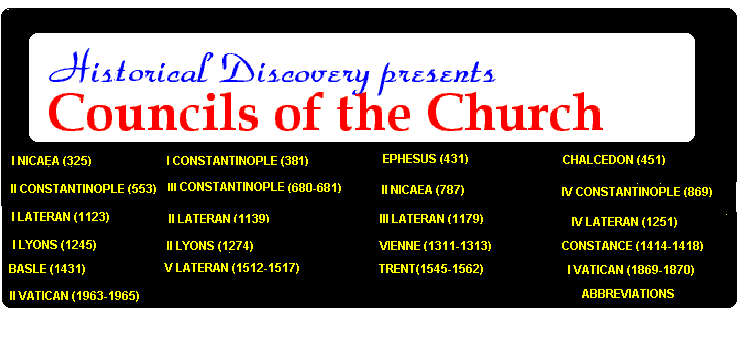

FIRST COUNCIL OF NICAEA - 325 AD
INTRODUCTION
This council opened on 19 June in the presence of the emperor, but it is uncertain who presided over the sessions. In the extant lists of bishops present, Ossius of Cordova, and the presbyters Vitus and Vincentius are listed before the other names, but it is more likely that Eustathius of Antioch or Alexander of Alexandria presided. (see Decrees of the Ecumenical Councils, ed. Norman P. Tanner S.J.
Alexander of Alexandria presided. (see Decrees of the Ecumenical Councils, ed. Norman P. Tanner S.J.)
The bold text in the profession of faith of the 318 fathers constitutes, according to Tanner "The additions made by the council to an underlying form of the creed", and that the underlying creed was most likely "derived from the baptismal formula of Caesarea put forward by the bishop of that city Eusebius" or that it "developed from an original form which existed in Jerusalem or at any rate Palestine". "A direct descent from the creed of Eusebius of Caesarea is manifestly out of the question." Vol 1, p2)
The figure of 318 given in the heading below is from Hilary of Poitier and is the traditional one. Other numbers are Eusebius 250, Eustathius of Antioch 270., Athanasius about 300, Gelasius of Cyzicus at more than 300.
THE PROFESSION OF FAITH OF THE 318 FATHERS
-
We believe in one God the Father all powerful, maker of all things both seen and unseen. And in one Lord Jesus Christ, the Son of God, the only-begotten begotten from the Father, that is from the substance [Gr. ousias, Lat. substantia] of the Father, God from God, light from light, true God from true God, begotten [Gr. gennethenta, Lat. natum] not made [Gr. poethenta, Lat. factum], CONSUBSTANTIAL [Gr. homoousion, Lat. unius substantiae (quod Graeci dicunt homousion)] with the Father, through whom all things came to be, both those in heaven and those in earth; for us humans and for our salvation he came down and became incarnate, became human, suffered and rose up on the third day, went up into the heavens, is coming to judge the living and the dead. And in the holy Spirit.
- And those who say
- "there once was when he was not", and "before he was begotten he was not", and that
- he came to be from
- things that were not, or
- from another hypostasis [Gr. hypostaseos] or substance [Gr. ousias, Lat. substantia],
CANONS
- If anyone in sickness has undergone surgery at the hands of physicians
or has been castrated by barbarians, let him remain among the clergy.
But if anyone in good health has castrated himself, if he is enrolled
among the clergy he should be suspended, and in future no such man
should be promoted. But, as it is evident that this refers to those
who are responsible for the condition and presume to castrate themselves,
so too if any have been made eunuchs by barbarians or by their masters,
but have been found worthy, the canon admits such men to the clergy.
- Since, either through necessity or through the importunate demands
of certain individuals, there have been many breaches of the church's
canon, with the result that men who have recently come from a pagan
life to the faith after a short catechumenate have been admitted
at once to the spiritual washing, and at the same time as their
baptism have been promoted to the episcopate or the presbyterate,
it is agreed that it would be well for nothing of the kind to occur
in the future. For a catechumen needs time and further probation
after baptism, for the apostle's words are clear: "Not a recent
convert, or he may be puffed up and fall into the condemnation and
the snare of the devil". But if with the passage of time some sin
of sensuality is discovered with regard to the person and he is
convicted by two or three witnesses, such a one will be suspended
from the clergy. If anyone contravenes these regulations, he will
be liable to forfeit his clerical status for acting in defiance
of this great synod.
- This great synod absolutely forbids a bishop, presbyter, deacon
or any of the clergy to keep a woman who has been brought in to
live with him, with the exception of course of his mother or sister
or aunt, or of any person who is above suspicion.
- It is by all means desirable that a bishop should be appointed
by all the bishops of the province. But if this is difficult because
of some pressing necessity or the length of the journey involved,
let at least three come together and perform the ordination, but
only after the absent bishops have taken part in the vote and given
their written consent. But in each province the right of confirming
the proceedings belongs to the metropolitan bishop.
- Concerning those, whether of the clergy or the laity, who have
been excommunicated, the sentence is to be respected by the bishops
of each province according to the canon which forbids those expelled
by some to be admitted by others. But let an inquiry be held to
ascertain whether anyone has been expelled from the community because
of pettiness or quarrelsomeness or any such ill nature on the part
of the bishop. Accordingly, in order that there may be proper opportunity
for inquiry into the matter, it is agreed that it would be well
for synods to be held each year in each province twice a year, so
that these inquiries may be conducted by all the bishops of the
province assembled together, and in this way by general consent
those who have offended against their own bishop may be recognised
by all to be reasonably excommunicated, until all the bishops in
common may decide to pronounce a more lenient sentence on these
persons. The synods shall be held at the following times: one before
Lent, so that, all pettiness being set aside, the gift offered to
God may be unblemished; the second after the season of autumn.
- The ancient customs of Egypt, Libya and Pentapolis shall be maintained,
according to which the bishop of Alexandria has authority over all
these places since a similar custom exists with reference to the
bishop of Rome. Similarly in Antioch and the other provinces the
prerogatives of the churches are to be preserved. In general the
following principle is evident: if anyone is made bishop without
the consent of the metropolitan, this great synod determines that
such a one shall not be a bishop. If however two or three by reason
of personal rivalry dissent from the common vote of all, provided
it is reasonable and in accordance with the church's canon, the
vote of the majority shall prevail.
- Since there prevails a custom and ancient tradition to the effect
that the bishop of Aelia is to be honoured, let him be granted everything
consequent upon this honour, saving the dignity proper to the metropolitan.
- Concerning those who have given themselves the name of Cathars,
and who from time to time come over publicly to the catholic and
apostolic church, this holy and great synod decrees that they may
remain among the clergy after receiving an imposition of hands.
But before all this it is fitting that they give a written undertaking
that they will accept and follow the decrees of the catholic church,
namely that they will be in communion with those who have entered
into a second marriage and with those who have lapsed in time of
persecution and for whom a period [of penance] has been fixed and
an occasion [for reconciliation] allotted, so as in all things to
follow the decrees of the catholic and apostolic church. Accordingly,
where all the ordained in villages or cities have been found to
be men of this kind alone, those who are so found will remain in
the clergy in the same rank; but when some come over in places where
there is a bishop or presbyter belonging to the catholic church,
it is evident that the bishop of the church will hold the bishop's
dignity, and that the one given the title and name of bishop among
the so-called Cathars will have the rank of presbyter, unless the
bishop thinks fit to let him share in the honour of the title. But
if this does not meet with his approval, the bishop will provide
for him a place as chorepiscopus or presbyter, so as to make his
ordinary clerical status evident and so prevent there being two
bishops in the city.
- If any have been promoted presbyters without examination, and
then upon investigation have confessed their sins, and if after
their confession men have imposed hands upon such people, being
moved to act against the canon, the canon does not admit these people,
for the catholic church vindicates only what is above reproach.
- If any have been promoted to ordination through the ignorance
of their promoters or even with their connivance, this fact does
not prejudice the church's canon; for once discovered they are to
be deposed.
- Concerning those who have transgressed without necessity or the
confiscation of their property or without danger or anything of
this nature, as happened under the tyranny of Licinius, this holy
synod decrees that, though they do not deserve leniency, nevertheless
they should be treated mercifully. Those therefore among the faithful
who genuinely repent shall spend three years among the hearers,
for seven years they shall be prostrators, and for two years they
shall take part with the people in the prayers, though not in the
offering.
- Those who have been called by grace, have given evidence of first
fervour and have cast off their [military] belts, and afterwards
have run back like dogs to their own vomit, so that some have even
paid money and recovered their military status by bribes -- such
persons shall spend ten years as prostrators after a period of three
years as hearers. In every case, however, their disposition and
the nature of their penitence should be examined. For those who
through their fear and tears and perseverance and good works give
evidence of their conversion by deeds and not by outward show, when
they have completed their appointed term as hearers, may properly
take part in the prayers, and the bishop is competent to decide
even more favourably in their regard. But those who have taken the
matter lightly, and have thought that the outward form of entering
the church is all that is required for their conversion, must complete
their term to the full.
- Concerning the departing, the ancient canon law is still to be
maintained namely that those who are departing are not to be deprived
of their last, most necessary viaticum. But if one whose life has
been despaired of has been admitted to communion and has shared
in the offering and is found to be numbered again among the living,
he shall be among those who take part in prayer only [here a variant
reading in Les canons des conciles oecumeniques adds "until the
term fixed by this great ecumenical synod has been completed"].
But as a general rule, in the case of anyone whatsoever who is departing
and seeks to share in the eucharist, the bishop upon examining the
matter shall give him a share in the offering.
- Concerning catechumens who have lapsed, this holy and great synod
decrees that, after they have spent three years as hearers only,
they shall then be allowed to pray with the catechumens.
- On account of the great disturbance and the factions which are
caused, it is decreed that the custom, if it is found to exist in
some parts contrary to the canon, shall be totally suppressed, so
that neither bishops nor presbyters nor deacons shall transfer from
city to city. If after this decision of this holy and great synod
anyone shall attempt such a thing, or shall lend himself to such
a proceeding, the arrangement shall be totally annulled, and he
shall be restored to the church of which he was ordained bishop
or presbyter or deacon.
- Any presbyters or deacons or in general anyone enrolled in any
rank of the clergy who depart from their church recklessly and without
the fear of God before their eyes or in ignorance of the church's
canon, ought not by any means to be received in another church,
but all pressure must be applied to them to induce them to return
to their own dioceses, or if they remain it is right that they should
be excommunicated. But if anyone dares to steal away one who belongs
to another and to ordain him in his church without the consent of
the other's own bishop among whose clergy he was enrolled before
he departed, the ordination is to be null.
- Since many enrolled [among the clergy] have been induced by greed
and avarice to forget the sacred text, "who does not put out his
money at interest", and to charge one per cent [a month] on loans,
this holy and great synod judges that if any are found after this
decision to receive interest by contract or to transact the business
in any other way or to charge [a flat rate of] fifty per cent or
in general to devise any other contrivance for the sake of dishonourable
gain, they shall be deposed from the clergy and their names struck
from the roll.
- It has come to the attention of this holy and great synod that
in some places and cities deacons give communion to presbyters,
although neither canon nor custom allows this, namely that those
who have no authority to offer should give the body of Christ to
those who do offer. Moreover it has become known that some of the
deacons now receive the eucharist even before the bishops. All these
practices must be suppressed. Deacons must remain within their own
limits, knowing that they are the ministers of the bishop and subordinate
to the presbyters. Let them receive the eucharist according to their
order after the presbyters from the hands of the bishop or the presbyter.
Nor shall permission be given for the deacons to sit among the presbyters,
for such an arrangement is contrary to the canon and to rank. If
anyone refuses to comply even after these decrees, he is to be suspended
from the diaconate.
- Concerning the former Paulinists who seek refuge in the catholic
church, it is determined that they must be rebaptised unconditionally.
Those who in the past have been enrolled among the clergy, if they
appear to be blameless and irreproachable, are to be rebaptised
and ordained by the bishop of the catholic church. But if on inquiry
they are shown to be unsuitable, it is right that they should be
deposed. Similarly with regard to deaconesses and all in general
whose names have been included in the roll, the same form shall
be observed. We refer to deaconesses who have been granted this
status, for they do not receive any imposition of hands, so that
they are in all respects to be numbered among the laity.
- Since there are some who kneel on Sunday and during the season of Pentecost, this holy synod decrees that, so that the same observances may be maintained in every diocese, one should offer one's prayers to the Lord standing.
THE LETTER OF THE SYNOD IN NICAEA TO THE EGYPTIANS
The bishops assembled at Nicaea, who constitute the great and holy synod, greet the church of the Alexandrians, by the grace of God holy and great, and the beloved brethren in Egypt, Libya and Pentapolis.
Since the grace of God and the most pious emperor Constantine have called us together from different provinces and cities to constitute the great and holy synod in Nicaea, it seemed absolutely necessary that the holy synod should send you a letter so that you may know what was proposed and discussed, and what was decided and enacted.
- First of all the affair of the impiety and lawlessness of Arius
and his followers was discussed in the presence of the most pious
emperor Constantine. It was unanimously agreed that anathemas should
be pronounced against his impious opinion and his blasphemous terms
and expressions which he has blasphemously applied to the Son of God,
- saying
- "he is from things that are not", and
- "before he was begotten he was not", and
- "there once was when he was not",
- saying too that
- by his own power the Son of God is capable of
- evil and
- goodness,
- by his own power the Son of God is capable of
- and calling him
- a creature and a work.
Against all this the holy synod pronounced anathemas, and did not allow this impious and abandoned opinion and these blasphemous words even to be heard.
Of that man and the fate which befell him, you have doubtless heard or will hear, lest we should seem to trample upon one who has already received a fitting reward because of his own sin. Such indeed was the power of his impiety that Theonas of Marmarica and Secundus of Ptolemais shared in the consequences, for they too suffered the same fate.
But since, when the grace of God had freed Egypt from this evil and blasphemous opinion, and from the persons who had dared to create a schism and a separation in a people which up to now had lived in peace, there remained the question of the presumption of Meletius and the men whom he had ordained, we shall explain to you, beloved brethren, the synod's decisions on this subject too. The synod was moved to incline towards mildness in its treatment of Meletius for strictly speaking he deserved no mercy. It decreed that that he might remain in his own city without any authority to nominate or ordain, and that he was not to show himself for this purpose in the country or in another city, and that he was to retain the bare name of his office.
It was further decreed that those whom he had ordained, when they had been validated by a more spiritual ordination, were to be admitted to communion on condition that they would retain their rank and exercise their ministry, but in every respect were to be second to all the clergy in each diocese and church who had been nominated under our most honoured brother and fellow minister Alexander; they were to have no authority to appoint candidates of their choice or to put forward names or to do anything at all without the consent of the bishop of the catholic church, namely the bishop of those who are under Alexander. But those who by the grace of God and by our prayers have not been detected in any schism, and are spotless in the catholic and apostolic church, are to have authority to appoint and to put forward the names of men of the clergy who are worthy, and in general to do everything according to the law and rule of the church.
In the event of the death of any in the church, those who have recently been accepted are thereupon to succeed to the office of the deceased, provided that they appear worthy and are chosen by the people; the bishop of Alexandria is to take part in the vote and confirm the election. This privilege, which has been granted to all others, does not apply to the person of Meletius because of his inveterate seditiousness and his mercurial and rash disposition, lest any authority or responsibility should be given to one who is capable of returning to his seditious practices.
These are the chief and most important decrees as far as concerns Egypt and the most holy church of the Alexandrians. Whatever other canons and decrees were enacted in the presence of our lord and most honoured fellow minister and brother Alexander, he will himself report them to you in greater detail when he comes, for he was himself a leader as well as a participant in the events.
The following is not found in the latin text, but is found in the greek text :
We also send you the good news of the settlement concerning the holy pasch, namely that in answer to your prayers this question also has been resolved. All the brethren in the East who have hitherto followed the Jewish practice will henceforth observe the custom of the Romans and of yourselves and of all of us who from ancient times have kept Easter together with you. Rejoicing then in these successes and in the common peace and harmony and in the cutting off of all heresy, welcome our fellow minister, your bishop Alexander, with all the greater honour and love. He has made us happy by his presence, and despite his advanced age has undertaken such great labour in order that you too may enjoy peace.
Pray for us all that our decisions may remain secure through almighty God and our lord Jesus Christ in the holy Spirit, to whom is the glory for ever and ever. Amen.
Translation taken from Decrees of the Ecumenical Councils, ed. Norman P. Tanner END OF TEXT - saying