
Since Pennsylvania's formation in 1682, the basic political
and administrative division of county organization has been
by township, boroughs and districts. Taxes were collected by
townships.
Records such as land and probate contain references to
townships. These important documents are in the County
Courthouse or the County Archives of each county.
Boundaries for counties, as well as townships, have changed
over the years. If the jurisdiction for tax and land records
is not known, it is easy to lose an ancestor. You could be
knocking on the wrong courthouse door!
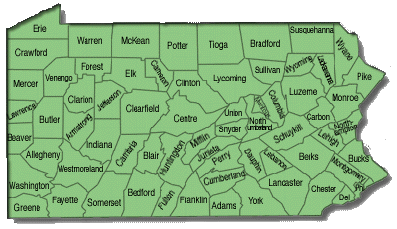
When Pennsylvania was first established, there were three
counties, Philadelphia, Bucks and Chester. From these three
counties gradually evolved the present day sixty-seven counties
comprising the Commonwealth of Pennsylvania. There were also
the three so-called lower counties: New Castle, Kent and Sussex,
which became the State of Delaware.
A study of the changes in Philadelphia County follows:
In 1752, present day Berks County was created from part of
Philadelphia and part of Lancaster County. (Lancaster had been
taken from Chester County in 1729.)Montgomery County was
created from Philadelphia County in 1784.
So, if your ancestor owned land in Frederick Township,
Montgomery County in 1785, it is necessary to go to Philadelphia
to find the original deed for the property he might have bought
in 1782!
In 1854, the City and County offices of Philadelphia were
consolidated. The boundaries of Philadelphia since 1854 for both
city and county have remained the same and, from that time on,
Philadelphia was divided into numbered wards. The townships,
wards, boroughs and districts that were in Philadelphia County
between the formation of Montgomery County in 1784, and the
consolidation of the city and county of Philadelphia in 1854
became forever lost.
The original townships, within the present boundaries of
Philadelphia, were: Germantown, Roxborough, Bristol, Oxford,
Lower Dublin, Moreland, Byberry, Northern Liberties, Blockley,
Kingsessing, Passyunk, and Moyamensing.
Moreland Township was split in 1784 when part of it was
included in Montgomery County - there was then a Moreland
Township in Philadelphia County, and a Moreland Township in
Montgomery County.
Over the years, these townships of Philadelphia County were
further divided into townships, boroughs and districts.
The original City of Philadelphia, which was a town until 1691,
covered the area between present day South Street and Vine
Street, and the Rivers Delaware and Schuylkill. Just prior to
1854, the old city contained the following wards: North Mulberry,
South Mulberry, North, Middle, South, Locust, Cedar, Spruce,
Lombard, Upper Delaware, Lower Delaware, High Street, Chestnut,
Walnut, Dock, Pine and New Market.
Pennsylvania Line, published by the Southwest Pennsylvania
Genealogical Services in Laughlin town, PA, is helpful in
determining the genealogy of townships in Pennsylvania;
however,only townships that exist today are included. Therefore,
these lost townships of Philadelphia are not shown. This can be
confusing.
For instance, there is a Bristol Township in Bucks County. If
you are looking for an ancestor from Bristol Township you might
pick up the one in Bucks County, as it is the only one that
appears in reference sources. In reality, your ancestor could
have been from Bristol township in Philadelphia County!
Genealogy of Philadelphia County Subdivisions, by John Daly and
Allen Weinberg, published by the City of Philadelphia Department
of Records and republished under the title Philadelphia County
Political Subdivisions, by Area Keys, contains a series of maps
that are extremely helpful in analyzing the boundaries through
the years in Philadelphia. Not included is information on the
portions that became Berks and Montgomery Counties. The original
publication is no longer in print, but has been reprinted by GSP
as "Special Publication no. 6" under the title Philadelphia
Maps, 1682 - 1982: Townships - Districts - Wards.
The Following is a list of Pennsylvania counties, with their
dates of creation, and the parent county or counties:
Adams, created 1800 from York.
Allegheny, created 1788 from Westmoreland, Washington.
Armstrong, created 1800 from Allegheny, Lycoming, Westmoreland.
Beaver, created 1800 from Allegheny, Washington
Bedford, created 1710 from Cumberland.
Berks, created 1752 from Chester, Lancaster, Philadelphia.
Blair, created 1846 from Huntington, Bedford.
Bradford, created 1810 from Luzerne, Lycoming (name changed from
Ontario in 1812).
Bucks, created 1682, original county.
Butler, created 1800 from Allegheny.
Cambria, created 1804 from Somerset, Bedford, Huntingdon.
Cameron, created 1860 from Clinton, Elk, McKean, Potter.
Carbon, created 1843 from Northampton, Monroe.
Centre, created 1800 from Lycoming, Mifflin, Northumberland,
Huntingdon.
Chester, created 1682, original county.
Clarion, created 1839 from Venango, Armstrong.
Clearfield, created 1804 from Huntingdon, Lycoming.
Clinton, created 1839 from Lycoming, Centre.
Columbia, created 1813 from Northumberland.
Crawford, created 1800 from Allegheny.
Cumberland, created 1750 from Lancaster.
Dauphin, created 1785 from Lancaster.
Delaware, created 1789 from Chester.
Elk, created 1843 from Jefferson, McKean, Clearfield.
Erie, created 1800 from Allegheny.
Fayette, created 1783 from Westmoreland.
Forest, created 1848 from Jefferson, and 1866 from Venango.
Franklin, created 1784 from Cumberland.
Fulton, created 1850 from Bedford.
Greene, created 1796 from Washington.
Huntingdon, created 1787 from Bedford.
Indiana, created 1803 from Westmoreland, Lycoming.
Jefferson, created 1804 from Lycoming.
Juniata, created 1831 from Mifflin.
Lackawanna, created 1878 from Luzerne.
Lancaster, created 1729 from Chester.
Lawrence, created 1849 from Beaver, Mercer.
Lebanon, created 1813 from Dauphin, Lancaster.
Lehigh, created 1812 from Northampton.
Luzerne, created 1786 from Northumberland.
Lycoming, created 1795 from Northumberland.
Mckean, created 1804 from Lycoming.
Mercer, created 1800 from Allegheny.
Mifflin, created 1789 from Cumberland, Northumberland.
Monroe, created 1836 from Pike, Horthampton.
Montgomery, created 1784 from Philadelphia.
Montour, created 1850 from Columbia.
Northampton, created 1752 from Bucks.
Northumberland, created 1772 from Lancaster, Bedford, Berks,
Northampton, Cumberland.
Ontario (see Bradford).
Perry, created 1820 from Cumberland.
Philadelphia, created 1682, original county.
Pike, created 1814 from Wayne.
Potter, created 1804 from Lycoming.
Schuylkill, created 1811 from Berks, Northampton and 1818 from
Columbia and Luzerne.
Snyder, created 1855 from Union.
Somerset, created 1795 from Bedford.
Sullivan, created 1847 from Lycoming.
Susquehanna, created 1810 from Luzerne.
Tioga, created 1804 from Lycoming.
Union, created 1813 from Northumberland.
Venango, created 1800 from Allegheny, Lycoming.
Warren, created 1800 from Allegheny, Lycoming.
Washington, created 1781 from Westmoreland.
Wayne, created 1798 from Northampton.
Westmoreland, created 1773 from Bedford.
Wyoming, created 1842 from Luzerne.
York, created 1749 from Lancaster.
Although your ancestors should have recorded their deeds and had
wills probated in the county where they lived, they did not
always do so! If you can't find the records where they should
be, check neighboring counties.
A wonderful, informative article written by Jane Adams Clarke
Penn In Hand, VOL. 9, NO. 1, 1987
Many Thanks To The GENEALOGICAL SOCIETY OF PENNSYLVANIA
 |  |  |
Background Music - On The Street Where You Live
Source - Midi Haven