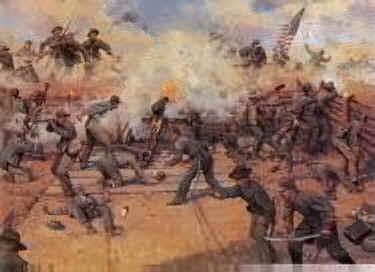
"Shoot and Be Damned!"
They couldn't know it, but General Robert E. Lee's Army of Northern Virginia was only a week away from having to surrender on April 2, 1865. Facing a Federal army that was a great deal larger than theirs, and far better supplied than theirs, the Confederate Army fought with its back to Richmond, Virginia as they sought to protect the Confederate capital. Close to the Appomatox River, Fort Gregg had been chosen as a strategic stopping point from which to try to hold back the Northern invaders. If the fort fell, the Federal Army could well break the thin Confederate line of defense.
The most famous of the Confederate artillery units, the Washington Artillery of New Orleans, posted its 3rd Company at Fort Gregg. That day, just one week from surrender at Appomatox Court House, the Federal Army attacked Fort Gregg and its 270 defenders. The men in Fort Gregg knew that they had to hold the line and prevent the Federal Army from overrunning their position; they had to hold the line until General Longstreet's soldiers could provide support and relief to the weak point under attack.
With relentless persistence, the Federal forces crashed against Fort Gregg time and time again until, at last, one wave of attackers surged over the parapet of the Fort and into the very faces of the Confederate defenders - and into the faces of the men and cannons of the 3rd Company - Washington Artillery. Lieutenant McElroy's men faced the blue assault with 3-inch Parrot cannon loaded with canister shot. Seeing Wasington Artillery Private Lawrence Berry with the lanyard in hand, a Federal soldier cried out to him, "Don't fire that gun! Drop the lanyard or we'll shoot!"
Berry roared, "Shoot and be damned!" and immediately fired his cannon into the faces of their Federal assailants. The Federal weapons responded as rapidly, and almost immediately Berry went down, wounded in several places. The 3rd Company helped to stem the tide of Federal soldiers just long enough with their desperate, tenacious defense of Fort Gregg to allow time enough for the Confederate forces to shore up their lines and hold back the Federal Army from Richmond for a little while longer.