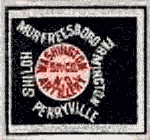
5th Company - Washington Artillery
On display at
929 Camp Street Museum
New Orleans, Louisiana

5th Company - Washington Artillery's first flag was given to them just before the battle of Shiloh by Colonel Walton. Colonel Walton, as it is told, was returning to New Orleans from Virginia to help with recruiting when he found out that 5th Company had moved up to Tennessee at General Beauregard's request, for General Beauregard had said, "The best place for the men of Louisiana to defend Louisiana is in Tennessee."
Colonel Walton was returning with a flag recently adopted by the Army of Northern Virginia as its battle flag. That pattern had been General Beauregard's inspired idea after the Battle of Manassas, and was designed by Porcher Miles who submitted it to the Confederate Congress for approval as its the National flag.
The Confederate Congress rejected it in favor of the one we all know and love - the Stars and Bars - saying that General Beauregard's battle flag design looked like suspenders.
In his post-War Memoirs, General Beauregard gave Colonel Walton credit for assisting in the design of the battle flag. The flag that Colonel Walton carried had been given to him by General Beauregard, one of the first Army of Northern Virginia pattern battle flags made by the ladies of Richmond, Virginia. The flag was adopted by 5th Company, and was used for the battle of Shiloh, the battles following Shiloh, and on through the battle of Perryville, Kentucky.
Following Perryville, the Army of Tennessee decided to use the Hardee pattern for their regimental flags, along with the other patterns used out West which included the (Polk pattern, the Van Dorn pattern, and others). The Hardee pattern flag the adopted by 5th Company - the same flag used today by the re-enacting 5th Company - is a copy of the flag used after the original Army of Northern Virginia flag was retired.
The first flag was sent to Mobile, Alabama by W.C.T Vaught for the duration of the War. His relatives kept it safe; it was in Mobile where the battle honors "Shiloh" and "Perryville" were added. After the War's end, Vaught's family donated the flag to the Confederate Memorial Hall on Camp Street in New Orleans where it remained until it was stolen in the 1970's. It has subsequently resurfaced, but has not been returned to Confederate Memorial Hall (now officially known as "929 Camp Street Museum").
5th Company's first and second flags are pictured under the 5th Company - Washington Artillery in the Time-Life books about the Civil War.
In an article in "The Columbiad", the subject of the first flag and its location today was addressed.

The Confederate Memorial Hall in New Orleans, Louisiana, is a
treasure trove. Dedicated in 1891 as a shrine to the Crescent City's Civil War
heritage, it is the temple of a bygone generation's central life experience and of a
would-be nation's brief existence. Old soldiers richly endowed the museum with every
kind of artifact imaginable, making its collection of Confederate memorabilia the second
largest in the United States.
Sometime in the 1970s, someone violated the sanctity of this brick, terra cotta, and
cypress temple, removing a Confederate battle flag that belonged to one of New Orleans'
most famous Civil War units. The museum's attempts to reclaim the flag ended in a
court case that in 1995 awarded the flag to its present owner and left the friends of
Memorial Hall frustrated and angry. Recently, however, the mood at the museum has
changed, due to the discovery of another battle flag - one the museum's staff believes may
be the original battle flag of the Confederacy.
The museum's new claim does not go unopposed. In Nebraska, the collector to whom the
museum lost its court battle contends that the museum's newly rediscovered
"original" battle flag is nothing of the kind. His flag, he claims, is the
Confederacy's first, and the museum's is, at best, only one of three prototypes patterned
after his original.
So today, officials at the Confederate Memorial Hall, also known as the Confederate Museum, find themselves again locked in a dispute with Dr. Lon Keim, a Civil War relic collector from Omaha. Keim possesses the flag flown early in the war by the 5th Company of the Washington Artillery Battalion. The flag was stolen from the museum about twenty years ago, and Keim bought it in 1983. The museum sued for its return in 1990, but finally, in 1995, the Eighth U.S. Circuit Court of Appeals in St. Louis, Missouri, awarded the flag to Keim.
To this day, both sides claim to own the original Confederate battle flag, and ironically, both cite the same pieces of evidence to support their claims: a 1905 letter written by one of the Confederates responsible for creating the flag, and the recent report of a conservator who has analyzed both banners.
[The Nebraska physician sued the Museum for defamation of
character, as well as for title to the flag. His legal theory for the latter was
that he had held the flag for over 10 years, and therefore possessed title by
prescription (an establishment of a claim of title to something under common law, usually
by use and enjoyment for a period fixed by statute). The legal action took place
over a period of several years. Finally, the legal debate went to the Federal Court
in Nebraska, but never made it to a jury because the physician won by summary
judgement. The judge ruled that prescription had been established at that point, and
therefore the Museum could not claim title. The Nebraska physician now legally owns
the flag. His current asking price for the flag is reputedly $1,000,000.]
Early in 1861, after the first few states had seceded, the Confederacy had no official
flag. The Provisional Confederate Congress established a committee that studied
hundreds of designs before narrowing the field to one: the "Stars and Bars,"
which featured two horizontal red stripes sandwiching one white stripe, and a field of
blue in the upper left corner containing a circle of white stars. It was designed to
be similar to, yet mark a departure from, the flag of the United States.
It did not, however, depart far enough. When Confederate troops carried the Stars
and Bars at the First Battle of Manassas, their leaders were unable to distinguish it from
the U.S. flag. So, General Pierre G.T. Beauregard, a corps commander in the
Confederate Army of the Potomac (later the Army of Northern Virginia), lobbied South
Carolina Congressman William Porcher Miles for an alternative flag. Miles chose as
the new Confederate battle flag the "Southern Cross," a red flag that featured a
blue St. Andrew's cross lined with white stars. This is where C. McRae Selph becomes
an integral, and still contested, part of Southern history.
Selph, a lieutenant and assistant adjutant general in the Provisional Army of the
Confederate States, detailed the creation of the first battle flag when he wrote in 1905
to J.A. Chalaron, then curator of the Confederate Memorial Hall and a former lieutenant of
the Washington Artillery.
According to the letter, Major William L. Cabell, Confederate assistant quartermaster
general, ordered Selph to go to Richmond, Virginia, purchase silk, and hire women in the
city to sew the initial flag from a colored sketch he carried. First, he sought the
help of Mrs. James Alfred Jones. "She made the first Battle Flag of the
Confederate States," Selph wrote. With this original pattern flag in hand, he
visited Hettie, Jennie, and Constance Cary, known through history as "the Cary
sisters," even though Constance was a cousin to Hettie and Jennie. "I
furnished the Misses Carey [sic] with money, and they purchased silk and made four flags,
edged with gold bullion."
The Cary sisters' flags were given to Mrs. Jones, who "collected in her house in
Richmond a number of young ladies...who worked faithfully and enthusiastically until they
had manufactured one hundred and twenty (120) silk Battle Flags, and had exhausted the
supply of silk in Virginia," Selph recalled. His letter also dispels an
enduring myth: "I know of no Battle Flags that were made of the silk dresses of our
ladies."
Both Keim and museum officials cite one paragraph in Selph's letter as proof of their
claims. "It is quite probable, that [the original flag] is now in the hands of
the Washington Artillery, for they had two of these Carey flags; one sent to the Battalion
by them, and the other presented after the war, to it by General Beauregard," Selph
wrote. "I feel quite sure from the texture of the flag that is now in the
possession of the Washington Artillery that it is the First Battle Flag of the Confederate
States."
Though Selph wrote that the Carys sewed four flags, Dr. Keith Cangelosi, chairman of the
nine-member Memorial Hall Committee that runs the museum, and James Carriere, the New
Orleans attorney the committee hired in 1990, believe it is more likely that the Carys
sewed three from the original, for a total of four flags. Remember, Carriere says,
Selph wrote his letter forty years after the war, and his memory may have faded.
Cangelosi says the three Cary flags went to Generals Beauregard, Joseph E. Johnston, and
Earl Van Dorn of the Confederate Army of the Potomac after the army's victory at Manassas.
Johnston, the army's commander, approved them as battle flags in September and
ordered the quartermaster to have more of them made and given to regiments. In
November, the first batch of these copies was issued.
The key difference between the three prototypes and the resulting copies was their edges,
Cangelosi says. The originals were bordered with gold fringe, and the later issues,
with a simple white strip. After the war, Beauregard ended up with two flags: the
flag Mrs. Jones had made - the original Confederate battle flag - and his own Cary
prototype. "The question is," Cangelosi says, "who has the original
pattern flag?"
Today, the Museum of the Confederacy in Richmond (which has the largest collection of
Confederate artifacts in the United States) possesses two of the first four flags - Cary
prototypes believed to have belonged to Johnston and Van Dorn. The Cary flag given
to Beauregard, a native of New Orleans, is at the Louisiana State Museum, says Mary Edna
Sullivan, curator of the state museum's costumes and textiles collection.
The remaining flag - the original - belongs to Memorial Hall, Cangelosi contends.
Keim's flag is only a first-issue copy, probably one of those sewn by the "young
ladies" working at Mrs. Jones's house. It is "very valuable," he
says, but not one of the three Cary prototypes. As Cangelosi puts it, "What
other symbol of the Confederacy is there than the original battle flag? I don't
think you can put a dollar figure on it. It's priceless."
Believing the museum possessed a historical treasure, members of the Memorial Hall
Committee hired Fonda Thomsen, director of Textile Preservation Associates of Sharpsburg,
Maryland, to analyze their newly discovered flag. In recent years Thomsen has
analyzed the two flags in Richmond's Museum of the Confederacy and, in 1996, Keim's flag.
Determining the origin of Memorial Hall's flag, however, will not be easy.
"It's in really bad shape," she says. "It's badly fractured and
fragmented. This one's going to take a lot of work."
Restoring the flag will be a long, painstaking ordeal, she says. It will have to be
humidified, flattened, repieced, and stabilized before it is framed and mounted. She
estimates the cost of restoration at $10,000. Museum officials are considering ways
to fund the project, says Patricia Ricci, the museum's curator for the last two decades,
but it will be difficult to market a fundraiser until the flag's pedigree is certain.
Thomsen's analysis of Memorial Hall's purported pattern flag was still in progress as
Columbiad went to press. Her preliminary report indicates "it's a pattern
flag," she says. "But it is still unclear which flag is which flag.
It's going to take some more time to sort out." Keim's flag seems to have been
sewn by a different hand, and while the three Cary flags reportedly had a gold fringe,
Keim's does not. "Just from the analysis we did, Keim's doesn't match as
well," she says. "The construction's quite a bit different. But we
can't be conclusive."
Howard Madaus, currently the curator of the Cody Firearms Museum at Buffalo Bill
Historical Center in Cody, Wyoming, claims Keim's flag is "the original original, the
first one made." Keim asked Madaus, an expert on flags, to study the 5th
Company's banner about twenty years ago, before Keim purchased it. When the flags
were first ordered in 1861, no fringe was specified. The first flag - the Mrs. Jones
flag - had no border, he contends, but the Carys added a gold fringe to the prototypes
they subsequently sewed; this, he says, proves that Keim's flag, and not the museum's, is
the true original.
As for the museum's claim that theirs is the original, Madaus says, "That's not the
case. They do have the battalion flag. But that's not the flag that went to
the 5th Company."
Keim agrees. The fact that his flag fails to match the three Cary prototypes shows
it was sewn by someone else, which, he says, supports his assertion that his is the Jones
flag.
According to Keim, Beauregard credited Colonel James B. Walton - the Washington Artillery
Battalion's commander and a friend of the general - with helping to design the first
battle flag, so the general gave the colonel the original flag as a sort of reward.
Walton in turn gave the flag to the 5th Company, which carried it into battle at Shiloh
and Perryville in 1862. The names of these two battles were sewn onto the flag
before it was retired. True, Keim says, the words were not part of the original
flag, but that only supports the argument that his is the Jones flag. The battle
honors would have been added well after the flag's creation, and as a result the words
would indeed fail to match the flag itself.
The Washington Artillery was organized in 1838. It was mustered into Confederate
service with four companies on May 26, 1861. Those four companies remained with the
Army of Northern Virginia until the end of the war and were surrendered at Appomattox
Court House. The 5th Company, however, was organized some nine months later and
eventually was attached to the Army of Tennessee. But before the 5th headed West,
Walton gave it a flag (Keim says the original; Cangelosi, a copy).
Unfortunately for the 5th, its corps in the West flew a Hardee flag. Named for Major
General William J. Hardee, this flag featured a central white moon in a field of blue.
The 5th continued to use the battle flag Walton had given it only until the unit
received its own Hardee flag. Thereafter, the 5th used its new Hardee banner -
now an uncontested part of Memorial Hall's collection - until the company was surrendered
at Citronelle, Alabama, on May 4, 1865.
The nonprofit Confederate Memorial Hall [now legally named "929 Camp Street
Museum"], located at 929 Camp Street in New Orleans, and its collection are owned by
the Louisiana Historical Association. The association's documents are held at the
Howard Tilton Library at Tulane University, and its artifacts, at Memorial Hall.
The association received the 5th Company flag as a donation at the turn of the century,
according to court documents, and it remained a part of its collection until it was
stolen. Because of the museum's small size and the growth of its collection,
however, certain items - the 5th Company's flag among them - are kept in storage vaults,
removed only for viewing by scholars. The museum's constitution decrees that pieces
in its collection may never be sold, exchanged, or even removed from New Orleans without
the unanimous approval of the Memorial Hall Committee.
Though they are unsure exactly how it happened, museum officials believe the flag was
stolen in 1974. The following February Joseph Canole allegedly bought the 5th's flag
from a Kenneth Foley, who, Canole contended in court, was selling it from the trunk of his
car.
Whatever the method, the flag was "misappropriated," says Carriere.
"It was definitely not an authorized removal or sale of the 5th Company
flag." Carriere took on the museum's case pro bono in 1990 after Keim sued the
institution for defamation, alleging that the museum's claims to the flag damaged his
reputation. Because Keim filed his suit in Nebraska, his home state, the Memorial
Hall Committee hired Omaha attorney David Castello to handle the case there while Carriere
managed it in Louisiana. In court, Castello agreed with Carriere. "If
Canole had no valid title he could not convey anything to Keim. Therefore, Keim has
no right to the flag."
According to Louisiana law, however, the person who possesses a portable item for ten
consecutive years owns it. "The issue became whether or not the museum had
noticed the flag was missing," Carriere says. The Memorial Hall Committee, he
says, did not discover the flag had disappeared from its vaults until an inventory showed
it missing in July 1982. For eight years officials did not know where it was or who
had it. Finally, in January 1990, they learned the flag had been displayed in The
Struggle for Tennessee, part of Time-Life Books's 1985 Civil War series.
The flag, however, was listed only as part of a "private collection." When
pressed by museum representatives, Time-Life's publishers refused to disclose the owner's
name. But a museum volunteer noticed a photograph of the same flag in a Civil War
publication only four months later. It identified Dr. Lon Keim, a pulmonary
specialist practicing in Omaha, as the owner.
According to Keim's lawyers, however, the Memorial Hall Committee knew in 1975 that Canole
had the flag. After analyzing it for Keim, Madaus wrote to Gladys Eddy, then the
museum's curator, and asked her if the museum still had the flag. She wrote back to
Madaus in April, stating that the flag was indeed at the museum. But rather than
examine the museum's storage vault, she had instead relied on an inventory record made in
the 1950's.
Meanwhile, Canole himself called the museum in late May or early June and spoke with Eddy
about the flag and Madaus's letter, Keim's lawyers claimed. From 1975 to 1983, no
one from the museum contacted Canole again, and in early August 1983 he sold it to Keim
for $25,000. The two men, in tandem, had held it for the decade required by law.
A Civil War relic collector since the 1950s, Keim calls the 5th Company flag "my
consummate piece." And, he asserts, though members of the Memorial Hall
Committee knew Canole had the flag in 1975, they did not seek its return. "All
they had to say was, 'It's ours. Send it back,'" Keim says. "They
waived title, and at that point I bought it. [Then] they changed their mind, and we
said, 'Can't do that.'"
In 1990, the museum claimed ownership of the flag, and Keim filed his defamation lawsuit.
The museum countersued, seeking the return of the flag. As the case was just
beginning, Carriere was president of the Civil War Round Table of New Orleans. A
member of the Memorial Hall Committee since just after the case closed in 1995, Carriere
currently is an adjunct professor of law and a lecturer of maritime law at the University
of Sussex in Brighton, England.
Carriere and Castello called Keim's defense "absurd." "Under their
reading a thief can steal anything, hide it for ten years then sell it to someone openly
and that purchaser would have valid title," Castello wrote. "Under the
Keim rationale, if the Declaration of Independence stopped in New Orleans on its 1976
Bicentennial trip and was stolen and hidden until 1983 when it was sold to him, he'd have
every right to throw the true owner out of court if they sued for its recovery in
1990."
The Eighth Circuit Court of Appeals sided with Keim. "The undisputed facts show
that Madaus and Canole both notified the Museum of the flag's whereabouts in
mid-1975," the judges' 1995 decision reads. "The Museum had sufficient
notice of the flag's whereabouts and, therefore, its potential cause of action, more than
ten years prior to the filing of this action, but instead chose not to pursue its
claim."
The decision left museum officials frustrated. "We all still feel like we own
the flag," Ricci says. "Dr. Keim gained ownership of the flag due to a
legal technicality. They didn't care about our explanation of how the flag was lost.
Our time ran out, so there was no chance of an appeal. This monumental piece
of history should be viewed and enjoyed by the public and not be in someone's personal
possession."
After the case closed, Carriere, still believing Keim's flag to be one of the 120
first-issue copies, wondered what became of the real pattern flag donated to the museum
decades ago. He visited Tulane's library in 1996 and studied Selph's letter.
There, he learned about the differences in the borders of the two flags in question.
The Carys had sewn the three pattern flags to match Mrs. Jones's original; they put a gold
fringe on each flag they sewed; therefore, Mrs. Jones's original must have had the fringe,
too. Keim's flag has no fringe. Forget intense analysis, Carriere says, this
is pretty damning evidence that Keim's is not a pattern flag, and certainly not the
original.
Armed with this information, Carriere and Ken Legendre, a friend he describes as a
"flag buff," went to the Confederate Museum and found the battle flag in box
number eighty-two. It was in poor condition, but it was the proper size (thirty-one
inches by thirty inches) and had a gold border. "I reached the conclusion that
we still had the original battle flag," Carriere says.
Though he was initially angered by the museum's loss of the 5th Company's flag, Carriere
says, developments since the case closed have softened his outlook. "It's an
ironic twist," the attorney says. "We lost the flag, but we gained so much
more. If the Washington Artillery flag had never been misappropriated, and if the
Keim defamation lawsuit had never been filed, we would never have discovered what may be
the original pattern flag. I don't begrudge Keim his flag anymore."
Legendre, the current president of the Civil War Round Table of New Orleans, has been
studying Confederate battle flags since 1989. Seeing Memorial Hall's flag reminded
him of photographs of the two pattern flags in the Museum of the Confederacy.
"I thought, 'This looks very, very familiar,'" he says. "I didn't
want to go hootin' and hollerin' right away. I compared photographs, and they
matched perfectly. It was kind of exciting."
But Legendre does not believe the newly found flag is the original pattern flag, nor does
he believe Keim's is. Instead, he claims Selph was correct: there were four flags
patterned after the original, making a total of five flags. The flag Memorial Hall
has is probably one of the two given to Beauregard. And Keim's flag?
Supposedly, says Legendre, Walton gave the 5th Company a battle flag before it headed west
in 1862. "How would a colonel of artillery just get the pattern flag?" he
says. "That [Keim's] is a nondescript flag of the first issue, no significance
whatever." And the original flag? "Its whereabouts are
unknown," he says.
Keim disagrees. He paid $25,000 for his flag and matched that figure in the court
costs that resulted. When he won ownership of the flag, he dropped his lawsuit.
Now, he says, the banner is too valuable to keep at his home. He has stored
it at a bank in Nebraska for the last several years.
Like the museum's representatives, Keim agrees that the flag is priceless. "I
got the first one," he says. "It's the true Betsy Ross equivalent for the
Confederacy. Put that up there with the Liberty Bell, the Star-Spangled Banner, and the
Declaration of Independence. How much is history worth?" He hopes to find
out soon. "I'm weighing my options. I'm not out on a street corner asking
if someone wants to buy a flag. I don't know where the appropriate home is."
Cangelosi says he knows: the Confederate Museum that owned it in the first place.
For now, all Cangelosi can do is wait, and hope the analysis of the flag the museum still
owns vindicates him. "All we're trying to do is find out what the truth
is," he says. "It's been hidden so long, we just want to shine the light
of day on it."



This page hosted by  Get your
own Free Homepage
Get your
own Free Homepage