 |
| Ok, this is my Botany page. I really enjoy botany and learning about different kinds of plants. I was really turned on to Botany, more specifically the scientific aspects of plant reproduction and chlorophyll producing plants and how they turn sunlight into power, by my Botany teacher at OU, Dr. Brian Akers. Dr. Akers has a Ph.D. in Micology and is just one of those all around neat guys. I found mushrooms so fascinating that I started studying how they work and what they do. Below is some things that I have learned about mushrooms and it will probably always be a field of interest for me. (Thank you for everything, Dr. Akers!) |
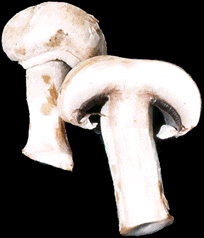
| This is a cross-section of the Agaricus bisporous. Notice that the gills are dark brown and that they are not attached to the stalk. The A. bisporous is the most cultivated mushroom in the world.* |
|
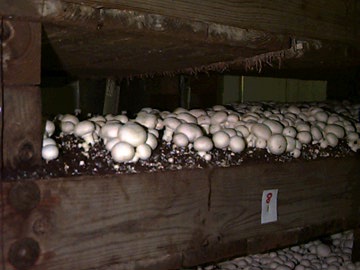 |
| The Agaricus bisporous, which is your common, grocery store mushroom, is one of the most widely known edibles. Some of it's contemporaries include the popular portobello and so on.The subtrate on which A. bisporous is cultivated include horse manure, wheat straw, corn cobs, several other plants wastes and some animal wastes such as feather meal and chicken manure.* |
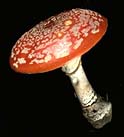 |
| Right ---------------------------> The beautiful, but poisonous Amanita muscaria is probably one of the most startling looking mushrooms I have ever seen. (Of course, there are plenty more! I just like the color!) It is more commonly known as the Fly agaric because people used to grind it up and mix it with sugar and water to stupefy houseflies.* |
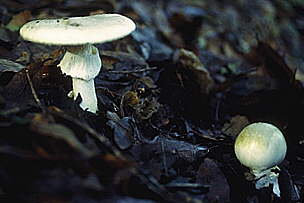 |
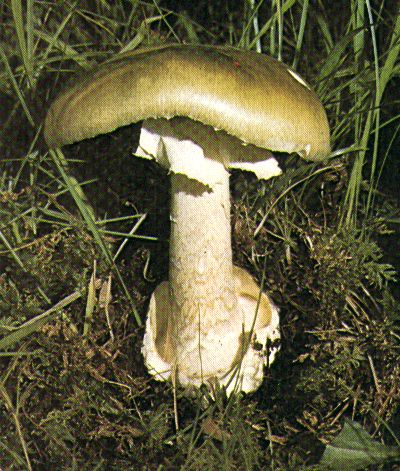
| Above and right: the Amanita phalloides, commonly known as the Death Cap, is probably responsible for more mushroom poisonings than any other because of it's slight resemblance to other edibles like the Lepiota procera, or the Parasol mushroom. According to the National Audubon Society Field Guide to North American Mushrooms,After eating this mushroom, symptoms include severe vomiting, diarrhea and cramps. A remission occurs after a day or so, but by the 3rd or 4th day, serious kidney and/or liver dysfunction occurs and can, without adequate treatment, cause painful death in 5 or 6 days. On the right, you can see remnants of the universal veil and at the bottom of the stalk, the sac-like cup around the base of the stalk. This is one of the more prevelant morpholoical characteristics of this beautiful, but deadly mushroom.* |
 |
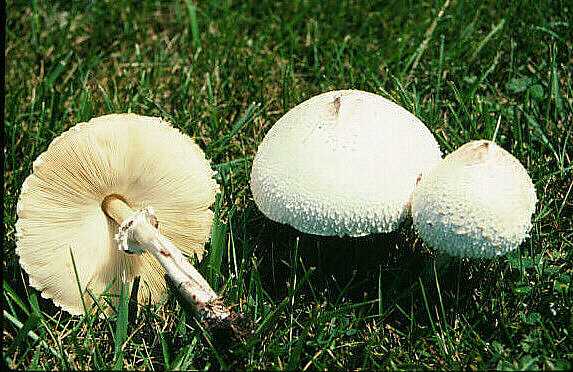 |
| Left: the Chlorophyllum molybdites, or Green-spored lepiota, is an interesting mushroom, mainly because it has greenish gills and produces a green spore print. Gills are free, close, and broad. Also resembles the Lepiota procera, and is a poisonous mushroom that is a severe gastro-intestinal irritant that can cause a few days of violent purging. These things can get really big, and can also appear in fairy rings.* |
| * All pictures and information obtained from "The National Audubon's Field Guide to North America Mushrooms" |