
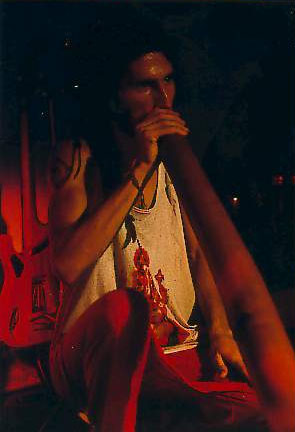

A
straight, natural trumpet used by aborigines of northern Australia. It consists
of a termite hollowed eucalyptus branch, stripped of its outer bark and with its
interior walls sometimes thinned at the ends by scraping. For a “mouthpiece”
a ring of beeswax or eucalyptus gum may be fitted to the narrower end. The
preferred length varies regionally from 1-1.5 metres. The instrument is played
by male aborigines together with clapping sticks to accompan singing and dancing
and it is primarily used for “open” (non-secret) ceremonies, clan songs,
camp entertainment songs, and
individually owned songs. It may also accompany children’s songs. The
didgeridoo has a wide expressive range. Through the employment of musical
imagination and physical skills a virtuoso instrument has been made of a very
high order out of crude implement.
