
Created with the CoffeeCup HTML Editor
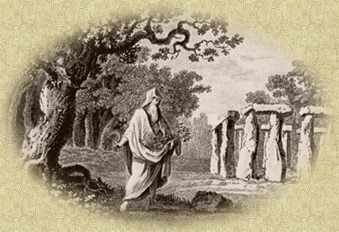 With that in mind, it's not hard to accept that a Druid's connection to nature is the source of all their powers, both in society and in magic. By understanding that connection, a Druid's being is joined with nature, and so they become aware of all that is known to nature, which is all things. A Druid then is a kind of nature mystic.
The Celtic people believed in a variety of gods and goddesses, although not every Celtic nation believed in the same group. Many of the most powerful gods in Celtic mythology were female. But the gender of deities is not a reliable guide for determining what each deity's area of responsibility is. There are male earth gods, female sun gods, female animal gods, female war gods, and male & female fertility gods, which is very much in contrast with contemporary Western occultism,
especially Wicca. There are also female river gods, male smith craft gods, male & female soverenty gods, and so on which is similar to conventional occultism.
Some of the main Gods/Goddesses are: Lugh, Dagda, Nuada, Morrigu, Brigid, Diancecht, and Manannan. There were a number of Welsh-specific deities that were worshiped as well: Arawn, Math ap Mathonwy, Pwyll, Arianhrod, Rhiannon, Cerridwen, Lyr, and Manawayddan (The counterpart to Manannan).
It should be noted, as well, that not all Druids worship a particular God/Goddess by name or spirit. There are many who believe in a kind of Universal Life Force, flowing from a central place (such as the Irish Well of Wisdom or the Welsh Spiral of Annwyn), to and from all living things. Such a force would presumably be superior to even the gods. If you had to put a name to it in respects to the Celtic culture, that name would have to be "Truth."
Much like Wicca and other Pagan religions, the Druids have holy days. They are a series of Fire Festivals that occur in 12 week intervals and are spaced between the seasonal festivals of solstice and equinoxes. They last for 3 days, beginning at sunset on the first day and would be the best time for sacrifices and divination. The holy days are: Samhain (Nov 1st), Imbolc (Feb 1st), Beltaine (May 1st), and Lughnasad (August 1st). These dates are commonly reversed in the Southern Hemisphere (such as Australia and New Zealand) with Beltaine starting on November 1st.
The Druids also believed in The Geas (pronounced "GESH"). In its plural form, it's Geasa. It's basically a kind of magical obligation, prohibition, or taboo that a person may possess & is usually imposed on magical people such as sacred kings, Druids, and great heroes.
There are several ways to receive a Geas. A parent can grant one to her children at birth, a king or Druid can impose one upon a criminal as a punishment, or a Druid can determine by oracular means what Geasa a person already has. In heroic mythology there is a trend in which male heroes receive their Geas from women, as in the cases of Cu Chullain and Diarmaid ua Duibhne. A hero may lose a gamble of cards or a chess game
to a hag, and she imposes a geas upon him as her reward for winning; typically a geas of that kind is a requirement to perform some impossible task.
The risk of breaking Geas is great. To break a geas is to act contrary to the forces of nature, and the result is the death of the person, or some other great social catastrophe. Knowing this, many heroes met their end when their enemies discovered the heroes' geas and plotted a situation in which it was impossible to avoid breaking them. Since each geasa is unique to each person, it's generally kept as an intimate & serious secret to those who possess them.
A simple description of the "Good in Druidism", similar to the Wiccan Rede, would be an old Irish Triad which reads: "Three candles that illuminate every darkness: Knowledge, Nature, Truth".
The Triad is a convention of Celtic poetry and, because much Druidic wisdom is communicated through such poetry, you would do well to examine and study the poems of the Celts.
The Ancient Druids generally distrusted written records and, although the Ogham did exist, it was generally unused outside of burial monuments, property divisions, and landmarks. To write things down is to weaken the power of edidic memory, which the Druids cultivated carefully, and to dishonor the thing written down.
Instead, the Druids relied heavily on their voices. They believed that the voice was the most potent ritual tool. Druids in training had to learn all the Bardic poetry, in a manner we would call sensory deprivation. Poetic inspiration was an important spiritual practice.
The Druids believed in Reincarnation, or Re birth in an otherworldly afterlife. This spiritual Otherworld is sometimes accessible to us, and particularly close, at certain times of the year (such as Samhain). They believe there is a great sense of connection and continuity between life and death. Death was viewed as a transitional phase in the course of a long, even eternal, life. There is no division between an Underworld and an Upper world. As such, the entities which live in the Otherworld are neither good nor evil, like ourselves.
There is no indication that the Druids believed in Karma.
Getting back to Druidic beliefs regarding deities, it should be noted that it's a complicated problem to describe and understand. The feature that all Gods share, which makes them distinct from mortals, is that they are descended from a particular divine ancestor. In the case of the Irish, that ancestor deity is the Goddess Danu, and so the pantheon of Irish Gods are called Tuatha de Dannann, meaning "Tribe of Danu". The Celtic Gods are inseparable from the environment in which they live, so much that it is difficult to categorize them neatly into groupings of what each deity is 'god of'.
As the Druids looked upon nature and saw it populated with spirits, Goddesses, and Gods, it is safe to speculate that they regarded nature as sacred and divine.
Also, getting back to the aforementioned Fire Festivals, it should be obvious that fire-worship is central to their religion. Fire is a spiritual force unto itself, and it is not bound into a cosmology of four equally necessary elements, as the Greeks are known to have done. Fire possesses the magical properties of both destructiveness and cleansing, bringing heat and energy and with it civilization. It is a spiritual principle, because it is always reaching up to the sky. This may be why they built hilltop fires (to reach even closer to their deities). Poetic inspiration is said to be a fire in the head, so Brigid is a fire-deity as well. The ritual "need fire" demonstrates the high spiritual regard the Celts had for fire, which was their main source of energy.
Just as Fire and various deities are sacred to the Druids, so are various animals. Horses, Salmon, Crows, Deer, Boars, Serpents and Cattle are amongst the most noted animals that were regarded as being sacred.
Druid magic is the result of a strong and healthy awareness of nature, and the spirits and gods who live in nature. A Druid must understand the language that Nature uses to speak its wisdom. All else follows from that. Druid magic has a votive quality; magic is performed by appealing to the gods to perform a service in return for an offering. Mythic Druids often used trance-ecstasy to achieve their purpose as well. But in the
myths very little attention is paid to summoning or controlling spirits and gods, instead, the Druids sought communication and communion.
"Aisling" is a dream or a vision. It's thought that this refers to altered states of consciousness.
"Immram" is a journey into the realms where the Gods live,
possibly by Shaman flight. Literally translated, Immram means
"sea journey," for it is in the Western ocean that the islands of otherworldly paradices were located.
"Imbas" means Inspiration, poetic frenzy, the "fire in the
head" that Amergin speaks of. This is thought to, also, refer to altered states of consciousness.
"Echtra" - "Adventure", expeditions and journeys on holy ground.This way of magic often happens "accidentally" to heroes,warriors, and hunters.
"Dra/iocht" is the word for magic. Literally translated, it means "what Druids do".
"Fi/rinne" means "Truth" or "Justice"; the binding force of
nature. (Note the significance of Truth and Justice being in the same word.)
It's a hotly debated topic, at present, whether or not Druids were actually Shamans. That is a topic I will leave you to decide for yourself. I, personally, do not consider the Ancient Druids to have been Shamans as we know them today. There are a great many similarities, but there are enough differences, for me, to keep them as separate & distinct things. (As I said before, I take my foundation of beliefs from both 'systems' and combine them in a manner that works well for me. It's because of the fact that they're so similar that I was able to make this work for myself.)
On that note, I'll leave you to ponder what I've said and do further research. What I've presented to you is definitely not a complete history, nor is it a complete outline of the Druidic faith. There are a great many web sites out there on this very topic, in addition to news groups, books and essays.
Keep in mind, though, that the best way to experience Druidism is to turn off your computer, put the book down, and go out into Nature. Find yourself a stream, or a nice wooded area. Look for a grove to call your own. Do something...ANYTHING... Just keep your eyes and ears open, because the spirits and magic are out there to be found as long as you're
receptive to their messages.
With that in mind, it's not hard to accept that a Druid's connection to nature is the source of all their powers, both in society and in magic. By understanding that connection, a Druid's being is joined with nature, and so they become aware of all that is known to nature, which is all things. A Druid then is a kind of nature mystic.
The Celtic people believed in a variety of gods and goddesses, although not every Celtic nation believed in the same group. Many of the most powerful gods in Celtic mythology were female. But the gender of deities is not a reliable guide for determining what each deity's area of responsibility is. There are male earth gods, female sun gods, female animal gods, female war gods, and male & female fertility gods, which is very much in contrast with contemporary Western occultism,
especially Wicca. There are also female river gods, male smith craft gods, male & female soverenty gods, and so on which is similar to conventional occultism.
Some of the main Gods/Goddesses are: Lugh, Dagda, Nuada, Morrigu, Brigid, Diancecht, and Manannan. There were a number of Welsh-specific deities that were worshiped as well: Arawn, Math ap Mathonwy, Pwyll, Arianhrod, Rhiannon, Cerridwen, Lyr, and Manawayddan (The counterpart to Manannan).
It should be noted, as well, that not all Druids worship a particular God/Goddess by name or spirit. There are many who believe in a kind of Universal Life Force, flowing from a central place (such as the Irish Well of Wisdom or the Welsh Spiral of Annwyn), to and from all living things. Such a force would presumably be superior to even the gods. If you had to put a name to it in respects to the Celtic culture, that name would have to be "Truth."
Much like Wicca and other Pagan religions, the Druids have holy days. They are a series of Fire Festivals that occur in 12 week intervals and are spaced between the seasonal festivals of solstice and equinoxes. They last for 3 days, beginning at sunset on the first day and would be the best time for sacrifices and divination. The holy days are: Samhain (Nov 1st), Imbolc (Feb 1st), Beltaine (May 1st), and Lughnasad (August 1st). These dates are commonly reversed in the Southern Hemisphere (such as Australia and New Zealand) with Beltaine starting on November 1st.
The Druids also believed in The Geas (pronounced "GESH"). In its plural form, it's Geasa. It's basically a kind of magical obligation, prohibition, or taboo that a person may possess & is usually imposed on magical people such as sacred kings, Druids, and great heroes.
There are several ways to receive a Geas. A parent can grant one to her children at birth, a king or Druid can impose one upon a criminal as a punishment, or a Druid can determine by oracular means what Geasa a person already has. In heroic mythology there is a trend in which male heroes receive their Geas from women, as in the cases of Cu Chullain and Diarmaid ua Duibhne. A hero may lose a gamble of cards or a chess game
to a hag, and she imposes a geas upon him as her reward for winning; typically a geas of that kind is a requirement to perform some impossible task.
The risk of breaking Geas is great. To break a geas is to act contrary to the forces of nature, and the result is the death of the person, or some other great social catastrophe. Knowing this, many heroes met their end when their enemies discovered the heroes' geas and plotted a situation in which it was impossible to avoid breaking them. Since each geasa is unique to each person, it's generally kept as an intimate & serious secret to those who possess them.
A simple description of the "Good in Druidism", similar to the Wiccan Rede, would be an old Irish Triad which reads: "Three candles that illuminate every darkness: Knowledge, Nature, Truth".
The Triad is a convention of Celtic poetry and, because much Druidic wisdom is communicated through such poetry, you would do well to examine and study the poems of the Celts.
The Ancient Druids generally distrusted written records and, although the Ogham did exist, it was generally unused outside of burial monuments, property divisions, and landmarks. To write things down is to weaken the power of edidic memory, which the Druids cultivated carefully, and to dishonor the thing written down.
Instead, the Druids relied heavily on their voices. They believed that the voice was the most potent ritual tool. Druids in training had to learn all the Bardic poetry, in a manner we would call sensory deprivation. Poetic inspiration was an important spiritual practice.
The Druids believed in Reincarnation, or Re birth in an otherworldly afterlife. This spiritual Otherworld is sometimes accessible to us, and particularly close, at certain times of the year (such as Samhain). They believe there is a great sense of connection and continuity between life and death. Death was viewed as a transitional phase in the course of a long, even eternal, life. There is no division between an Underworld and an Upper world. As such, the entities which live in the Otherworld are neither good nor evil, like ourselves.
There is no indication that the Druids believed in Karma.
Getting back to Druidic beliefs regarding deities, it should be noted that it's a complicated problem to describe and understand. The feature that all Gods share, which makes them distinct from mortals, is that they are descended from a particular divine ancestor. In the case of the Irish, that ancestor deity is the Goddess Danu, and so the pantheon of Irish Gods are called Tuatha de Dannann, meaning "Tribe of Danu". The Celtic Gods are inseparable from the environment in which they live, so much that it is difficult to categorize them neatly into groupings of what each deity is 'god of'.
As the Druids looked upon nature and saw it populated with spirits, Goddesses, and Gods, it is safe to speculate that they regarded nature as sacred and divine.
Also, getting back to the aforementioned Fire Festivals, it should be obvious that fire-worship is central to their religion. Fire is a spiritual force unto itself, and it is not bound into a cosmology of four equally necessary elements, as the Greeks are known to have done. Fire possesses the magical properties of both destructiveness and cleansing, bringing heat and energy and with it civilization. It is a spiritual principle, because it is always reaching up to the sky. This may be why they built hilltop fires (to reach even closer to their deities). Poetic inspiration is said to be a fire in the head, so Brigid is a fire-deity as well. The ritual "need fire" demonstrates the high spiritual regard the Celts had for fire, which was their main source of energy.
Just as Fire and various deities are sacred to the Druids, so are various animals. Horses, Salmon, Crows, Deer, Boars, Serpents and Cattle are amongst the most noted animals that were regarded as being sacred.
Druid magic is the result of a strong and healthy awareness of nature, and the spirits and gods who live in nature. A Druid must understand the language that Nature uses to speak its wisdom. All else follows from that. Druid magic has a votive quality; magic is performed by appealing to the gods to perform a service in return for an offering. Mythic Druids often used trance-ecstasy to achieve their purpose as well. But in the
myths very little attention is paid to summoning or controlling spirits and gods, instead, the Druids sought communication and communion.
"Aisling" is a dream or a vision. It's thought that this refers to altered states of consciousness.
"Immram" is a journey into the realms where the Gods live,
possibly by Shaman flight. Literally translated, Immram means
"sea journey," for it is in the Western ocean that the islands of otherworldly paradices were located.
"Imbas" means Inspiration, poetic frenzy, the "fire in the
head" that Amergin speaks of. This is thought to, also, refer to altered states of consciousness.
"Echtra" - "Adventure", expeditions and journeys on holy ground.This way of magic often happens "accidentally" to heroes,warriors, and hunters.
"Dra/iocht" is the word for magic. Literally translated, it means "what Druids do".
"Fi/rinne" means "Truth" or "Justice"; the binding force of
nature. (Note the significance of Truth and Justice being in the same word.)
It's a hotly debated topic, at present, whether or not Druids were actually Shamans. That is a topic I will leave you to decide for yourself. I, personally, do not consider the Ancient Druids to have been Shamans as we know them today. There are a great many similarities, but there are enough differences, for me, to keep them as separate & distinct things. (As I said before, I take my foundation of beliefs from both 'systems' and combine them in a manner that works well for me. It's because of the fact that they're so similar that I was able to make this work for myself.)
On that note, I'll leave you to ponder what I've said and do further research. What I've presented to you is definitely not a complete history, nor is it a complete outline of the Druidic faith. There are a great many web sites out there on this very topic, in addition to news groups, books and essays.
Keep in mind, though, that the best way to experience Druidism is to turn off your computer, put the book down, and go out into Nature. Find yourself a stream, or a nice wooded area. Look for a grove to call your own. Do something...ANYTHING... Just keep your eyes and ears open, because the spirits and magic are out there to be found as long as you're
receptive to their messages.