Cable Media
1. Twisted Pair Cable

Twisting is to cancel out the EMI (ElectroMagnetic Interference
電磁場干擾)
There are two types of twisted pair cable:
- UTP (Unshielded twisted pair)
- STP (Shielded twisted pair)
UTP
- consists of four twisted pair of copper wire
- UTP is specified in the EIA/TIA 568 Commercial Building Wiring Standard.
- maximum length 100m
- using RJ-45 connector like RJ-11 telephone connector
EIA/TIA stands for Electronic Industries Association and the
Telecommunications Industries Association.
EIA/TIA defines UTP in:
- category 1 ----- for voice only (telephone cable)
- category 2 ----- 4Mbps
- category 3 ----- 10Mbps
- category 4 ----- 16 Mbps
- category 5 ----- 100Mbps
STP
- consists of two twisted pair of copper wire
- use a foil warp around the wire pairs.
- 16 to 500 Mbps
- maximum length 100m
- using RJ-45 connector like RJ-11 telephone connector
Coaxial Cable
The copper wire mesh as a shielding that protects the transmitted data from
EMI and more resistant to crosstalk and attenuation than twisted pair.
Crosstalk

Attenuation
- The weakening of a signal over distance
- Usually measured in decibels (分貝)
- Can be corrected with a repeater
There are two types of coaxial cable:
- Thinnet
- Thicknet
Thinnet
- about 0.25 inch in diameter
- maximum length 185m
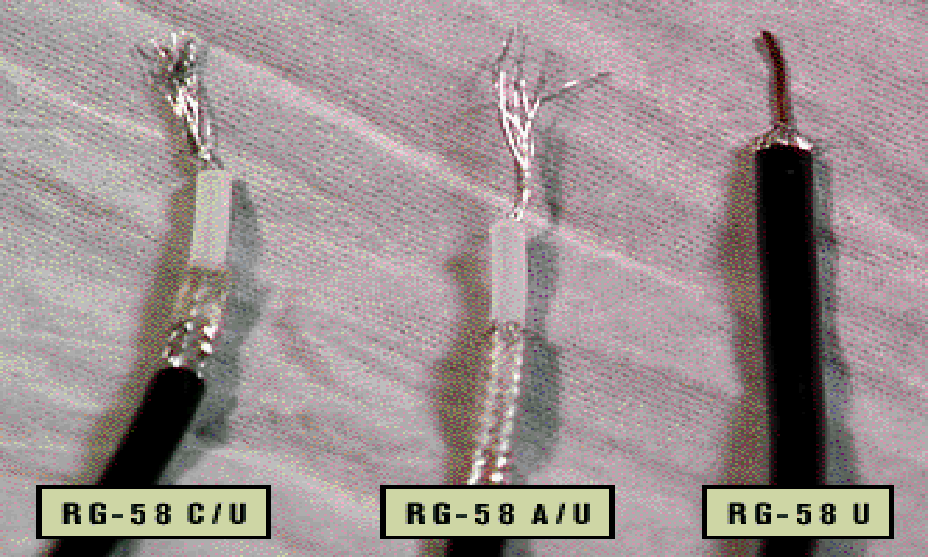
- also called BNC (British Naval Connector) or RG-58
- requires 50-ohm terminators.
- 10Mbps
- using BNC connector
Thicknet
- about 0.5 inch diameter
- maximum length 500m
- also called RG-11 or Standard Ethernet
- using external transceivers
- 10Mbps
- using AUI (or called DIX or DB15) connector
Remark: Transceiver is used to convert parallel signals to serial signals and
vice versa. Actually, every network adapter card must use a transceiver to
transmit and receive data, Most network adapter card use built-in transceivers,
except thicknet network adapter card.
Fiber-Optic Cable
carry digital signals in the form of light. Hence, fiber-optic cable is more
secure than coaxial or twisted-pair cable form tapped.(勾線)
- diameter in unit of micron (微米)
- maximum length 2000m
- requires expertise to install (Polishing打磨)
- 100 Mbps to 2Gbps
Ethernet
LAN Specification
IEEE 802.3 Ethernet Standard
IEEE stands for (Institute of Electrical and Electronics Engineers)
10BaseT
- STP,UTP category 3,4,5
- Up to 1024 computers per LAN
- Star Bus Topology
10Base2
- Thinnet
- Up to 30 computer per segment
- Linear Bus Topology
10Base5
- Thicknet
- Up to 100 computers per segment
- Linear Bus Topology
10BaseFL
|
Thinnet Coaxial |
Thicknet Coaxial |
UTP |
STP |
Fiber-Optic |
| Cable cost (expensive) |
4 |
2 |
5 |
3 |
1 |
| Installation (hardness) |
4 |
2 |
5 |
3 |
1 |
| Capacity |
10Mbps |
10Mbps |
4-100Mbps |
16-500Mbps |
100Mbps-2Gbps |
| EMI (sensitive) |
2 |
2 |
1 |
2 |
3 |
| Maximum length |
185m |
500m |
100m |
100m |
2km |
| Total Computers |
30 per segment |
100 per segment |
1024 per LAN |
1024 per LAN |
|
| IEEE project 802 |
10Base2 |
10Base5 |
10BaseT |
|
10BaseFL |
| Connector |
BNC/RG-58 |
AUI/DIX/DB15 |
RJ-45 |
RJ-45 |
|