。The element carbon &
Compounds made of Carbon。
Carbon
has four electrons in its valence shell (outershell).
Since
this energy shell can hold eight electrons,
each
carbon atom can share electrons with up to four different atoms.
Carbon
can combine with other elements as well as with itself.
This
allows carbon to form many different compounds of varying size and shape.
Carbon
alone forms the familiar substances graphite and diamond.
Both
are made only of carbon atoms. Graphite is very soft and slippery.
Diamond
is the hardest substance known to man.
If both
are made only of carbon what gives them different properties?
The
answer lies in the way the carbon atoms form bonds with each other.
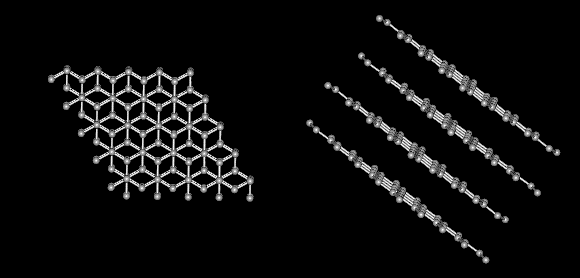 Notice
that graphite is layered.
Notice
that graphite is layered.
There are strong covalent bonds between carbon atoms in each
layer.
But, only weak forces exist between layers.
This allows layers of carbon to slide over
each other in graphite.
On the other hand,
in diamond each carbon atom is the same distance to each of
its neighboring carbon atoms.
In this rigid network atoms cannot move.
This explains why diamonds are so hard and have
such a high melting point.
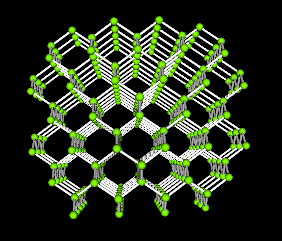
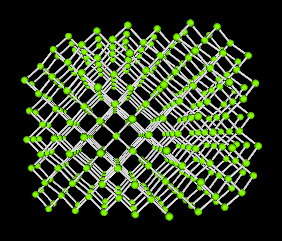
The 3-D coordinates for graphite and diamond are available
in the
MathMol Structural Database.
We urge you to download these structures to your home
computer and use one of the suggested 3-D viewers.
The Molecule of the Month Page has recently included
information on diamond located
here
~~~~~~~~~~~~~~~~~~~~~~~~~~~~~~~~~~~~~~~~~~~~~~~~~~~~~~~~~~~~~~~~~~~~
A third class of carbon compounds has recently been
discovered.
They are called fullerenes.
The figure shown on the left is one form composed of 60
carbons.
Notice the geometric patterns of
pentagons and hexagons that form the familiar icosohedron.
。Compounds made of Carbon。
The simplest organic compounds contain molecules composed of carbon and
hydrogen.
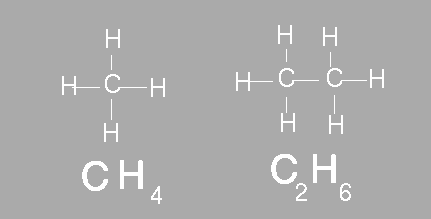
The compound methane contains one carbon bonded to four hydrogens.
Ethane
is another example of a simple hydrocarbon.
Ethane contains two carbon atoms and four hydrogen atoms.
In
chemistry we use a molecular formula to show how many atoms of each element are
present in a molecule.
A
molecular formula however does not show the structure of the molecule.
Scientists often use structural formulas to show the number and arrangement of
atoms in a compounds.
Below the molecular formula for methane and ethane are shown.
Above the molecular formula are their respective structural formula.
Although
structural formulas can be very helpful
they do
not give a complete picture of a molecule.
Structural formulas do not tell us anything about the distances between bonds,
the
angles formed by these bonds,
or the
size and shape of the molecule.
Scientists use three different representation to show what molecules look like.
.
THE
WIRE FRAME MODEL
This model clearly shows the type of atoms in the molecule,
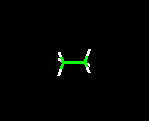
the
distances between bonds, and angles associated with the atoms.
Because
the lines drawn are very thin,
molecules
can very easily be manipulated when viewed on a computer screen
THE BALL-AND-STICK MODEL
Atoms are represented by balls and
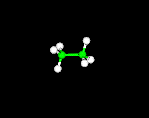
bonds are represented as sticks.
THE SPACE FILLED MODEL
This model shows the space that the molecule will take up.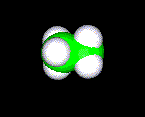
Because of all the points required to draw this molecule
on
a computer screen you should expect
these molecules to be very difficult to manipulate.
BACK to main