 |
|
|
|
|
|
|
|
|
|
|
|





|
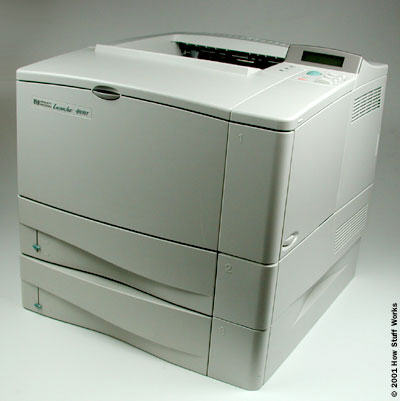
There are several major printer technologies available. These technologies can be broken down into two main categories with several types in each:
¡E Impact - These printers have a mechanism
that touches the paper in order to create an image. There are two main
impact technologies:
„X Dot matrix printers use a series of
small pins to strike a ribbon coated with ink, causing the ink to transfer
to the paper at the point of impact.
„X Character printers are basically computerized
typewriters. They have a ball or series of bars with actual characters
(letters and numbers) embossed on the surface. The appropriate character
is struck against the ink ribbon, transferring the character's image to
the paper. Character printers are fast and sharp for basic text, but very
limited for other use.
¡E Non-impact - These printers do not touch the paper when creating an image. Inkjet printers are part of this group, which includes:
„X Inkjet printers, which are described
in this article, use a series of nozzles to spray drops of ink directly
on the paper.
„X Laser printers, use dry ink (toner),
static electricity, and heat to place and bond the ink onto the paper.
„X Solid ink printers contain
sticks of wax-like ink that are melted and applied to the paper. The ink
then hardens in place.
„X Dye-sublimation printers have a long
roll of transparent film that resembles sheets of red-, blue-, yellow-
and gray-colored cellophane stuck together end to end. Embedded in this
film are solid dyes corresponding to the four basic colors used in printing:
cyan, magenta, yellow and black (CMYK). The print head uses a heating
element that varies in temperature, depending on the amount of a particular
color that needs to be applied. The dyes vaporize and permeate the glossy
surface of the paper before they return to solid form. The printer does
a complete pass over the paper for each of the basic colors, gradually
building the image.
„X Thermal wax printers are something
of a hybrid of dye-sublimation and solid ink technologies. They use a
ribbon with alternating CMYK color bands. The ribbon passes in front of
a print head that has a series of tiny heated pins. The pins cause the
wax to melt and adhere to the paper, where it hardens in place.
„X Thermal autochrome printers have the
color in the paper instead of in the printer. There are three layers (cyan,
magenta and yellow) in the paper, and each layer is activated by the application
of a specific amount of heat. The print head has a heating element that
can vary in temperature. The print head passes over the paper three times,
providing the appropriate temperature for each color layer as needed.
Out of all of these incredible technologies, inkjet printers are by far
the most popular. In fact, the only technology that comes close today
is laser printers.