 |

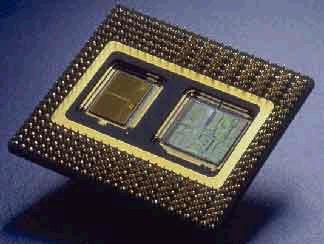
Microprocessor is an integrated circuit
designed to process instructions.
It also called CPU (Central Processing Unit)
How does it work??
There is a miniaturized circuitry in a microprocessor, which is group into important functional area, such as the ALU and the control unit
ALU
It performs arithmetic operations and logical operations. ALU uses registers to hold data that is being processed.
Control Unit
It fetches each instruction .
Where does the microprocessor get its instructions??
The simple answer is that a microprocessor executes instructions provided by a computer program. Microprocessor can't follow just any instructions. The list of instructions that a microprocessor can perform is called its instruction set . top
Microprocessor Performance Factor:
A microprocessort's performance is affected by:
• Clock speed
•Word size
•Cache size
•Instruction set
•Processing techniques
Microprocessor Clock: (e.g. MHz, GHz)
A timing device that sets the pace for executing instructions. However, the clock speed is not equal to the number of instructions a processor can execute in one second.
Work size: (e.g. 32-bit processor, 64-bit processor)
It refers to the number of bits that a microprocessor can manipulate at one time.
Cache:
It is sometimes called “RAM cache” or “cache memory”. It is special high-speed memory that allows a microprocessor to access data more rapidly than from memory located elsewhere on the motherboard.
Some computer ads specify cache type and capacity. A Level 1 cache (L1) is built into the processor chip, whereas a LEVEL 2 cache (L2 ) is located on separate chip and takes a little more time to get data to the processor. Cache capacity is usually measured in kilobytes.
Instruction set:
There are two kinds of instructions------ CISC & RISC.
A microprocessor with a limited set of simple instructions uses RISC (reduce instruction set computer) technology.
A microprocessor with a construction set which have more complex instructions uses CISC (complex instruction set computer) technology .
A RICS processor performs most instructions faster than a CISC processor. However, it might require more of these simple instructions to complete a task than a CISC processor requires for the same task.
Processing techniques:
Some processors execute instructions “serially”----that is, one instruction at a time.
With serial processing , the processor must complete all steps in the instruction cycle before it begins to execute the next instruction.However, using a technology called pipelining ; a processor can begin executing an instruction before it completes the previous instruction.
Many of today's microprocessors also perform parallel processing, in which multiple instructions are executed at the same time. Pipelining and parallel processing enhance processor performance.
Which so many factors to consider, how can I compare microprocessor performance??
A serious of tests gauges the overall speed of a microprocessor. The results of these tests---- called benchmarks ----can then be compared to results for other microprocessors. Top
Today's Microprocessor:

Intel is the world's largest chipmaker and supplies a sizable percentage of the microprocessors that power PCs.
AMD (Advanced Micro Devices) is intel's chief rival in the PC chip market.
Motorola is the main chip supplier for Apple computers.
Transmeta Corporation specializes in chips for mobile computing devices.
 |
 |
 |
 |
 |
 |