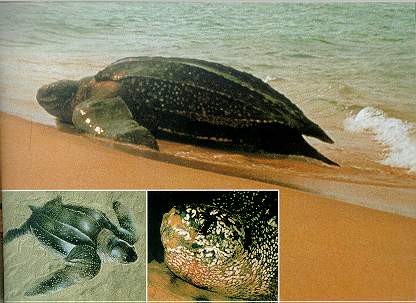
Adult, Photo: Eugene Schumacher/WWF. Inset: drawing by Filip Yip Ngai Leung (left) Photo: P.Dubois/WWF(right)
Leatherback Turtle
Adult, Photo: Eugene Schumacher/WWF. Inset: drawing by Filip Yip Ngai Leung (left) Photo: P.Dubois/WWF(right)
Description: A marine turtle of gigantic proportions, attaining a record size of 240 cm. Carapace with seven light-coloured, prominent, longitudinal keels. Head, neck and carapace dark, with much white stippling. Has a fairly prominent beak. Upper jaw with two tooth-like cusps. Unlike other sea turtles the adult has no true horny shields, only tough, hardened skin, from which comes the name 'Leatherback'. Scales present on hatchlings up to 2-3 months only. Front flippers very large, without claws.
Habits and habitat: The world's largest living turtle. Travel far across open ocean; has been reported in far northern region, even Scandinavia. Dives very deep in pursuit of its prey. Sometimes migrates to the cold northern waters of the Arctic to feed. Despite the low water temperatures, because of its large size is able to maintain core body temperature several degrees higher to keep it from freezing.
Diet: Is reported to feed on jellyfish, particularly the Portuguese man-of-war. Has a tough throat lining, which cannot be penetrated by the stings of jellyfish.
Reproduction: Does not breed in Hong Kong. Known nesting sites in Asia are in Malaysia and Sri Lanka. Lays 90-150 eggs. Hatchlings about 10 cm long; greenish, with yellow-coloured keels, giving them a pin-striped appearance.
Distribution: Rarely seen in Hong Kong waters. First reported off Cheung Chau, where one individual beached itself and was later returned to the sea. Also sighted at Lei Yue Mun in 1964. A dead specimen was found on a beach in Sai Kung in 1977 and another in 1988. The most recent record is that of a dead adult washed ashore on Tung Lung Island in 1994. Occurs all along the coast of China, and all the temperate and tropical seas of the world.
Diagnostic features: Carapace dark, with much white stippling, with seven keels; horny shields absent; upper jaw with two tooth-like cusps; no claws on the limbs.