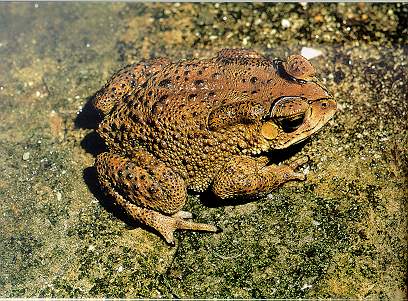
Asian Common Toad
Description: A large, warty toad, yellowish-brown or darker in colour. Average adult size about 6 cm but may reach a maximum size of 10 cm. Head angular, with dark ridges. Has two large, sausage-shaped parotoid glands, one behind each eye, which can secrete a milky poison. Underside of body pale-coloured, with dark granulation. Digits not webbed.
Habits and habitat: A very abundant species generally. Occurs in many localities, from sea level to the summit of the highest local peaks; in semi-urban areas as well as the more remote countryside. Requires still or slow-flowing water to breed in, and is absent from several small local islands, where there is little or no water. Can live in somewhat drier habitats. Is frequently found hiding beneath objects during the day. Is crepuscular or nocturnal. Inflates it body when disturbed or is about to be swallowed by a snake. Moves about by taking short hops.
Diet: Includes insects such as beetles, termites and crickets as well as earthworms.
Reproduction: Breeds from February to April or May. The female lays black, gelatinous eggs, in long chains, which are wound around submerged vegetation or rocks. Tadpoles small and jet-black in colour, with a round body and a short, blunt tail. Toadlets slim, less than 1 cm at metamorphosis.
Distribution: Probably the most widespread of Hong Kong amphibians, and frequently occurs in large numbers. Range widely from Sri Lanka, throughout central and southern China, and southward to Indonesia.
Diagnostic features: Angular head, with black, bony ridges; large parotoid glands behind the eyes; very warty skin; unwebbed, black-tipped digits.