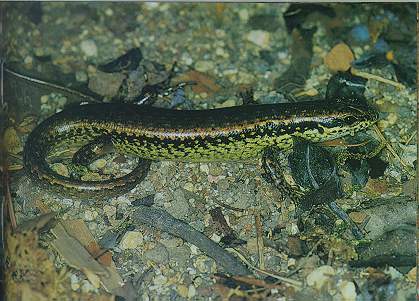
Brown Forest Skink
Description: A medium-sized robust skink, up to 20 cm in total length; 7-10 cm in snout-vent length. Brown in colour, with a dark brown or black zig-zag lateral stripe that extends from eye to hind legs. Back usually mottled with golden brown speckles. Black speckling also on lower flanks, particularly evident in young skinks. Labials whitish, with scattered black flecks. Juveniles have two light tan, zig-zag stripes on dorsal tail surface which disappear in adults. Underside white or yellowish white. Scales small, completely smooth. Resembles Mabuya longicaudata but, unlike it, has short blunt head, much narrower snout, noticeably raised supraoculars and much shorter tail.
Habits and habitat: A skink of hilly secondary forest and riparian woodland. Usually seen scuttling through leaf litter. Sometimes occurs in old plantation woodland. Also found in dwarf bamboo near rock outcrops on Tai Mo Shan, which it probably entered from adjacent woodlands. Both diurnal and nocturnal, but is more often seen by day. If distributed near a stream, will jump into the water and swim away or hide among debris at the bottom. Is preyed upon by Sibynophis chinensis.
Diet: Feeds on leaf litter cockroaches, small grasshoppers, earthworms and other small arthropods.
Reproduction: Viviparous. Is reported to give birth to 6-12 young. Nothing is known of its local breeding habits. Hatchlings appear in summer and are about 7 cm in total length.
Distribution: Widely distributed in several parts of the New Territories. Common at Shing Mun Reservoir and Tai Po Kau Nature Reserves areas. Unrecorded so far from off-shore islands. Ranges from India, eastward through central and southern China including Taiwan, to the Malay Peninsula.
Diagnostic features: Back uniformly brown in colour; a black lateral stripe on upper flanks extending to hind legs; much golden-brown speckling; bead-like scales; pointed snout.