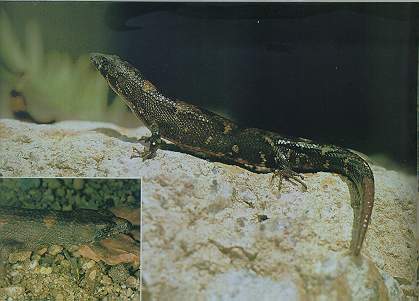
Chinese Waterside Skink
Description: A medium-sized robust skink, up to 15 cm in total length; 7.5 cm snout-vent length. Dorsum dark chocolate brown, occasionally almost black, with 10-13 rusty brown bars. Body quite stout. Head narrow and pointed. Labials black, with a few white flecks. All scales roughly keeled except ventral scales. Underside of body orange-yellow. Tail thick, muscular and somewhat laterally compressed to aid in swimming. Females larger than males. Young with whitish bars on the back and yellowish-white belly.
Habits and habitat: Usually found close to streams. Frequents clear, rocky hill and mountain streams that either have wooded margins or flow through dense forest. Is both diurnal and nocturnal. During the day is found under stones, rotting logs or boards in or near streams. Termites often congregate under such cover and are an important food source. When uncovered and disturbed, darts quickly under another rock, or dives into the water and hides under rocks at the bottom. Tail not as fragile ad that of other skinks.
Diet: Feeds on termites, leaf litter cockroaches, earthworm, insect larvae and other arthropods. In captivity also feed on small lizards.
Reproduction: Viviparous. Breeds in April. Females give birth to 3-6 young. Young some 3-4 cm in total length. Female does not feed for several weeks prior to giving birth; resumes feeding after the young are born.
Distribution: Found in many suitable habitats in the New Territories, where it is relatively common. Less common on Lantau and Hong Kong islands. Is known from Guangxi and Guangdong provinces in China, and from Vietnam.
Diagnostic features: Body dark brown; rusty brown diamond patterns on the back; strongly-keeled scales; tail laterally compressed.