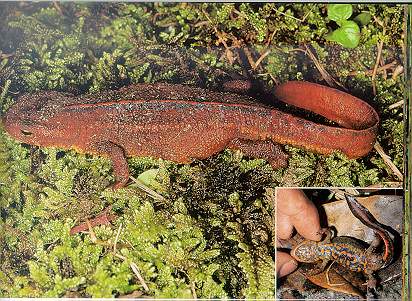
Inset: underside of a breeding male
Hong Kong Newt
Inset: underside of a breeding male
Description: A tailed amphibian. Total length, include tail, about 15cm. Back dark brown or black, with granules scattered all over the body. A mid-dorsal skin ridge extends backwards from neck through anterior third of tail. Two dorsalateral folds also present. Head spatulate, roughly triangular. Eyes with horizontal pupils. Bell black or dark brown, with numerous irregular orange-red blotches extending from chin to vent. Tail dark coloured, thin and laterally flattered, with a thin red stripe along its ventral border. Anterior limbs with four unwebbed digits. Posterior limbs with five unwebbed digits.
Habits and habitat: Occurs in pools in clear hill and mountain streams, up to 2m deep, which have large boulders and vegetated areas; also in shallow backwater pools with a muddy or sandy bottom and without any vegetation. Also spends some time on land. Can be found at all altitudes. Usually seen prowling the stream beds at night.
Diet: In captivity adults eat earthworms, tadpoles, fish fry, shrimps and insect larvae. The newt larvae are carnivorous and may cannibalize their own kind.
Reproduction: Breed period in Hong Kong from September to March. About 120 pale grey, gelatinous eggs, oval in shape, are glued singly to submerged plants. Breeding males have a broad, light blue streak midway down the sides of the tail. This line fades after breeding. Hatching takes place from 3 to 6 weeks. Young larvae measure about 1.5cm in length and possess external feathery gills. Metamorphosis occurs about 7 months later, at which time the gills disappear.
Distribution: Is the only species of newt in Hong Kong. Widely distributed in the New territories, and abundant in a few localities; more localized on Lantau Island and Hong Kong Island. Known only from Hong Kong and coastal Guangdong Province. Altitude range in Hong Kong from 900m down to almost sea level.
Diagnostic features: Long flat tail; lizard-like body but without any scales; fore limbs with four short digits without claws.