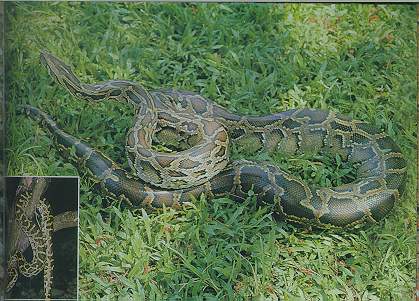
Burmese Python (non-venomous)
Description: Hong Kong¡¦s largest snake, up to 6 m in total length; more often 3-4 m. Back yellowish or grayish, with large chocolate-brown blotches, edged in black, extending from head to tail tip. Two series of alternating light and dark brown blotches on lower sides. Blotches bordered with black and white. Scales smooth and bead-like. Head elongated, slightly triangular, with a dark brown spear-like marking on top. A dark brown stripe from nostril through eye to angle of jaw. Another cream-coloured strak extends from eye to lower labials. Upper labials with pits. Ventral whitish, with black spots on either side of vent. Spurs better developed in males.
Habits and habitat: Found in a variety of habitats, but seems to prefer well-grown shrubland, broad-leaf woodland and edges of mangrove swamps, probably because they offer abundant cover and a variety of prey. Seems to avoid the interior of large cultivated fields and high mountains. Protected in Hong Kong since 1976. As a result, has become considerably more common in recent years. Sometimes swims between islands and mainland. Local pythons have a large home range. An adult female radio-tracked for 24 days on Lantau covered an area of over 12 hectares. Large specimens taken from the wild are powerful and vicious. Their bite can cause severe lacerations.
Diet: Feeds on birds and small mammals, but will sometimes tackle larger pre such as deer and domestic claves. Kill by constriction. In Hong Kong is sometimes considered a nuisance by farmers because of its chicken- and calf-eating proclivities.
Reproduction: Lays up to 30 eggs. The female coils around them and incubates them by raising her body temperature. Incubation period 2-3 months. Hatchlings about 65 cm in total length.
Distribution: Widely distributed in the territory, including all major islands. Occurs in central and southern China, Burma, Indochina and Indonesia.
Diagnostic features: Heavy-bodied snake; with irregular, brown blotches on the back and flanks; brown, spear-like marking on the head; rostral and first two upper labials with pits; short, blunt-tipped tail; a pair of spurs near the cloaca; ventral scales only half the width of ventral surface.