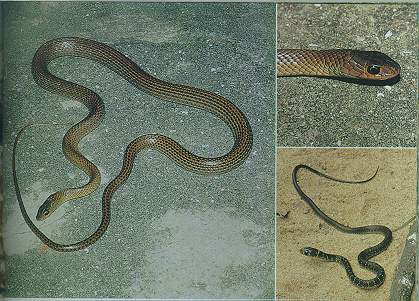
Indo-Chinese Rat Snake (non-venomous)
Description: A large, slender snake, averaging 120-150 cm in total length, but occasionally reaching 180 cm. Olive-brown or brown in colour, with a dark longitudinal brown line across each scale, giving the impression of thin, brown stripes down entire length of body. Chin and ventral scales yellow or off-white. Scales smooth. Tail long and whip-like. Juveniles olive brown, with white dots arranged in transverse crossbands on anterior part of body. The bands disappear in adults.
Habits and habitat: Occurs in many open habitats such as grassy banks of streams and reservoirs, edges of cultivated fields and ponds, dry shrubland and woodland. Rare in mountain grassland and dense forest. Often hunts Gunther¡¦s frogs in the tall grass around reservoirs, streams and catchwaters. An active diurnal species. If surprised near water, will usually dive into it and reappear on the surface a minute or so later, swimming away with its head up. When caught, will constantly thrash about and twist the body, making it extremely difficult to hold; will also bite vigorously. Does not become tame in captivity, but accepts food readily. Captive specimens remain nervous, darting about, striking and biting when approached. Commonly sold in snake shops for its gall bladder and meat.
Diet: Feeds largely on frogs, but also on rodents and lizards.
Reproduction: Lays 6 to 11 eggs, which hatch in about 45 days. Hatchlings about 25 cm long.
Distribution: Common throughout the territory including many islands. Distributed from East India to central and southern China including Taiwan, and south through Malay Peninsula to Indonesia.
Diagnostic features: Chocolate or olive brown above; chin and ventrals pale yellow; thin, long tail; juveniles with white spots, forming crossbands.