1564-1616
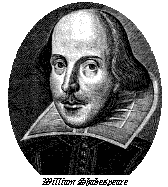
1564-1616
The Tempest
Misery acquaints a man with strange bedfellows.
He that dies pays all debts.
Two Gentlemen of Verona
And if it please you, so; if not, why, so.
That man that hath a tongue, I say, is no man,
O heaven! were man The Merry Wives of Windsor
If there be no great love in the beginning, yet heaven may decrease it upon better acquaintance,
Thou art the Mars of malcontents.
Why, then the world 's mine oyster, Measure for Measure
Some rise by sin, and some by virtue fall.
Condemn the fault, and not the actor of it?
Why, all the souls that were, were forfeit once;
O, it is excellent
But man, proud man,
The miserable have no other medicine,
Virtue is bold, and goodness never fearful.
They say, best men are moulded out of faults, The Comedy of Errors
Every why hath a wherefore Much Ado About Nothing
He wears his faith but as the fashion of his hat.
What, my dear Lady Disdain! are you yet living?
Silence is the perfectest herald of joy: I were but little happy, if I could say how much.
Every one can master a grief but he that has it.
When the age is in the wit is out. A Midsummer Night's Dream
Love looks not with the eyes, but with the mind;
I know a bank where the wild thyme blows,
A lion among ladies is a most dreadful thing.
Lord, what fools these mortals be! The Merchant of Venice
I hold the world but as the world, Gratiano,--
The devil can cite Scripture for his purpose.
It is a wise father that knows his own child.
Must I hold a candle to my shames?
But love is blind, and lovers cannot see
He is well paid that is well satisfied.
The man that hath no music in himself,
This night methinks is but the daylight sick. As You Like It
Beauty provoketh thieves sooner than gold.
All the world 's a stage,
Neither rhyme nor reason
I had rather have a fool to make me merry than experience to make me sad.
"So so" is good, very good, very excellent good; and yet it is not; it is but so so.
No sooner met but they looked; no sooner looked but they loved; no sooner loved but they sighed;
I will kill thee a hundred and fifty ways. The Taming of the Shrew
No profit grows where is no pleasure ta'en; All's Well that Ends Well
Our remedies oft in ourselves do lie,
From lowest place when virtuous things proceed,
No legacy is so rich as honesty.
Whose words all ears took captive.
All impediments in fancy's course
Twelfth Night
If music be the food of love, play on;
Is it a world to hide virtues in?
Journeys end in lovers meeting,
An you had any eye behind you, you might see more detraction at your heels than fortunes before you.
Some are born great, some achieve greatness, and some have greatness thrust upon 'em.
Love sought is good, but given unsought is better.
If this were played upon a stage now, I could condemn it as an improbable fiction.
What, man! defy the Devil: consider, he is an enemy to mankind.
For the rain it raineth every day. The Winter's Tale
What 's gone and what 's past help
When you do dance, I wish you King John
I will instruct my sorrows to be proud;
Life is as tedious as a twice-told tale
And oftentimes excusing of a fault King Richard II
Truth hath a quiet breast.
The ripest fruit first falls.
And nothing can we call our own but death King Henry IV, part I
By heaven, methinks it were an easy leap
King Henry IV, part II
Past and to come seems best; things present worst.
Let the end try the man.
Thus we play the fools with the time, and the spirits of the wise sit in the clouds and mock us.
O sleep, O gentle sleep,
We have heard the chimes at midnight.
I may justly say, with the hook-nosed fellow of Rome, "I came, saw, and overcame."
Commit King Henry V
Base is the slave that pays.
O for a Muse of fire, that would ascend
Self-love, my liege, is not so vile a sin
Once more unto the breach, dear friends, once more,
You may as well say, that 's a valiant flea that dare eat his breakfast on the lip of a lion.
There is some soul of goodness in things evil,
There is occasions and causes why and wherefore in all things. King Henry VI, part I
Delays have dangerous ends. King Henry VI, part II
Could I come near your beauty with my nails,
Smooth runs the water where the brook is deep.
King Henry VI, part III
Suspicion always haunts the guilty mind; King Richard III
The world is grown so bad, True hope is swift, and flies with swallow's wings;
My conscience hath a thousand several tongues, King Henry VIII
Heat not a furnace for your foe so hot
'T is better to be lowly born,
Men's evil manners live in brass; their virtues
'T is a cruelty Troilus and Cressida
All lovers swear more performance than they are able, and yet reserve an ability that they never perform; vowing more than the perfection of ten, and discharging less than the tenth part of one.
And like a dew-drop from the lion's mane,
The end crowns all, Titus Andronicus
The eagle suffers little birds to sing. Romeo and Juliet
He that is strucken blind cannot forget
One fire burns out another's burning,
True, I talk of dreams,
It seems she hangs upon the cheek of night
He jests at scars that never felt a wound.
See, how she leans her cheek upon her hand!
O Romeo, Romeo! wherefore art thou Romeo?
What 's in a name? That which we call a rose
At lovers' perjuries,
A gentleman, nurse, that loves to hear himself talk, and will speak more in a minute than he will stand to in a month.
Too swift arrives as tardy as too slow.
A word and a blow.
A plague o' both your houses!
Rom. Courage, man; the hurt cannot be much.
Adversity's sweet milk, philosophy.
Ap. My poverty, but not my will, consents.
Eyes, look your last! Timon of Athens
Nothing emboldens sin so much as mercy.
We have seen better days.
I 'll example you with thievery: Julius Caesar
The live-long day.
Beware the ides of March.
Why, man, he doth bestride the narrow world
Let me have men about me that are fat,
He reads much;
'T is a common proof,
But when I tell him he hates flatterers,
Cowards die many times before their deaths;
Et tu, Brute!
How many ages hence
Cry "Havoc," and let slip the dogs of war.
Not that I loved Cæsar less, but that I loved Rome more.
Friends, Romans, countrymen, lend me your ears; Macbeth
Fair is foul, and foul is fair.
And oftentimes, to win us to our harm,
Letting "I dare not" wait upon "I would,"
Memory, the warder of the brain.
The attempt and not the deed
I had most need of blessing, and "Amen"
When our actions do not,
What, all my pretty chickens and their dam
I bear a charmed life.
If with his tongue he cannot win a woman.
But constant, he were perfect.
when we are married and have more occasion to know one another: I hope, upon familiarity will grow more contempt.
Which I with sword will open.
And He that might the vantage best have took
Found out the remedy. How would you be,
If He, which is the top of judgment, should
But judge you as you are?
To have a giant's strength; but it is tyrannous
To use it like a giant.
Drest in a little brief authority,
Most ignorant of what he 's most assured,
His glassy essence, like an angry ape,
Plays such fantastic tricks before high heaven
As make the angels weep.
But only hope.
And, for the most, become much more the better
For being a little bad.
And therefore is winged Cupid painted blind.
Where oxlips and the nodding violet grows,
Quite over-canopied with luscious woodbine,
With sweet musk-roses and with eglantine.
A stage, where every man must play a part;
And mine a sad one.
The pretty follies that themselves commit.
Nor is not moved with concord of sweet sounds,
Is fit for treasons, stratagems, and spoils;
The motions of his spirit are dull as night,
And his affections dark as Erebus.
Let no such man be trusted.
And all the men and women merely players.
They have their exits and their entrances;
And one man in his time plays many parts,
His acts being seven ages. At first the infant,
Mewling and puking in the nurse's arms.
And then the whining school-boy, with his satchel
And shining morning face, creeping like snail
Unwillingly to school. And then the lover,
Sighing like furnace, with a woful ballad
Made to his mistress' eyebrow. Then a soldier,
Full of strange oaths and bearded like the pard;
Jealous in honour, sudden and quick in quarrel,
Seeking the bubble reputation
Even in the cannon's mouth. And then the justice,
In fair round belly with good capon lined,
With eyes severe and beard of formal cut,
Full of wise saws and modern instances;
And so he plays his part. The sixth age shifts
Into the lean and slipper'd pantaloon,
With spectacles on nose and pouch on side;
His youthful hose, well saved, a world too wide
For his shrunk shank; and his big manly voice,
Turning again toward childish treble, pipes
And whistles in his sound. Last scene of all,
That ends this strange eventful history,
Is second childishness and mere oblivion,
Sans teeth, sans eyes, sans taste, sans everything.
no sooner sighed but they asked one another the reason; no sooner knew the reason but they sought the remedy.
In brief, sir, study what you most affect.
Which we ascribe to Heaven.
The place is dignified by the doer's deed.
Are motives of more fancy.
Give me excess of it, that, surfeiting,
The appetite may sicken, and so die.
That strain again! it had a dying fall:
O, it came o'er my ear like the sweet sound
That breathes upon a bank of violets,
Stealing and giving odour!
Every wise man's son doth know.
Should be past grief.
A wave o' the sea, that you might ever do
Nothing but that.
For grief is proud, and makes his owner stoop.
Vexing the dull ear of a drowsy man.
Doth make the fault the worse by the excuse.
And that small model of the barren earth
Which serves as paste and cover to our bones.
For God's sake, let us sit upon the ground
And tell sad stories of the death of kings.
To pluck bright honour from the pale-faced moon,
Or dive into the bottom of the deep,
Where fathom-line could never touch the ground,
And pluck up drowned honour by the locks.
Nature's soft nurse! how have I frighted thee,
That thou no more wilt weigh my eyelids down
And steep my senses in forgetfulness?
The oldest sins the newest kind of ways.
The brightest heaven of invention!
As self-neglecting.
Or close the wall up with our English dead!
In peace there 's nothing so becomes a man
As modest stillness and humility;
But when the blast of war blows in our ears,
Then imitate the action of the tiger:
Stiffen the sinews, summon up the blood.
Would men observingly distil it out.
I 'd set my ten commandments in your face.
The thief doth fear each bush an officer.
That wrens make prey where eagles dare not perch.
Kings it makes gods, and meaner creatures kings.
And every tongue brings in a several tale,
And every tale condemns me for a villain.
That it do singe yourself.
And range with humble livers in content,
Than to be perked up in a glistering grief,
And wear a golden sorrow.
We write in water.
To load a falling man.
Be shook to air.
And that old common arbitrator, Time,
Will one day end it.
The precious treasure of his eyesight lost.
One pain is lessen'd by another's anguish.
Which are the children of an idle brain,
Begot of nothing but vain fantasy.
Like a rich jewel in an Ethiope's ear.
But, soft! what light through yonder window breaks?
It is the east, and Juliet is the sun.
O that I were a glove upon that hand,
That I might touch that cheek!
By any other name would smell as sweet.
They say, Jove laughs.
Mer. No, 't is not so deep as a well, nor so wide as a church-door; but 't is enough, 't will serve.
Rom. I pay thy poverty, and not thy will.
Arms, take your last embrace!
The sun 's a thief, and with his great attraction
Robs the vast sea; the moon 's an arrant thief,
And her pale fire she snatches from the sun;
The sea 's a thief, whose liquid surge resolves
The moon into salt tears; the earth 's a thief,
That feeds and breeds by a composture stolen
From general excrement: each thing 's a thief.
Like a Colossus, and we petty men
Walk under his huge legs and peep about
To find ourselves dishonourable graves.
Men at some time are masters of their fates:
The fault, dear Brutus, is not in our stars,
But in ourselves, that we are underlings.
Sleek-headed men, and such as sleep o' nights:
Yond Cassius has a lean and hungry look;
He thinks too much: such men are dangerous.
He is a great observer, and he looks
Quite through the deeds of men.
That lowliness is young ambition's ladder,
Whereto the climber-upward turns his face;
But when he once attains the upmost round,
He then unto the ladder turns his back,
Looks in the clouds, scorning the base degrees
By which he did ascend.
He says he does, being then most flattered.
The valiant never taste of death but once.
Of all the wonders that I yet have heard,
It seems to me most strange that men should fear;
Seeing that death, a necessary end,
Will come when it will come.
Shall this our lofty scene be acted over
In states unborn and accents yet unknown!
I come to bury Cæsar, not to praise him.
The evil that men do lives after them;
The good is oft interred with their bones.
The instruments of darkness tell us truths,
Win us with honest trifles, to betray 's
In deepest consequence.
Like the poor cat i' the adage.
Confounds us.
Stuck in my throat.
Our fears do make us traitors.
At one fell swoop?