 |
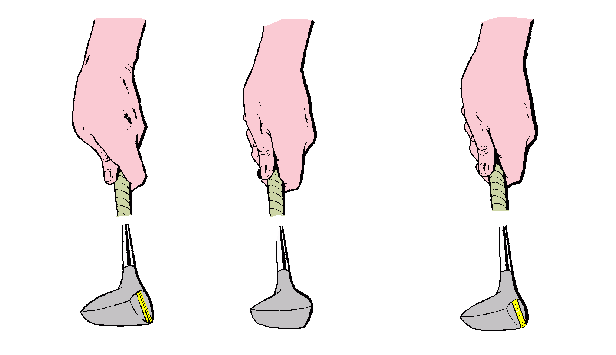
Left is a bad grip with the left hand turned too far to
the golfer's right, at impact it produces a closed clubface (centre). Right shows the proper left
hand grip which results in a square impact. |
Home >> The Hands
The moment anyone picks up a golf club for the first time to attempt to play golf, they have taken the first step to create or build a golf swing. There can be no doubt that the first foundation of a swing is the correct grip - get this right and the rest follows in sequence.
A golf shot is measured by two standards. One is direction, the other is distance. Direction is governed partly by the position of the club face at impact and partly by the path the club head follows. The position of the club face is largely determined by the grip. The grip, to a large degree, decides if the face is square, open or closed on the direction line resulting in a straight, sliced or hooked flight. The following grip descriptions are for a right handed player.
|
Left is a bad grip with the left hand turned too far to
the golfer's right, at impact it produces a closed clubface (centre). Right shows the proper left
hand grip which results in a square impact. |
Many leading golfers today use the overlapping Vardon Grip which allows both hands to work in unison.
To the beginner this grip will feel strange and awkward as any new action does for a while but with practice the grip will be automatic and will co-ordinate the essential factors of left-hand control and right-hand power.
|
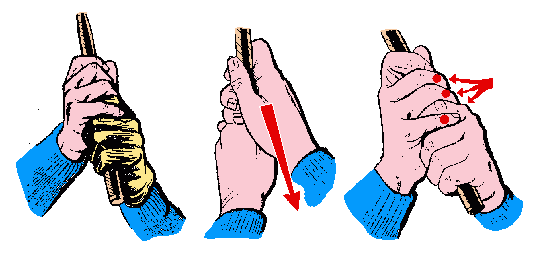
Showing the two knuckles, the 'V' pointing to the right shoulder and the pressure points and fingers. |
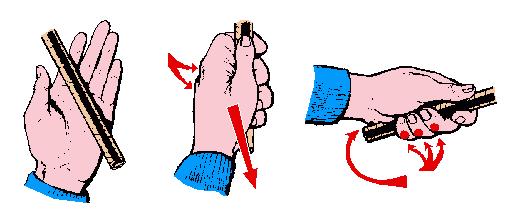
To hold the club properly, let the shaft lie where the fingers join the palm of the left hand. Fold the left hand over the club placing the left thumb just to the right of the top centre of the shaft. All fingers of the left hand are around the shaft with the last three fingers closed snugly to the grip. The pressure is applied between these three fingers and the heel of the hand. To check the left-hand grip, ensure that as you address the ball and look down at your hand, you can see the two knuckles, those at the base of the index finger and the big finger. The V of the thumb and forefinger will point to the right shoulder. The back of the hand will point in the direction of the target.
|
The three pressure fingers of the right hand, the 'V' pointing to the right shoulder |
Holding the club with the correct left hand grip, the right little finger goes over the forefinger of your left hand, or curls around the exposed knuckle of the left forefinger - depending on the size or shape of your hands. Fold or wrap the right hand over the shaft so that the third finger fits against the index finger of the left hand. The palm of the right comes up and faces directly to the target. The right thumb will be placed just to the left of the top centre of the shaft.
The right hand is a finger grip and the pressure on the shaft should be felt at the very base or root of the second and third fingers. The V of the right thumb and forefinger also points to the right shoulder.
The hands should then be fitted compactly together and work as one unit. Should some players find they have a tendency to relax the left hand a worthwhile tip is to pull the right hand further up the left hand thereby strengthening the grip.
Nobody can have a fine hand action without a grip suited to his shape of hands.
Golf is a two-handed game. The left hand guides the club and keeps the face in the desired position for impact, and the power is supplied by the coupling of the right hand and the club. They must work together to maintain full and tight contact throughout all stages of the swing.
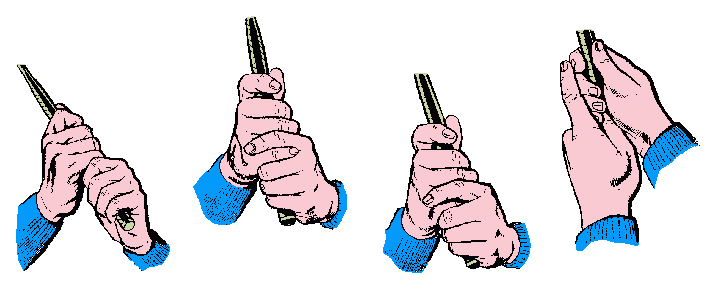
There are exceptions to the general preference for the Vardon grip, for example Bob Rosburg of the US used a Baseball Grip with all ten fingers on the shaft. Another is the Interlocking Grip in which the index finger of the left hand engages up between the two small fingers of the right hand. The Reverse Overlap Grip has all fingers of the right hand around the shaft with the left hand index finger over the small finger of the right hand or alternatively this same finger laying along all the fingers of the right hand.
|
|||
Baseball grip |
Interlocking grip | The reverse overlap grip |
|
| No fingers interlock or overlap | Left index finger and right small finger interlocked | 1) All the right hand fingers are on the shaft with the left index finger overlapping | or 2) The left index finger laying on top of the right hand fingers and parallel with the club shaft |
Two variations of grips, the interlocking and reverse overlap, have been successfully used by some golfers. The interlocking grip has often been recommended for players with small hands. Exceptions to standard technique, which are used by proficient golfers who can get away with these variations because of considerable practice and play, are usually confusing to the average player.
Most professionals recommend that the grip should be firm but light enough so there is no tightening or tenseness in the forearm muscles. Bearing this in mind, golf pupils have a tendency to take too light a grip. The loose grip leads to faults - opening the hands at the top of the swing, collapsing the left wrist overswinging, etc. As the pressure fingers of the left hand, the last three, must be in contact with the club throughout the swing - grip them tightly. The punch into the shot is controlled by the first three fingers of the right hand, but when you analyse the grips of top golfers they only grip tightly with these fingers on their downswing - whereas at address and during the backswing the pressure fingers of the right hand are the last three.
One long hitting golfer maintains that his distance off the tee is controlled by his right forefinger and thumb. When he has the sensation of delivering a strong punch with these fingers he gets great distance with the shot.