
Chapter 1 Introduction
Since the first demonstration in 1960 [1.1], lasers have been applied to fields ranging from the most sophisticated research to everyday consumer products. Highly intensive and coherent, these light sources play indispensable roles in many applications. However, the spectral coverage of lasers currently available is incomplete, not to mention the emission range of a single one. Even in the accessible spectral regions, many bands are attainable only with very intricate and exorbitant laser systems.
To overcome this deficiency, frequency conversions are implemented with the nonlinearity in materials to generate widely tunable, coherent radiation at other frequencies. This technique, a major branch of nonlinear optics (NLO), dates back to when the laser was invented. These phenomena are nonlinear in the sense that they occur when the response of a material to an applied optical field depends nonlinearly upon the strength of the field. Among the various types of nonlinear behavior, second-order nonlinearity is the most useful in frequency conversion. Nearly all of the fundamental concepts of NLO frequency conversion had been worked out by 1970. In 1962, Armstrong, Bloembergen, et al. published the basic theory behind NLO frequency conversion [1.3]. The first experimental demonstration is often taken to be the observation of second-harmonic generation (SHG) in the quartz crystal by Franken et al. in 1961 [1.3]. Shortly afterwards, Giordmaine and Miller constructed the first tunable optical parametric oscillator (OPO) [1.4]. The light generated from the NLO frequency conversion, especially from OPO, is very much like that of a laser. It is highly monochromatic, coherent and with a nearly Gaussian beam profile. However, the most significant difference from a laser is that wide-band tuning of the generated radiation is possible in these nonlinear interactions. Reviews on the early works can be found in [1.5] and [1.6].
Despite of the versatility of NLO frequency conversion, the development was notably slowed down during the next twenty years until the early 90's. The retardation can be attributed to the limited sorts of suitable nonlinear crystals and to the demand of high pumping power. In the early 90's, because of the rapid progress in pico-second and femto-second solid-state lasers and the improvement of nonlinear optical materials, the rate of advancement in the construction of traveling-wave and synchronously pumped optical parametric amplifiers (OPA's) as well as optical parametric oscillators (OPO's) had increased significantly. The newly developed crystals like BBO and LBO also extend the spectral coverage and provide good properties for the ultra-short pulse operation.
However, even successfully demonstrated, most of the systems described above are restricted to advanced laboratories. Tremendous efforts are required to setup and maintain these systems. There are in general two basic reasons that hamper the prevalence of NLO frequency conversion. The first is that very high pumping intensities are commonly required to attain high efficiency in the traveling-wave configuration or to drive the resonator merely above the threshold. The other reason is that these systems are very sensitive which makes alignments and tuning difficult. In addition to the problems encountered in the stabilization of cavities, most of the difficulties come from the nature of the nonlinear crystal. Note that phase-matching, which will be explained in more detail later, is necessary for NLO frequency conversion. Traditionally, the birefringence of the nonlinear crystal is utilized to satisfy this requirement. The critical phase-matching, which results in the propagation of interacting waves in the non-principle directions of the crystal, is usually required due to the intrinsic property of the nonlinear crystal. In this situation, a complex cavity configuration is often required for OPO and walk-off can be a limiting problem in all kinds of design. Narrow angular acceptance, which makes alignment more difficult, is another disadvantage of critical phase-matching. Furthermore, the largest nonlinear coefficient of the crystal may not be accessible because of the phase-matching requirement. The reluctant choice of smaller nonlinear coefficient must be compensated by higher pumping power in order to reach the same efficiency. Finally, only part of the transparent region could be utilized by the traditional birefringent-phase-matching. Therefore, in view of the drawbacks mentioned above, the bottleneck of the NLO frequency conversion mainly originates from the material.
One clever solution to these problems caused by the inherent properties of the nonlinear crystal is the quasi-phase-matching (QPM) technique. Proposed as early as in 1962 by Bloembergen [1.2], it took almost thirty years to successfully realize this concept [1.7]. In the QPM technique, the nonlinearity of the crystal is periodically modulated to compensate the phase difference among the interacting waves. By applying this technique, the phase-matching condition can be satisfied by choosing an appropriate modulation period without resorting to critical birefringent-phase-matching and the problems of walk-off and narrow angular bandwidth can be eliminated. Also with the QPM technique, the largest nonlinear coefficient of the crystal can always be accessible and the full transparent region can be utilized.
However, the modulation period is in the micro-meter order and is difficult to fabricate before the 90's. It had been reported in 1976 that by stacking 12 GaAs plates, each with 97um thickness, the second-harmonic of 10.6um CO2 laser can be generated [1.8]. However, it is almost impossible to fabricate devices by the same method for the NLO frequency conversion of shorter wavelengths because at least thousands of plates as thin as a few micro-meters have to be stacked precisely and without imposing large scattering losses at the boundaries. In the past decade, many techniques such as chemical diffusion and electrical poling are developed to fabricate QPM devices. Most of the techniques are favored by the advances of micro fabrication in the electronics industry. So far, guided-wave and bulk type devices are successfully manufactured and NLO frequency conversion in the traveling-wave and oscillator configurations are demonstrated with superb characteristics. Although interactions such as SHG, difference-frequency generation (DFG), OPA, and OPO have been demonstrated by both birefringent-phase-matching and QPM technique, there are many novel features that are unique to quasi-phase-matching. The most intriguing characteristic of QPM is its totally artificial nature, which is highly engineerable. The search of new nonlinear materials is now transformed to the design of lithography patterns. By the QPM technique, second-order nonlinear effects could be manipulated with incredible facility that is not possible ever before.
1.1 Basics of Quasi-Phase-Matching
In this section, the basic concepts of second-order nonlinearity and quasi-phase-matching (QPM) will be explained concisely.
Nonlinear optics, in its general definition, is the study of phenomena that occur as a consequence of the modification of the optical properties of a material system by the presence of light [1.9]. Typically, only laser light is sufficiently intense to modify these properties. For its specific definition in NLO frequency conversion, nonlinearity means that the polarization of a material system induced by the applied optical field responds nonlinearly to this field, in terms of classical terminology. "Second-order" means that the response is quadratic. The polarization can be explicitly written as :
 (1.1)
(1.1)
where
 is the polarization and
  is the optical field. The second term on
the right-hand side is the induced nonlinear polarization. Since second-order nonlinear
effects are three-photon processes from a quantum mechanical point of view, three
frequencies, not necessarily all different, should be involved.
is the optical field. The second term on
the right-hand side is the induced nonlinear polarization. Since second-order nonlinear
effects are three-photon processes from a quantum mechanical point of view, three
frequencies, not necessarily all different, should be involved.
To simplify the treatment, the periodically modulated nonlinear coefficient in the QPM structure is expanded by Fourier series [1.10]:
 (1.2)
(1.2)
where
 is the effective nonlinear coefficient of
the same process in single-domain bulk material and
is the effective nonlinear coefficient of
the same process in single-domain bulk material and  is the grating vector of the m-th Fourier component.
In the phasor notation,
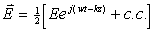 , the coupled equations describing the
interacting waves become:
, the coupled equations describing the
interacting waves become:
 (1.3.a)
 (1.3.b)
 (1.3.c)
where
and
 is the wave vector,
  is the refractive index, and subscripts
p, s, and i represent the pump, signal, and idler waves, respectively,
in the order of descending frequency. Also,
is the refractive index, and subscripts
p, s, and i represent the pump, signal, and idler waves, respectively,
in the order of descending frequency. Also,  . In
deriving these equations, the plane-wave approximation is made.
. In
deriving these equations, the plane-wave approximation is made.
Now, consider a simple case: the idler wave is generated by the DFG process where the pump and the signal waves are not depleted. The intensity of the generated idler wave after a length
 of interaction can be derived by
integrating (1.3.b). The result is:
of interaction can be derived by
integrating (1.3.b). The result is:
 (1.4)
(1.4)
where
 is the free space impedance. Despite of
the coefficients, the intensity is determined by the sinh function. It is well known that
this function peaks when the argument is zero and rapidly decreases as the argument
deviates from zero. Therefore, in order to generate the idler wave with the highest
efficiency, it is necessary that
is the free space impedance. Despite of
the coefficients, the intensity is determined by the sinh function. It is well known that
this function peaks when the argument is zero and rapidly decreases as the argument
deviates from zero. Therefore, in order to generate the idler wave with the highest
efficiency, it is necessary that  equals
zero.
equals
zero.
Next, the requirement of having
zero will be sought. By simple manipulations we have:
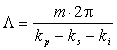
Assume that the nonlinear coefficient is modulated by periodic sign reversal. Then, the Fourier coefficient is:

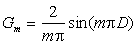
where
 is the duty cycle of the grating, defined
by the length of a reversed domain divided by the period
is the duty cycle of the grating, defined
by the length of a reversed domain divided by the period  of the modulation.
From (1.5) and (1.6), it can be seen that to simultaneously have the largest effective nonlinear coefficient (defined by
 ) and
) and  , the choice of (
 ,
, ) is (1,
0.5). That is, the QPM period, , should be
first-order, and the duty cycle, , should be
50%, in order to achieve the optimal frequency conversion.
) is (1,
0.5). That is, the QPM period, , should be
first-order, and the duty cycle, , should be
50%, in order to achieve the optimal frequency conversion.
In the birefringent-phase-matching, there is no periodic modulation of the nonlinear coefficient, or, in other words,
 .
Therefore,
.
Therefore,  is zero in this case. If high efficiency
is to be achieved, proper adjustments of
is zero in this case. If high efficiency
is to be achieved, proper adjustments of  ,
,  , and
, and  are required to have
  . Birefringence is utilized by this method
for this purpose. However, the refractive indices of the three wave are not independently
adjustable, consequently imposing extra constrains on this kind of phase-matching. On the
contrary, in QPM, the existence of provides
numerous possibilities to make . For
example, many sets of frequencies can be phase-matched in the same crystal.
. Birefringence is utilized by this method
for this purpose. However, the refractive indices of the three wave are not independently
adjustable, consequently imposing extra constrains on this kind of phase-matching. On the
contrary, in QPM, the existence of provides
numerous possibilities to make . For
example, many sets of frequencies can be phase-matched in the same crystal.
The requirement of phase-matching in NLO frequency conversion can be understood as follows. Take the DFG process discussed above as an example. Suppose that the idler wave has already existed, no matter how weak it is. The generation of more power in this wave is attributed to the nonlinear polarization induced by the other waves. For efficient amplification, the temporal and spatial variations of the nonlinear polarization (source) should be in phase with the idler wave. As a consequence,
and  follows immediately. There is no conceptual difference between NLO frequency
conversion and swinging a cradle.
follows immediately. There is no conceptual difference between NLO frequency
conversion and swinging a cradle.
1.2 Overview of this Thesis
In this thesis, an attempt has been made to study QPM second-order nonlinear effects in three aspects: numerical modeling, device fabrication, and optical experiment.
The numerical modeling is studied from chapter 2 to chapter 4. The beam-propagation method (BPM) has been extended to simulate QPM second-order nonlinear effects, especially in waveguides, by many authors. Although many schemes have been developed, the finite-difference (FD) method is most prevailing. Therefore, the study is confined exclusively to this category of method. However, as will be explained in later chapters, the results drawn from this study should also be valuable for other schemes. In chapter 2, the published methods, EFD-BPM and SS-BPM, together with the methods proposed in this thesis, IFD-BPM and ISS-BPM, will be explicitly expressed and discussed. Comparisons of these methods are left in chapter 3 where a QPM-DFG in AlGaAs and a QPM-SHG in LiNbO3 are simulated by each method to evaluate characteristics such as accuracy, stability, convergence, and efficiency. The results will show the superiority of the proposed IFD-BPM and ISS-BPM. The choice between these two methods in practical simulations will also be addressed. In chapter 4, IFD-BPM is used exclusively to explore some specific cases including bulk-type interactions in LiNbO3 and SHG with propagation loss. The influence of system parameters like QPM period mismatch, duty cycle variation and various initial conditions on the performance of QPM devices will also be studied
In chapter 5, the fabrication of spikelike domain structures in LiNbO3 by one-direction-heated proton-exchange (PE) is described in detail. The whole process is setup for the first time in the Semiconductor Laser Optics Laboratory. In addition to spikelike domains, some intriguing domain structures are also observed. Possible forming mechanisms will be discussed, which might indicate new research directions.
Next, preliminary works for the QPM-DFG are presented in chapter 6. These experiments are designed to generate mid-IR radiation in the traveling-wave configuration. Tuning curves and various bandwidths are figured out in this chapter. It is shown that by angle-tuning, coherent emission in the 3
 ~4.5
~4.5 range is possible when a 1064nm laser and
a tunable laser emitting in the vicinity of 808nm are used. A Nd:YVO4
solid-state laser will be end-pumped by a 808nm diode laser to generate the 1064nm
radiation needed by these DFG experiments. Also will be shown in this chapter is the
manufacturing of a temperature-controllable crystal mount and its driving circuit.
range is possible when a 1064nm laser and
a tunable laser emitting in the vicinity of 808nm are used. A Nd:YVO4
solid-state laser will be end-pumped by a 808nm diode laser to generate the 1064nm
radiation needed by these DFG experiments. Also will be shown in this chapter is the
manufacturing of a temperature-controllable crystal mount and its driving circuit.
Finally, some conclusions of this thesis will be given in chapter 7.
[1.1] T. H. Maiman, "Stimulated Optical Raadiation in Ruby", Nature, vol. 187, pp. 493,1960
[1.2] J. A. Armstrong, N. Blombergen, J. Ducuing,
and P. S. Pershan, "Interaction between light waves in a nonlinear
dielectric", Phys. Rev.,
vols. 127, pp. 1918-1939, 1962
[1.3] P. A. Franken, A. E. Hill, C. W. Peters,
and G. Weinreich, "Generation of optical harmonics", Phys. Rev. Letters,
vol. 7, pp. 118, 1961
[1.4] J. A. Giordmaine and R. C. Miller,
"Tunable coherent parametric oscillation in LiNbO3 at optical
frequency", Phys.
Rev. Letters, vol. 6, pp. 169, 1965
[1.5] S. E. Harris, "Tunable Optical Parametric Oscillators", Proc. IEEE, vol 57, pp. 2096-2113, 1969
[1.6] R. Fischer and L. A. Kulevskii,
"Optical parametric oscillators", Sov. J. Quantum Electron., vol. 7, pp.
135-159,
1977
[1.7] E. J. Lim, M. M. Fejer, and R. L. Byer,
"Second harmonic generation of green light in periodically poled planar
lithium niobate waveguide",
Electron. lett., vol. 25, pp. 174-175, 1989
[1.8] D. E. Thompson, J. D. McMullen, and D. B.
Anderson, "Second-harmonic generation in GaAs "stack of plate" using
high power CO2 laser
radiation", Appl. Phys. Lett., vol. 29, pp. 113-115, 1976
[1.9] R. W. Boyd, “Nonlinear Optics”, San Diego: Academic Press, 1992.
[1.10] E. Myers, R. C. Eckardt, M. M. Fejer, and
R. L. Byer, “Quasi-phase-matched optical parametric oscillations in
bulk periodically poled LiNbO3”,
J. Opt. Soc. Am. B, vol. 12, pp. 2102-2116, 1995.
[ Return ]