Main Battle Tank:
Challenger 2
The hull and automotive parts of the Challenger 2
are based upon its predecessor Challenger 1, but Challenger 2 incorporates
over 150 improvements aimed at increasing reliability and maintainability.
The turret of Challenger 2 is a totally new design. Armour is an uprated
version of Challenger 1's Chobham armour.
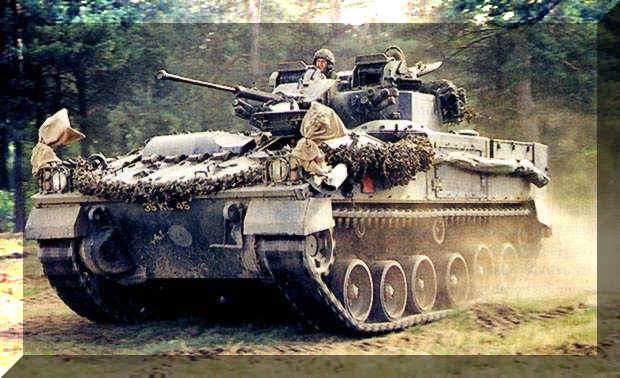
Warrior
Warrior is an armoured combat
vehicle. It is NBC proof, and a full range of night vision equipment is
included as standard. Warrior is part of a family of seven variants which
include a Milan carrier, a mechanised recovery vehicle, an engineer combat
version and an artillery command vehicle. Warrior has excellent cross
country mobility and is armed with a 30 mm Rarden cannon. Used by armoured
infantry battalions, Royal Artillery and Royal Electrical and Mechanical
Engineers.

Scimitar
Scimitar is a CVR(T) vehicle
(Combat Vehicle Reconnaissance Tracked) with a primary role to gather
information. Used by medium reconnaissance Regiments and armoured infantry
units for reconnaissance, the vehicle is fitted with a Rarden 30mm cannon
for self defence.
Striker
Striker is a CVR(T) vehicle with a primary role
to destroy enemy armour. Striker carries 10 Swingfire anti-tank missiles
with a range of up to 4000 metres. Five of these missiles are carried in
bins on top of the vehicle, however these need to be reloaded from outside
the vehicle.
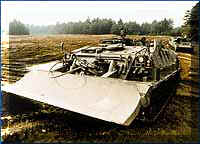
Challenger ARRV (Armoured
Repair and Recovery Vehicle)
In service with the British Army
since the early 90's, the ARRV has a crew of 3 plus additional separate
compartment space for another 2 REME fitters. Fitted with 2 winches plus
an Atlas crane capable of lifting, a complete Challenger 2 power pack.
Front dozer blade can be used as a stabiliser blade for the crane or as a
simple earth anchor.
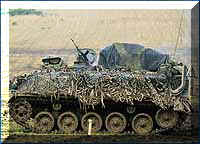
FV 430 Series
First introduced in 1962 the FV
430 series of vehicles has developed to fulfil 14 roles including Command
Post APC, ambulance, minelayer, recovery and repair vehicle, mortar, radar
or troop carrier. NBC proof, it can carry up to 10 men and 2 crew and may
be armed with a 7.62mm machine gun or turret mounted L37 machine gun.

Combat Engineering Tractor
(CET)
The Combat Engineer Tractor (CET)
is a versatile tracked AFV that can clear obstacles, dig pits, prepare
barriers and tow other vehicles out of difficult positions. It can assist
in almost every battlefield task and has an impressive amphibious
capability. The 100m winch cable can be fired from the CET by rocket, and
using an anchor, can assist in dragging the vehicle up steep slopes and
over river banks. CET is found in close and general support Engineer
Regiments.
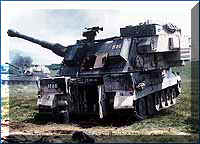
AS 90
First delivered to the British
Army in 1993, the AS90 equips 5 field regiments, replacing the Abbot and
M109. AS90 is equipped with a 155mm gun which fires the NATO L15
unassisted projectile out to a range of 24.7 kms. Fitted with autonomous
navigation and gun laying system (AGLS), AS90 can work independently of
external sighting references. Central to the system is an inertial Dynamic
Reference Unit (DRU). All main turret functions are controlled by a Turret
Control Computer (TCC). This technology allows AS90 a burst fire
capability of 3 rounds in 10 seconds
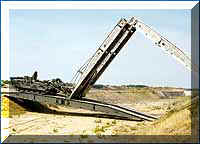
Armoured Vehicle
Launcher Bridge (AVLB)
The AVLB launches a single Close Support Bridge to cross
gaps of up to 24.5m or a combination of such bridges to cross gaps of up
to 60m. A single bridge can be laid in about 3 minutes without exposing
the crew. Once the bridge has been laid the launch vehicle can drive over
it and recover it from the far bank.
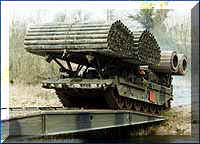
Armoured Vehicle
Royal Engineers (AVRE)
The AVRE provides intimate battlefield engineer support
to armoured battle groups. It creates mobility by being able to breach
minefields, cross gaps and clear obstacles. The crew remain protected
throughout
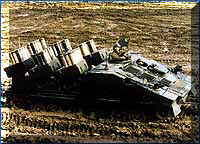
Shielder
Integrated scatterable mine launcher modules are
mounted on a STORMER chassis. SHIELDER adds a dynamic element to mine
warfare. As a defensive measure, scatterable mines may be laid to provide
a rapid response to changing tactical requirements. Offensively they may
be deployed in the likely path of enemy movement. Mines may be fired from
one or more sides of the vehicle and from the rear. The mines are self
arming anti tank mines with a programmable life.
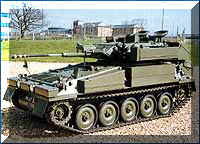
Sabre
Sabre was brought into service in 1995 using a Scorpion
chassis and the 30mm turret from CVR(W) Fox. It is almost identical to
Scimitar but has a lower profile turret. Equipped with a Rarden Canon and
Hughes chain gun, Sabre is used for close reconnaissance.
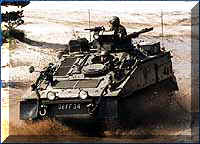
Spartan
Spartan is a derivative of the CVR(T) vehicle
(Combat Vehicle Reconnaissance tracked). Spartan is used by specialist
troops which can include Mortar Fire Control Teams, anti aircraft teams
equipped with Javelin, or as Engineer Command Vehicles.
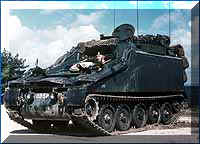
Sultan
Sultan is the Command and Control variant of the
CVR(T) family of vehicles which came into service in 1972. Light and
highly mobile, Sultan is used as a Command or Headquarters vehicle in
armoured and armoured reconnaissance formations
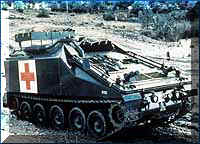
Samaritan
Samaritan is a derivative of the CVR(T) vehicle - it is
an armoured ambulance equipped with stretchers.
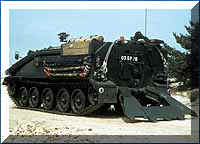
Samson
Samson is a derivative of the CVR (T) Vehicle
(Combat Vehicle Reconnaissance Tracked) - it is the Armoured Recovery
Vehicle for all the vehicles in this class.
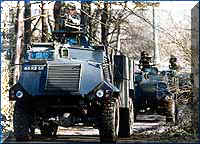
Saxon
Saxon is a wheeled Armoured Personnel Carrier used by
mechanised infantry battalions. Capable of travelling across very rough
terrain and fording 3 feet of water the vehicle has excellent battlefield
mobility. Fitted with a 7.62 millimetre machine gun.