I must be crazy. Thirteen hours
of classes, 10 different groups, over 250 students. I like connecting
with people one at a time, but I have always found dealing with audiences
stressful!
I had just three classes this past week (September 10). However, I met 96 different students. These are sophomores majoring in international trade. They get to college by their scores on a national test, through a system that feels somewhat like the testing and negotiating system for med school in the US. Many did not chose this university, and seemingly few chose the major they were put into – wanting either to be in one of the pharmacy specialties or to be English majors.
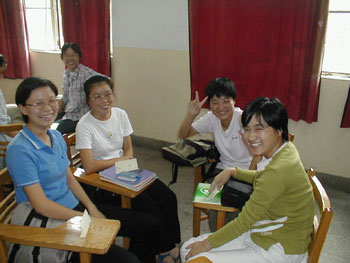
I've been studying pictures of these 96 students taken last year by Gwen Crotts, my Amity teaching partner. In what they wrote for her last year they reveal both an ignorance and hopefulness about their future. Some specified they wanted to be the “boss” in a business, others just to be a “little manager” or “office lady,” and a few boldly claim they will own their own company. Some wished to study more after college, some simply wanted to be wealthy, and many just did not know.
(left) First year English majors,
pictured in their first
class with me (Sept. 24)
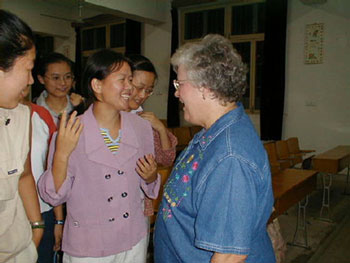
"They are eager to know English," says the newly designated head of the English Department, Ms. Zhang Lei Feng, "but it takes hard work and that discourages them. So be strict with them, not democratic like you are in the US."
Gwen Crotts, Amity teacher (right)
Zhang Lei Feng (below left), with
Lu Ping,assistant for administration
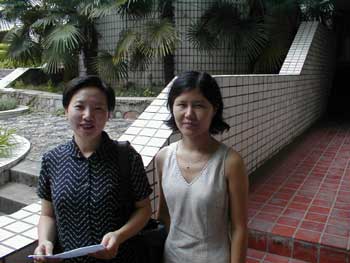
Daughter of college language teachers, Zhang Lei Feng had been encouraged in middle school to aim for a career in science. She says she failed the college entrance exam in science, changed her major to English which she had always liked, and taking the exam now in English got the top score in Hunan Province.
While studying English at Nanjing University, the traditional emphasis in foreign language teaching on grammar and vocabulary was being challengeder professors were taken by the newer emphasis in the 1980s on competence in communication. “I was both beneficiary and victim." Gaining fluency because of those methods, she did not gain accuracy and when she herself became an English teacher she said she had to struggle for it. "So," she ordered me, gently,“they need correction in their pronunciation, so give it to them."
The English Department of China Pharmaceutical University with its 29 teachers is just beginning to claim its own identity, launching a major in English just two years ago. Last year Zhang managed to secure equipment for a sophisticated computerized language learning lab for her department. Gwen Crotts and I had a tour of the labs. Computer terminals at every desk, offering the ability to work with books, drawings, computer text and images, and DVDs--well over $120,000 worth of equipment, installed, and working! If Gwen and I can catch up with these techniques, we have all this to use.“They don't know much here about what it takes to teach the liberal arts," says Zhang about getting this lab set up, “so you just have to keep working with them."
With such vision and energy swirling
around me, China promises much to be part of. That is, if I survive
dealing with 265 students. Can I for starters just learn to say their
Chinese names without generating roomfuls of laughter?

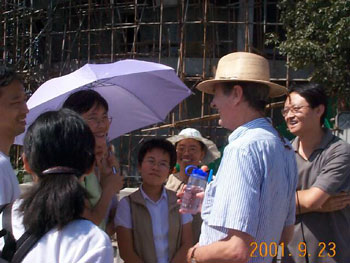
P.S. Pictured above a hike, September 29, on ZijinShan (Purple
Mountain, a huge park in Nanjing) with graduate students in pharmacology.
A view of the city and lots of good talk. An extended oral English
lesson for them, an extended opportunity for me to try to learn names and
to recognize and pronounce where they came from.