I was
introduced early in my stay in Nanjing to
Dr. Wang Shi Jun,
a friend of one of my teaching colleagues, who taught sociology at Nanjing
Normal University. 
Wang and I resonated
to common interest. Wang quizzed me over several visits through
an interpreter about how social service and social work was being done
in the United States. His recent doctorate had been based
on a study of single parents through interviews made in one of the districts
of Nanjing. He was also doing studies on the floating population
(migrant workers from the countryside), on elderly living separate from
their parents, and on urban crime. He had recently written
papers on the history of social work in China, tracing its origins to the
work of Christian missionaries.
In his
teaching Wang regularly takes students out to do field observations.
We two made a series of visits during the year to let me see for myself
the organization of social service in the city.
His spoken English was developing during the year. So when he translated
during a visit it would usually be only a sentence in English that summed
up paragraphs of animated Chinese.
Missing
in what follows
about social service in Nanjing is a context-- demographic data about
Nanjing, such as how many poor there are and where they are located and
much else that Wang knows and I could not ask him.
There is a developing literature in English both about Nanjing and about
social service in China that I have not had a chance to read.
Here you get what I have made out of my observation and the insights
from my limited conversations with Wang.
Suo Jin Cun Community Service Center


 The home for elderly seemed an even more a pleasant environment than the
place my mother had lived in until her death. Both were small, newly built
facilities. Eighty seniors would eventually live here. The rooms were
bright and the staff attentive. But here were four meals a day, not the
three my mother was served. And across a small lawn with children’s play
equipment in it was a preschool where 100 children came everyday.
In a way that I have not usually felt in the US about facilities for
the old, this seemed like a place where elderly were as treasured as the
children. This seems something special about China's culture
.
The home for elderly seemed an even more a pleasant environment than the
place my mother had lived in until her death. Both were small, newly built
facilities. Eighty seniors would eventually live here. The rooms were
bright and the staff attentive. But here were four meals a day, not the
three my mother was served. And across a small lawn with children’s play
equipment in it was a preschool where 100 children came everyday.
In a way that I have not usually felt in the US about facilities for
the old, this seemed like a place where elderly were as treasured as the
children. This seems something special about China's culture
.
 This facility for the elderly and for children is part of the Community
Service Center for Suo Jin Cun, whose main building houses upstairs a public
library, a smoky room full of small tables where older men were playing
cards, along with offices for staff and small meeting rooms.
Downstairs there is an auditorium and a large, marble-floored lobby lined
on both sides with counters above which are signs for various services,
including pension, employment, and housing,
Both afternoons when I was in the lobby it was nearly empty.
This facility for the elderly and for children is part of the Community
Service Center for Suo Jin Cun, whose main building houses upstairs a public
library, a smoky room full of small tables where older men were playing
cards, along with offices for staff and small meeting rooms.
Downstairs there is an auditorium and a large, marble-floored lobby lined
on both sides with counters above which are signs for various services,
including pension, employment, and housing,
Both afternoons when I was in the lobby it was nearly empty.
The "Community"
“Cun”
means village. This area of Nanjing
is just outside the old walls of the city, a wedge of flat land between XunWu
Lake on the west and Purple Mountain on the east, two of three major features
of Nanjing, the other being the Yangtze River that forms its northwestern
border.
 Walking with Wang Shijun the first time into the community from the major
boulevard that skirts the base of Purple Mountain, we followed a small
canal bordered by tiny, one-story, tile-roofed houses that may have been
there when this was a separate village and there were fields across the
canal. Behind and surrounding them
and forming the majority of housing in the area are 6-story apartment complexes
of grey cement built by work units in the 1980s for their workers.
The acting dean of the English department, Zhang Leifang, China Pharmaceutical
University lives in one of these, with her daughter and husband.
They were given this apartment by his work unit, a publishing company
of ancient Chinese texts where he is a senior editor.
They have now bought the apartment for a very reasonable amout.
In their building have lived other workers from the same company, professionals
along with clerks and maintenance workers.
This housing pattern has given the community its present mixture of ages
and social class.
Walking with Wang Shijun the first time into the community from the major
boulevard that skirts the base of Purple Mountain, we followed a small
canal bordered by tiny, one-story, tile-roofed houses that may have been
there when this was a separate village and there were fields across the
canal. Behind and surrounding them
and forming the majority of housing in the area are 6-story apartment complexes
of grey cement built by work units in the 1980s for their workers.
The acting dean of the English department, Zhang Leifang, China Pharmaceutical
University lives in one of these, with her daughter and husband.
They were given this apartment by his work unit, a publishing company
of ancient Chinese texts where he is a senior editor.
They have now bought the apartment for a very reasonable amout.
In their building have lived other workers from the same company, professionals
along with clerks and maintenance workers.
This housing pattern has given the community its present mixture of ages
and social class.
 Scattered among the grey blocks
of flats are growing new highrise apartment buildings, painted in pastels.
Zhang’s family hopes to buy into
one of these, their move presaging the evolving social stratification of
the area, which close to major parks and good public transportation is making
Suo Jin Cun into a community of the upwardly mobile.
Scattered among the grey blocks
of flats are growing new highrise apartment buildings, painted in pastels.
Zhang’s family hopes to buy into
one of these, their move presaging the evolving social stratification of
the area, which close to major parks and good public transportation is making
Suo Jin Cun into a community of the upwardly mobile.
New High Rise Apartments,
going up everywhere today
Function and Funding of Community Services
In another community service near the center of Nanjing we saw elegant rooms
for a child development
pre-school.
Parents, grandparents, or the ama, bring and pick up the child for a
few hours of pre-school several times a week. Parents are expected as
well to participate in parenting classes.
We saw lots of creative play devices including a large display of Leggo
blocks. This program is getting funded
by a national grant as a demonstration project, and may also be getting
funding from Leggo. This center had
a health clinic where we saw a pregnant woman receiving a consultation.
In the lobby a group of men were crowded around one of the counters,
seeking help with jobs I was told.
Both of these community service
centers remind me of one-stop social service centers I have seen at home
in Oakland, California. A difference
is the grandness of the buildings, and the relative emptiness of the lobbies.
Where were the people, the community
and the staff to serve them? It
is as if a concept has been developed but the ways of implementing it not.
Different from California also is
that these services, including the housing for the elderly and daycare for
pre-schoolers, are not something one buys into, but are what one is, or
should be, entitled to as a resident of the particular community.
Particularly striking is that the services for those early and late in
life seem to have the sense of entitlement we attach to neighborhood schools.
How are such nice facilities
and elegant programs funded?
My question triggered a lively conversation between Wang and the director
of Suo Jin Cun’s programs for the elderly.
The Suo Jin Cun sub-district has a budget for buildings and for operations,
coming from some source of funds that are its own—from taxes, I pressume.
The city also channels some money
for buildings, and there are some national funds for buildings.
But the community had to get a bank loan to complete the building for this
elderly housing. How would the community
pay this back? Helping to fund the
operating budget are fees from parents using the preschool and the elderly
residents, but the director shrugged and then finally laughed over how to
answer the question. She said she
really did not know how they would find money to pay back the loan, nor how
she would keep getting enough money to operate her programs.
This sounded familiar.
"Neighborhood Committees"
The Community Service Center
at Suo Jin Cun serves a sub-district of over 50,000 people that includes 10
neighborhood committees. What do
these “neighborhood committees” do?
Going to a different section of the city we visited the offices of a committee
for a housing complex, Pei Jia Qiao, built for families with special needs.
These persons included the floating
population (people who came to the cities from the countryside without
residence permits), single parents, and returned criminals.
Entering through a gate from Hunan Lu,
one of Nanjing’s major shopping streets (about which I wrote in an
earlier story),
we walked into a small play space full of children.
Small alleys led off in three directions, with 6 story apartment blocks
on either side. Vegetable and fruit
venders and trades people were squatting around the square, and there were
people walking and talking. A pleasant
seeming place, without the ominous feel of the “projects” at home.
We visited the neighborhood
committee office, and talked with its three staff, all men.
Two seemed to have had middle school education, and had then while on
this job taken classes in community service.
Wang already knew the third, who was the head of the committee.
He had had two years of college, was active in district level meetings
about community service, and was to go soon to Beijing to a conference
on community service. He talked
non-stop to Wang. His role in the
neighborhood seemed to be to help preserve community harmony and mobilize
community volunteers for projects that needed to be done.
Many of these seemed to be clean-up projects.
.
In place is a system of volunteers,
often retired folk, who monitored different buildings.
These persons are chiefly the ones who would come to these meetings.
I think this is a long-time pattern for social organization in Chinese
cities, established early on by the Party.
Our conversation partner’s chief concern was how more effectively to
mobilize these volunteers, rather than to "empower" them to take more initiative
in building community.
The staff would identify problems from their own inspection of the area
or from complaints from residents, and then convene a meeting to discuss
what they would do about it
. There did not seem to be the concept of a neighborhood association made
up of residents who at least in principle would set directions which staff
would help implement, the model for empowering people through neighborhood
organization that I know.
Aims of Community Service
"Building democracy from the grass roots," however, does seem to be one aim
of the government's program of community service. We visited Mr. Ma in the
offices of Nanjing's Department of Civil Affairs. Ma is trained in social
work and he and Wang knew each other from meetings and conferences. Ma spoke
of this policy with a note of conviction. "This is President Jiang ZeMin's
aim."
Central to this goal is building
up “community” as an experienced social reality that claims loyalty and
is facilitated by civic skills exercised through widespread voluntary participation
with others in mutually beneficial activities.
Shaping the need for developing community participation, at least in part,
is the intent behind the other slogan I heard many times, “moving from big
government and small society, to small government and big society." If,
for example, jobs are to be determined by mutual choice and not governmental
assignment, then many needs of people have to be met through other ways.
Some needs can be met through
the market, but others only through their participation in activities in
their communities of residence.
What are the issues for these workers in social service ?
For Ma it is making the concept of the community and
its implications for government clear to a variety of government agencies.
He must clarify roles within the city departments, he said, and clarifying
tasks for the district level offices of civil affairs. In a sense, Ma's
work is to draft regulations for the work of government offices so that community
involvement is encouraged.
The China Daily regularly publishes articles about the need for
laws—on worker safety, or judicial process, or protection of intellectual
property—and often reports someone urging the responsible body to work
harder to create these laws. In
the US it seems we have too many laws. But Ma needs more detailed laws,
it seems. China needs guidelines
on how to make intentions work so that concepts become facts.
One can get a new appreciation of the “work” of lawmaking as providing
not just a way some ideology scores over opponents, but as the way society
is able to function with some intentionality.
Redevelopment
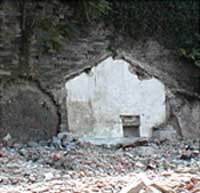
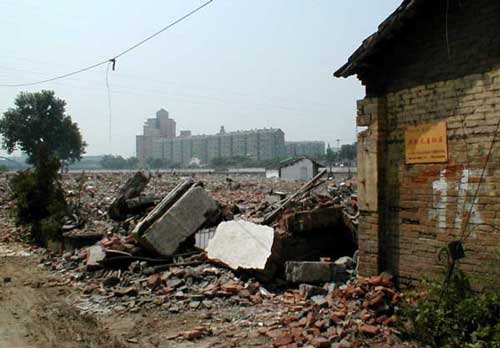 A whole community lived here a month ago by a canal.
This will be a prime site to develop with pastel highrise buildings, as
has already been done on the other side of the canal.
Where did these families go?
A whole community lived here a month ago by a canal.
This will be a prime site to develop with pastel highrise buildings, as
has already been done on the other side of the canal.
Where did these families go?
The front of the offices of the Gu Lou District government
I asked what the implication was for their work that the city itself
was displacing so many persons through its redevelopment of urban boulevards.
This triggered one of those waves of conversation with Wang that I got
just bits and pieces of. 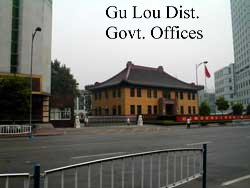
What are the issues in a district office? I did not get a clear
an answer about issues. Neither
the district's director for civil affairs nor his associate were trained
professionally in social service. They were professionals in the bureaucracy
of the district. The director
was new at this job and had not sought the assignment.
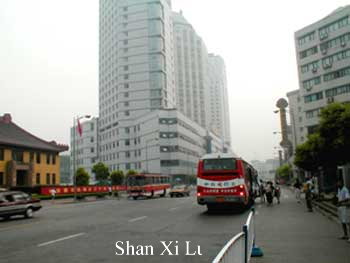
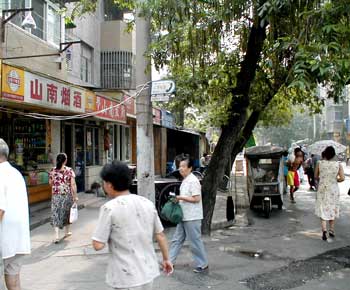
The District Government headquarters is located on a broad thoroughfare.
Five years ago it was a busy, smaller street, full of shops, like those
above right.
My question evoked no identification with those being displaced nor even
concern that the demands on the community service centers they supervised
might be unduly increased. Some
other department deals with this, I gather.
There is some help in relocation.
But many live in those places illegally, they said.
They identified with the purpose of the destruction of neighborhoods,
to attract new investment in big businesses that eventually would benefit
the people through more jobs. Just
as was done by the apologists for massive urban renewal in the past in the
US.
Social work.
The director and assistant for elderly programs
of activities at the Suo Jin Cun center.
Wang has visited with them often as he did field studies in this community
for his research and teaching. Social work is a new calling in
modern China. There are people like
Wang and Ma for whom the planning and strategizing is a stimulating challenge.
There are people like the head
of the neighborhood committee and the staff at the elderly center who seem
captured by the opportunities of their jobs to make a difference in people’s
lives.
I do not know what giving social service in urban China is really like.
The context is different, in ways
I do not yet appreciate. But there
certainly were aspects that felt familiar. The staff working with the elderly
felt like people who enjoy people.
They seemed to welcome the break in their day by our visit and urged
me to come again, but they also enjoyed their contacts with their people.
Like others I know who work at
the grass roots they were mildly, at least, in doubt that the folks higher
up in their hierarchy were as clear as might be about the importance of
seeing their work thrive.
It seemed to me that each of these are at the doorway to doing advocacy,
within the limits of their own situation, for change that will benefit the
people who need it, that calling I have always seen as central to social
service. 

The challenge faced by the neighborhood
level staff in social service is to get participation.
Sounded to me like the puzzle of the pastor of a small congregation that
wants to grow.