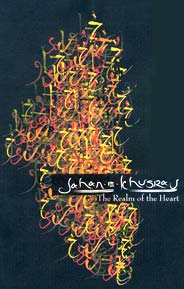
The album jacket
Originally a Turk, Amir Khusrau spoke Persian fluently and was familiar with Arabic, Hindi, and Sanskrit. From his early days, he was attracted to Persian literature, especially the poetry of the poet of Ganja, Nizami. Emulating the poetry of Nizami, he himself, over the years became one of the most celebrated Sufi poets of his day. Additionally, Amir Khusrau was a born musician. He mastered the art of Indian music at a very early age and went on to perfect it. His invention of the sitar, an instrument with three-strings, testifies to his dedication to the art.
Muzaffar Ali is the kind of person people love to hate. Most of the irk is generated by the fact that people find him snobbish, accusing him of indulging in difference for the sake of difference. Now I agree thats quite a strong accusation and I am not even faintly tainting these observations with my own colors or prejudices.
I must admit I find Muzaffar Ali cool (to say someone is "kewl" is a yuppie way of saying that "I can live with it"). To be more explicit, I find his attempt to differentiate himself from the crowd a welcome sign of his own personal ego trip (which unlike most others, I find refreshing)
He shot to fame with his grand costume drama called Umrao Jaan, starring the eternally beautiful (a more yuppie word to use would be "hot", said with a emphasis on "h" almost making it sound like "haute") Rekha. Muzaffar Ali tried his hand at politics too. Never a faint heart, he even consented to lock horns in the electoral battle against (now)Prime Minister Atal Behari Vajpayee. Naturally, he failed but that did not deter him from contesting again and again and again. A deep interest and passion for music, poetry and the fine arts is ingrained within the chap.
I am now presenting the inner jacket of the album which is quite information about Abida Parveen and even Ali too. On a more personal note, Abida Parveen symbolises female Sufism, like Ustad Nusrat Saheb rules the male roost. Abida epitomises the art of Sufi singing for someone like me (one who is not aware of all nuances, for someone who is deep into Sufi music, maybe Abida is hogwash, I dont really know and cant even guess).
(From
the inner jacket)
I have become you and you have become me, in my body is your soul, May
none say hereafter that you and me are different beings.
Divinity becomes definable with the poet-mystic Hazrat Amir Khusrau. The
poet, his poetry, his emotion, his surrender to the Almighty caolesces in
the seeminlgy simple lyrics to present a throbbing and grand celebration of
God.
Understanding Khusrau is as easy as understanding a child and as difficult
as understanding a sage. His Pir, Hazrat Nizamuddin Aulia, passed on the
Sufi tradition light from the heart to the heart and till this day the name
of Hazrat Amir Khusrau is entrenched in our cultural and spiritual history
as a poet, philosopher and mystic who has received the ultimate blessing.
His poetry has layers and layers of meaning, nuances that might apply to
people from all walks of life and from every corner of the earth. His poetry
provides the base to the thristy wanderers to rejoice and meditate on the
fundamental mystery of life. Khusrau's poetry reveals his vision of the
almighty-his love, submission and anguish, his changing forms to capture
every facet of gods omniscience - as a woman, as a supplicant, as a beloved
or even as a friend.
In his poetry, Hazrat Amir Khusrau created Sama or Divine music, music that
eased and assuaged hungry hearts and souls. He sought the truth like
soldier, restless for divine light, looking for finding rays of pure,
lilting joy. And blessed with this divine sensitivity, Khusrau's couplets
have stood the test of time to draw out our belief that this will reveal the
light, will take us to the path.
Khsurau's poetry spans from the earthy Hindi to the sophisticated Persian
imagery. He has probed into Indian Raagas and created imaginative blends
with Arabic and Iranian Usuls and Maqaams. Truly, his eyes of love, watered
by the tears of submission, are unparalled in Sufiana Kalaam - a term used
for devotional songs sung in praise of Sufi Saints. His love for the
Almighty was utterly simple and totally profound at one and the same time.
The word Sufi comes from the Arabic word "Suf" meaning pure. Sufies are
called as because their inner world is purified and enlightened by the light
of wisdom, unity and oneness. In Sufi Music, the songs of the poet-singer
invariably alternate between the moods of the lover and the saint, the
beloved.
Early in 2001, an event to commemorate Hazrat Amir Khusrau was concieved -
and the one and only Sufi mystic from South Asia Begum Abida Parveen was the
only choice to be the brigde who could make mere mortals live through the
incomparable experience of conversing with God. Thus the concert of
Jahan-e-Khusrau was born - where Begum Abida Parveen and Tunisian Sufi
singer Lofti Bouchnak.
No one can express Sufi mysticism and its depth as mellifluously as Begum
Abida Parveen. A Sindhi from Larkana, Abida started her singing career as a
little girl. Her father was a singer who encouraged young Abida to become a
disciple of Ustad Salamat Ali Khan. After the maestro's death, Abida Parveen
has taken his place as the undoubted numero uno. As the queen of Sufi
mystical singing, she's at her best with Sufiana Kalaam, be it in Hindi,
Urdu, Punjabi, Sindhi, or Saraiki.
Her inspiration is the Sufi Saint Shah Abdul Latif, an 18th Century poet and
composer who blended folk music and classical raga in a style known as Kafi.
Begum Abida Parveen primaryily sings the structured poetic Kafi as well as
the soulful ghazal genre of singing and improvisational qawwali style.
When she sings, there is a wild masti about her as she raises her hands
exutling to an (in)visible God. Her singing is an exquisite adventure into
the music, the table, the lyric melody, the improvisations, the note
arrangements passed down from older generations that hint at secrets from
the beginning of time, different from anything ever experienced.
At the festival Jahan-e-Khusrau, Begum Abida Parveen and Tunisian Sufi
Mystic singer Lofti Bouchnak share the honors to immerse themselves in pure
and pristine poetry.
Steeped in Tunisian Nuba and Oriental musical heritage Lofti Bouchnak
trained in folk, Tunisian Maluf, Andalusian and Sufi music. He has worked
and trained with leading Tunisian composers Ali Sriti, Mohamed Azzouz, Saleh
El Mehdi and Fethi Zghounda. His abiding and strongest influences have come
with his association with Arab artistes like maestros Ahmed Sidqui, Saeed
Makaoui and Heni Snouda. From the opening bars to the end, his voice soars
and pierces through the range of tenor, baritone and bass lending remarkable
authenicity and mood to his music. His collabration with Begum Abide Parveen
has brought the conventional and unexpected closer. It is said that 'One how
dies for the love of Truth, dies a Sufi.'. And Sufis never die.
(A very seedy disclaimer needs to be put out. Someone after reading this asked me how come a complete atheist is a believer of Sufism. On one hand, he's hit bulls eye, how can I like something, especially when the philosophical roots of the same lie in something I detest. On the other hand, he could be wrong, I dont believe in Sufism, I just like their music. The important point is I like Sufis, I like their music, but I have completely different opinions on Sufism. Battleground set. Sufi vs. Sufism. Match. Set and Game. Amitabh)
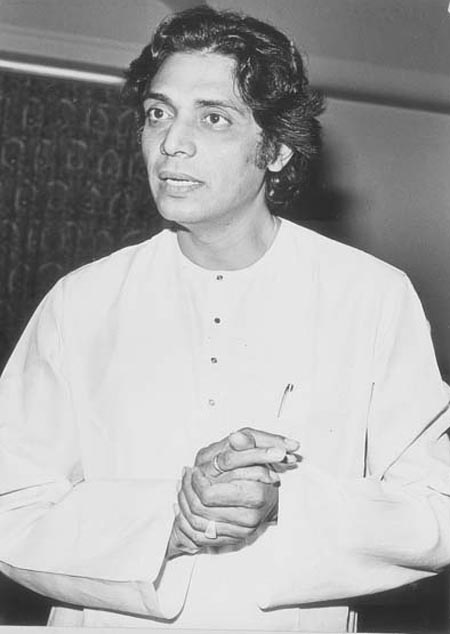
Muzaffar Ali
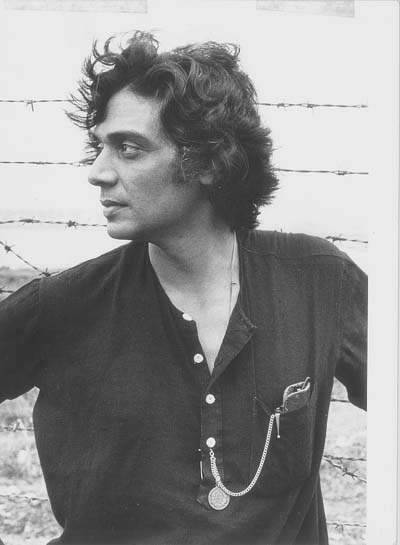
Muzaffar Ali
Abida Parveen
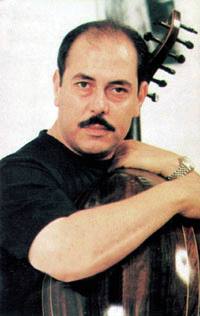
Lofti Bouchnak