The interesting feature is the locking trem unit which has Schecter stamped into the fixed block, although I believe it's possibly a licensed Schaller unit. I've only seen the same unit on the earlier 'Music Man' guitars, but without a maker's stamp. The moving part of the trem has a blade the full width of the unit, which locates into a groove in the fixed block part. All metal hardware is black chrome finish apart from the switch toggles. Epiphone Nighthawk
The guitar was originally part of a wild goose chase when somebody had mistakenly identified the pickups on a Hamer guitar I'd tried earlier as OBL (Original Bill Lawrence) pickups. They were in probability likely to have been some version of a Seymour Duncan 'rails' pickup, but I had the OBL in mind when I spotted them as standard on the Nighthawk. As far as I know the pickup wiring (and possibly the pickup choice?) is from Steve Howe.
The guitar has a mini humbucker at the neck, an OBL angled humbucker at the bridge and an OBL single coil at the mid position. The switches are a 5 postion and a mini toggle. With the mini toggle up the 5 way selects single coils from the pickups in nearly the standard 'Strat' configuration. With the toggle down the 5 way selects the bridge humbucker, bridge and neck, neck only, on the first 3 poitions of the 5 way. The 4th position selects also a capacitor and inductor which work as a filter to give a peculiar 'jazzy' setting. The mini toggle selects a slightly different version of this 'jazz' sound in the second 4th position. The final 5th position is silent. The Gibson Nighthawk as far as I know doesn't have the 'jazz' settings, and has 10 permutations, rather than 9. I intend to rewire the Epiphone sometime to the Gibson arrangement because I don't use the 'jazz' settings, and I suspect they're contributing 'clicks' to the switching. I replaced the 5 way and the clicks remain but seem only to happen when switching across the 4th position?
I was very impressed by the wide and useable tonal range available from the guitar and the switching arrangement. I've tried other guitars with flexible switching, but they've been too varied in volume between the settings and were less easy to use.
The body and neck are mahogany with a dark rosewood fingerboard, most of the metalwork is gold plated and the strings a fed through the body Tele-fashion. The bridge is fixed and has an unusual trapezoid shape, the bridge pieces are brass versions of the standard Strat arrangement of spring, screw and 2 grub screws for height adjustment.
|
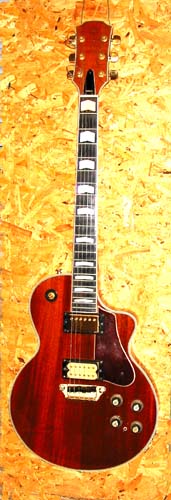 The SG85 immediately predates the SG2000 Santana range. It's a Les Paul shape apart from the body which is flat, not contoured, and the bottom cutaway has no end point. The body and set-neck wood is mahogany, the fingerboard is ebony and the fittings gold plated. I swapped the bridge pickup for a DiMarzio Dual-Sound, because the original was too mellow toned compared to my previous guitar, and put the coil-tap mini toggle in the centre of the the controls, due to the limited existing routing available in the body.
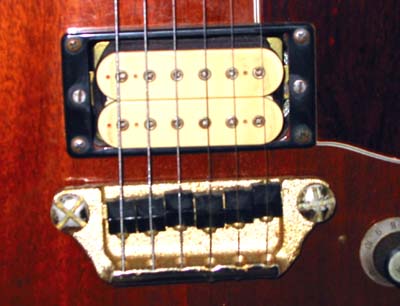 A close-up view of the brige shows a combined string retainer with adjustable bridge pieces mounted on two screw mounting posts. The bridge pieces are black plastic triangular shapes, with the ends extended down to house the adjustment screw, which locates in a threaded hole in a raised bar on the bridge casting. The end of the screw is retained in the bridge piece by a circlip.
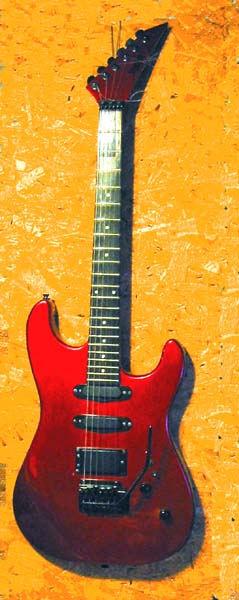 This guitar is actally labelled on the headstock 'Strategy by Schecter' and as far as I know was a projected budget guitar by Schecter, which didn't develop, and this is one of the few which made it to the market before the project was stopped. There are no other markings or serial numbers. I've only seen 2 other guitars of this model, at the time I bought this, and they were both finished bright pink!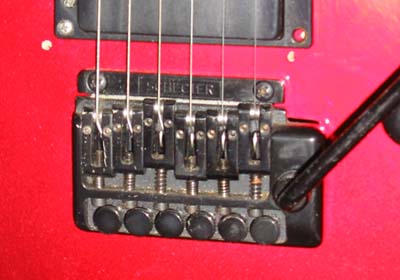
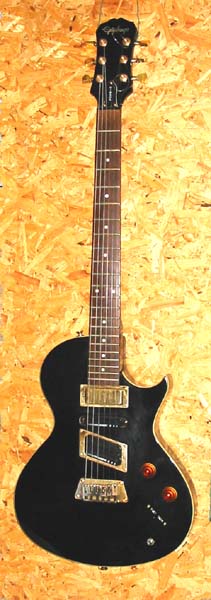 The Epiphone Nighthawk I found second hand in a York music shop, although it was still within the guarantee period, and half the recommended retail price at the time. I remember trying a few of these guitars in different shops plugged into Peavey Transtube amps. The combination was very impressive but I wasn't sure if it was the guitar, amp or both? Having already bought a Transtube amp earlier courtesy of a Building Society windfall, when I saw the Nighthawk at a price within my budget, I jumped at the chance to put the two together.