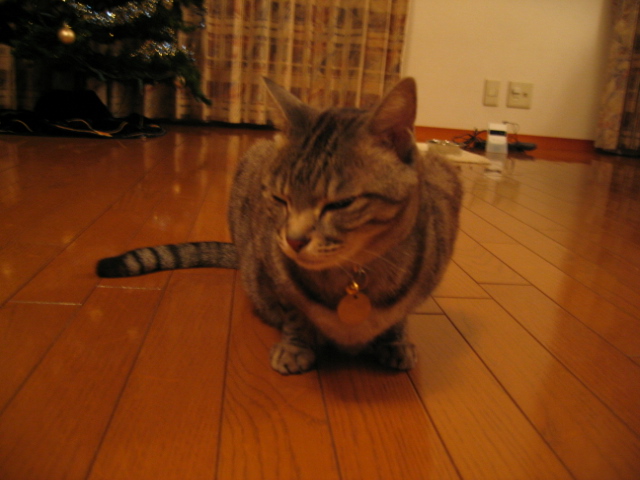
| Our own two cats are Kanga, who looks a bit grumpy here for some reason, | |
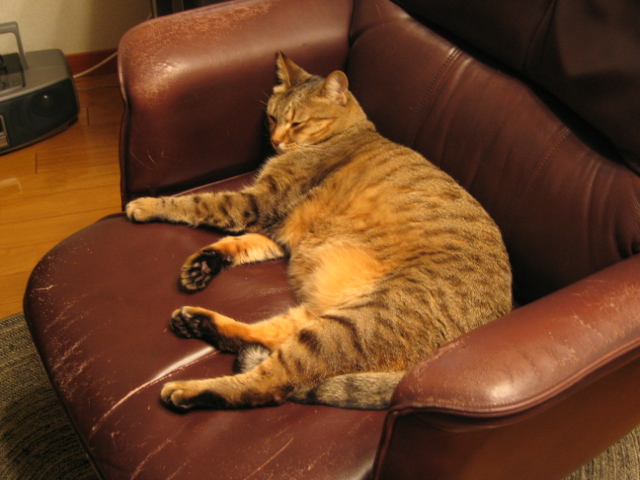 |
and Roo, who will allow me a little bit of space on my comfortable chair too, if I ask nicely. |
 |
To left and right, a couple of photos of Kanga, maybe suspicious of the camera. |  |
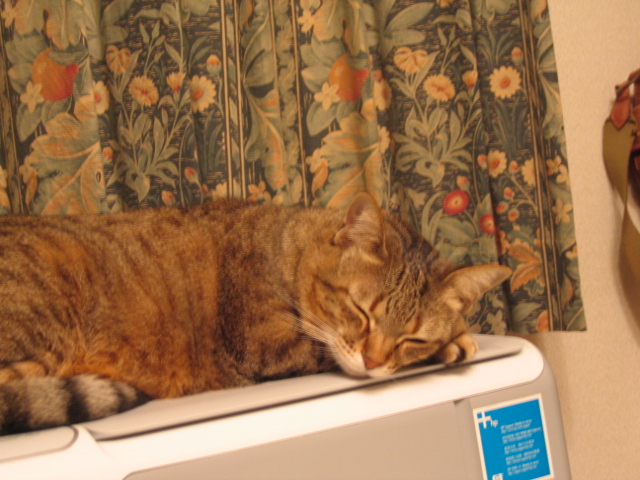
| Roo looks as if she's afraid of being thrown out of the chair, | 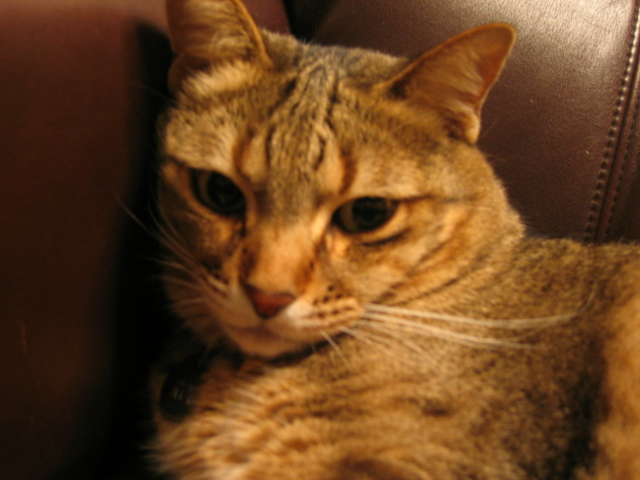 |
but the top of the printer makes a good alternative resting place:
 |
 |
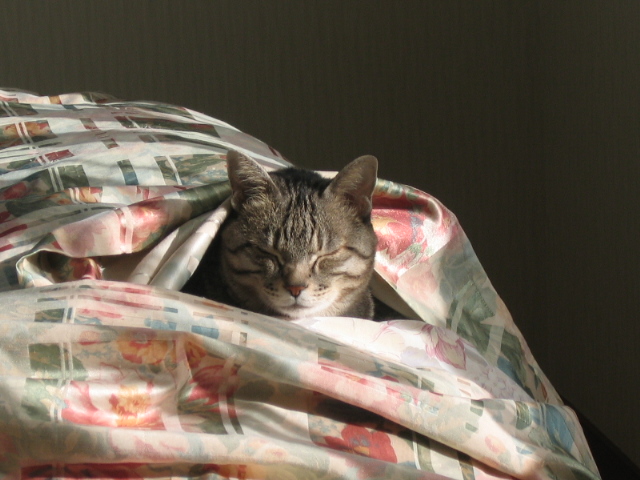 |
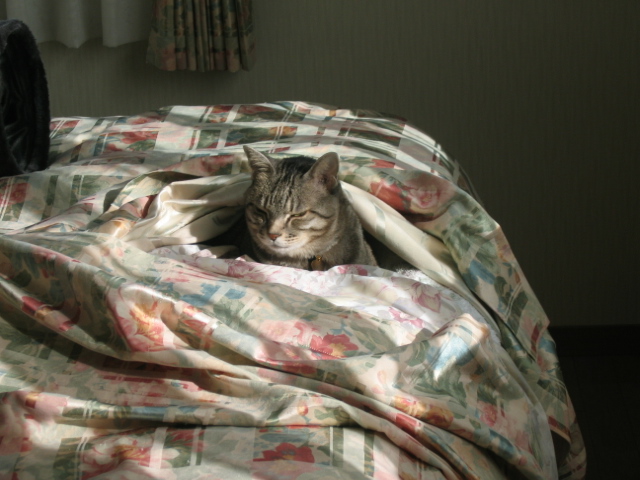
Left, right and below: Kanga loves to be under the bedcover. | 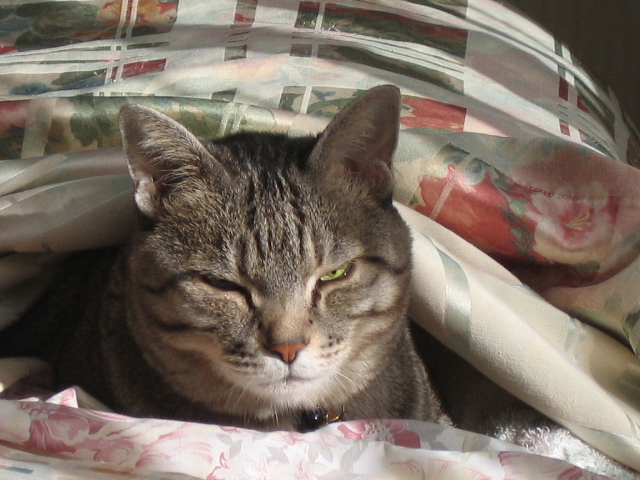 |
|
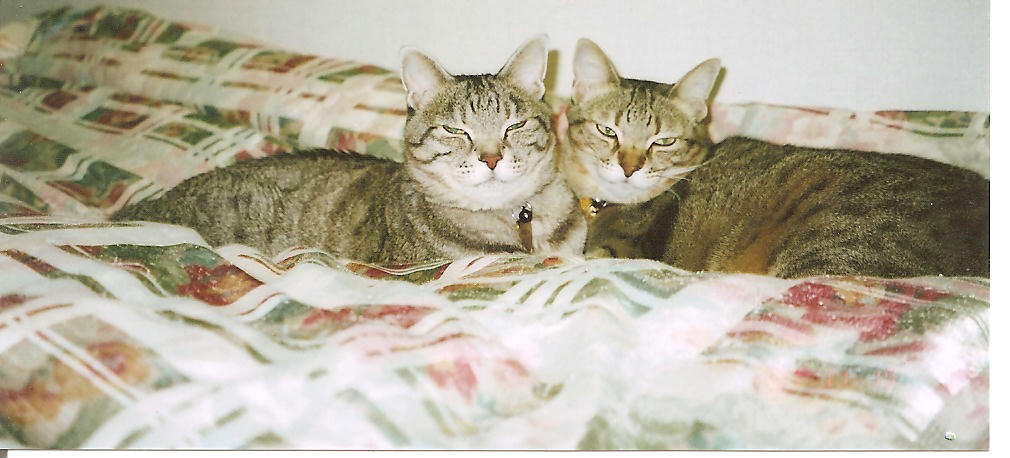
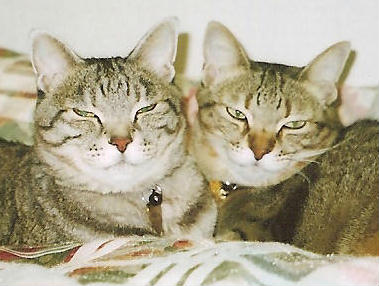
They often sit and lie together, but rarely heads together like this - luckily my mother-in-law was there with a camera:
 |
 |
As you can see, we dote on our two furry friends. Just soppy cat lovers, you maybe think. Well, I've just been reading about the 2008 International Stroke Conference, at which Professor Adnan Qureshi of the University of Minnesota announced the results of a survey of 4,500 adults. After allowing for all other risk factors, it seems that just 3.4% of cat owners died of a heart attack over some period compared to 5.8% of those who did not have cats. A 40% difference - so there!
And let's be realistic about the little predators. Cats do not accommodate themselves to their humans as dogs do - they just follow their own instincts. Fortunately those instincts are suitable for a domestic animal. Domestic cats are derived from small wild cats living in the semi-desert near the North African coast. They keep themselves clean by licking because they are susceptible to parasites and ticks, and their saliva is somewhat antiseptic. They like to bury their faeces, because these are smelly and would keep potential prey far away if they were left lying around. So if humans provide a place where droppings can be buried, the cats are happy to use it.
Charles Darwin was puzzled by cats rubbing their faces against doorframes and corners and furniture as well as their humans' legs. Now we know that they have scent glands in their cheeks, and are marking territory in this way. Cats' territory is complicated, being a sort of time share matter. Other cats can enter, but only if they are close friends or relatives or if the scent is old enough. Luckily the pheromones they use are not detectable by humans: it's not difficult to keep a house free of obvious cat odours. Foxes would also make good pets in the same way as cats, but unfortunately their pheromones are detectable to humans, and are not so pleasant!
In other behaviour, domestic cats treat their humans like they did their mothers in kittenhood. That means no scratching or biting, and looking out for a share of any food on offer! Their territorial nature means that they can easily be trained to keep away from certain places - we didn't have much trouble dissuading our two from climbing into the butsudan, for instance. A loud voice, or a sharp tap on the nose, as cat mothers inflict, was quite enough sanction. On the other hand, it seems quite impossible to stop cats sampling food they come across on counter or table. Desert predators need to eat as much as they can at every opportunity that presents itself, for they may have to suffer long periods without. They just cannot understand that food may be available but forbidden! The only solution is to keep food out of their reach.
Our cats are mongrels, partly American Shorthair, partly Abyssinian, and partly goodness knows what. They spent their first three months of life with their mother, a good length of time to be socialised.
Roo is a very intelligent cat, and Kanga isn't, though she makes up for her intellectual deficiency by being very affectionate. When we first brought them home, Roo soon learned how to open doors by herself, while Kanga was much more slow. But eventually even she learned the trick of hooking a paw round the edge of a door and pulling it open wide enough to go through.
The door of my room is a bit tricky to open, because there is a piece of furniture right next to it, so just hooking a paw and pulling means that the door opens, hits your nose (if you're a cat) and closes again. Roo soon learned how to deal with this problem by pulling at the door and then jumping back, so that it swung open with hitting her. Kanga never has learned what to do, and just miaows by the closed door until someone opens it for her.
Although I have loved animals all my life, my parents didn't feel the same way, and I was never able to have a pet in childhood. But of course I got to know various neighbourhood animals, among them the two cats Toshy and Poppy. They were both female, and great friends although they lived in different houses. They seemed to spend all day every day together. A great deal of their time was taken up chasing birds, but luckily neither of them was very good at hunting. One day I was looking out of a window at home, when Poppy appeared walking boldly towards the lawn in our back garden. This lawn was bordered at its southern end by some bushes. There were quite a few birds on the lawn at this time, and Poppy seemed interested in them. I was just reflecting that Poppy really was a bad hunter if she expected to catch birds by marching towards them in full view. At that moment, the birds spotted her and flew quickly away, low over the bushes at the end of the lawn. And there was Toshy! As the birds flew over, she hurled herself into the air from behind the bushes and tried too seize one in her claws. She missed, I'm glad to say, but I was deeply impressed at the two cats' behaviour. Without language, how could they possibly have dreamt up such a plot between them?
Long after I got a clue while watching a television documentary about lions. Female lions cooperate in this way, I learned. Some lionesses creep unnoticed past a group of prey animals, and hide in the long grass beyond. The other females stay in full view and rush towards their prey, chasing them right into the ambush. Toshy and Poppy must have had a vestige of this ancient instinct in their feline brains, I think. Maybe Toshy crept quietly beside the lawn towards the bushes, and this caused Poppy to realise her role in this instinctive behaviour.