that of precisely four 1/8, precisely six 1/16, and of at least eight also 1/16 -
that is as far as the diagram goes, with no indication of larger numbers.
The theory of evolution tells us that all living things on our planet are related. But it is easy just to accept this idea without thinking very deeply about it. Let's try a bit of deeper thinking, starting with human ancestors. The following argument is originally due to the American philosopher Daniel Dennett, in his fascinating book Darwin's Dangerous Idea (1995, Penguin edition 1996). I have adapted it a little.
Imagine the set of all human beings alive today - all six billion or so of them:
{all human beings alive today}
I'm using the mathematical term "set" here, and the curly bracket notation for sets, but there's nothing very mathematical about this argument!
Anyway, now consider the additional set {mothers of all human beings alive today}. We could show the relationship between the two sets as follows:
{mothers of all human beings alive today} → {all human beings alive today}
The set of mothers is obviously smaller than the set of all human beings, since the latter includes all males as well as females. If we go a step back to the set {mothers of mothers of all human beings alive today}, that will be smaller still, as there must be plenty of mothers who give birth to more than one daughter who herself becomes a mother. Then the set {mothers of mothers of mothers ...} should be smaller still, for the same reason, and as we go further and further back in time, female generation by generation, we must eventually reach a set of just one female. That one has to be the closest female ancestor of every human being alive today - inevitably called Eve, though obviously nothing else of the bible story is assumed:
{Eve}
That looks plausible, but there a couple of errors in the argument. One of them is easy to put right. In the set {all human beings alive today}, living mothers are obviously included. Thus there will be any number of sets of triples having the form {X, X's mother, X's mother's mother}, all of whose members are alive now. X's mother and X's mother's mother will also be members of the preceding set {mothers of all human beings alive today}, together with X's mother's mother's mother. Clearly each set as we go back through the generations will contain two of X's female ancestors from the previous set plus another one. It is impossible to get back to a set with just one female ancestor in it.
But all we need to do to avoid that problem is to amend the definition of the first set as follows:
{all human beings alive today except for mothers}
and add the phrase "except for mothers" to the definitions of all the other sets. In that case, X's mother and X's mother's mother will be excluded from the first set, as will X, if female and a mother.
The other problem is a bit more tricky. Although in a large population you would expect quite a lot of women to give birth to two or more daughters who go on to become mothers, it might not happen in a small group. Suppose we traced back the sets until we reached one of say six mothers. It is not so unlikely that the set of their mothers would also be six in number - just by chance each of those women just had one daughter who became a mother. That does not mean to say they only had one child, just that any other children were either sons or childless daughters.
So sets may remain the same size as we go one back. But that is unlikely to happen for many generations - in the end we must surely get back to the set {Eve}. There is one question that this argument cannot answer, however. Was Eve a human being? In tracing back the mothers, we may have gone past members of our own species to those of an ancestral one, some kind of ape or even something much earlier in the tree of life.
Genetics can now answer this question, however. All the cells of our bodies contain units called mitochondria, which provide energy for the working of the cell. Mitochondria have a small set of genes of their own, which in virtually every case is inherited from our mothers alone. This makes it particularly easy to trace back our female lines, and this genetic information makes it clear that Eve lived not much more than about 100,000 years ago, a surprisingly short time. She was thus certainly a human being. But we should not suppose that all the other females of her generation left no descendants - probably many of those women figure in all our direct ancestor trees, it is just that the line from any one of us to any one of them goes through at least one male.
Given such empirical evidence, the "mothers" argument may not seem to have much significance. However, we can use it to make more vivid our relationship with the rest of the living world.
Consider this time the following starting set:{all human beings and cats alive today except for mothers}
"Mothers" here of course includes cat mothers as well as human ones. And if your preferred pets are dogs, rabbits, parrots or goldfish, then imagine your preference in place of "cats".
Then of course we go back a generation and imagine {mothers of all human beings and cats ....}, then {mothers of mothers ....} and so on. Where do we get to this time? Pretty clearly a set of two, Eve and an early domestic cat, or one of their wild cat ancestors. The two females are not so likely to have been contemporaries - cat generations go by rather quicker than human ones.
Going back further, the sets are likely to have two members for many generations, one female ancestor of humans and one of cats. But in the end we must get back to a set of one, the closest female ancestor of both cats and humans. We know of course that cats and humans are both mammals, so this common ancestor is most likely to have been an early kind of mammal, no doubt looking more like a cat than a human. But the argument is not meant to be part of any scientific investigation - it just demonstrates to us in a vivid way the interrelatedness of the whole living world.
If you were thinking of dogs or rabbits instead of cats, the result would have been similar: an early mammalian ancestor. But the closest female ancestor of parrots and humans is harder to imagine, and that of humans and goldfish even more so. Yet there must of course have been such ancestors, and this is a topic we shall come back to.
It is also possible to make the argument more personal. Suppose instead of such a huge initial set we consider one of just two human beings. The next set has as its members their two mothers and so on. Eventually we reach the two people's closest female ancestor. This may well be somebody far more recent than Eve - if the first two humans are siblings, there won't even be a second set of two, but of just one, their mother.
Even more personally still, let us take the first set to consist of me and my two cat companions. The cats are sisters, so the next set will contain just my mother and the cats' mother. Then as we go back there will be a long, long series of two-membered sets until we finally reach the closest female ancestor of the three of us. That mammal may well be the same as the closest female ancestor of all humans and all cats. But again there is no deep significance in this: it just vividly connects me to the rest of the living world. Often when I pick up one of the cats I wonder what our common ancestor looked like. I think such thoughts are good to remind us of our ethical responsibilities towards the natural world, as pointed out by Madeleine Bunting in the newspaper article we read (Madeleine Bunting, The Guardian, 29th December 2008).
The close interrelations of human beings can be illustrated more clearly by considering descendants rather than ancestors. There are sophisticated statistical arguments about this, many to be found on the internet, but their mathematics is sophisticated too, and quite beyond me. However, a crude numerical example may give some idea of how those arguments basically work.
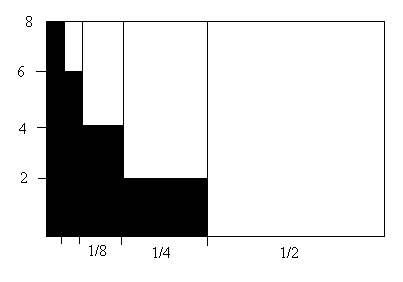
Suppose that in some population of humans the chance that an individual remains childless is 1/2, and the chance of having at least two children is also 1/2. That would ensure population growth, as the number of children per individual will be more than one. But notice that complications about the number of females and males and so on are being ignored - we are just thinking about the probabilities associated with a particular individual, male or female. To keep up the simplicity, suppose that the chance of having at least four children is 1/4, that of at least six is 1/8, and in general the chance of having at least 2n is 1/2n.
A diagram can illustrate this:
|
It is easy to see that the chance of precisely two children will be 1/4, that of precisely four 1/8, precisely six 1/16, and of at least eight also 1/16 - that is as far as the diagram goes, with no indication of larger numbers. |
In this situation, the chance that an individual will leave no descendants is quite high, 50%. That means that she or he will not appear in the direct ancestry tree of anyone in future generations. (I use "direct ancestry tree" instead of just "family tree", because of course people may include aunts and uncles or other relatives in their family tree.) If the individual has two children, then the chance that neither of those children leave offspring for the third generation would be 1/2 x 1/2 or 1/4, a not inconsiderable chance. But if the individual has six or more children, the chance of having no grandchildren at all becomes very small. But the chance of having six or more children is not so high.
Summing up, an individual's chances of leaving no descendants after two or three generations is quite high. But if she or he does have some descendants after a few generations, the chances are that the line will never die out: the number of descendants will grow generation by generation. In that case, the individual will figure in the direct ancestry trees of a lot of people in the future. In fact it turns out that after a few centuries, an individual will either be in almost everybody's ancestral tree or in nobody's. This only applies to a freely interbreeding population, of course, but nation states generally have such populations.
A few centuries ago, too, people started travelling around a lot further than before. If just one new arrival establishes a line of descendants in a country, it means that a whole new ancestral tree is planted, as it were. The new person's ancestral tree will gradually join the trees of most of the original inhabitants. We are all probably more directly related to more people in our own countries and around the world than we ever imagine. All men are indeed brothers, or, as it would be better to say, all humans are siblings.
Whenever a new president is inaugurated in the United States, newspaper articles inevitably appear expressing astonishment at some relationship established with some royal family, previous president or other famous person. George Bush turned out to be related to Britain's Queen Elizabeth, and Barack Obama is related to Winston Churchill. Actually, of course, it would be much more astonishing if they weren't so related - the only remarkable thing is that there are sufficient extant paper records to establish these relationships for certain!