A simple diagram like the one below may help to make Daniel Dennett's view of free will easier to grasp.
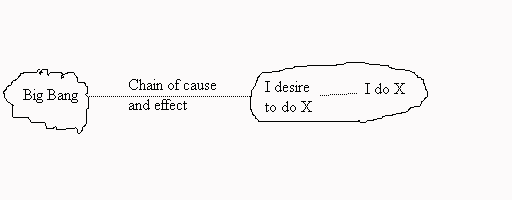
The universe is deterministic, so there are chains of cause and effect stretching out from the Big Bang and determining everything that happens. In this case, my doing something X is preceded in the causal chain by having a desire to do X. There is nothing mystic about a desire: it is just a certain kind of state in my physical brain. Dennett regards a "free will act" as such a combination of a desire and an action. The fact that the universe is deterministic makes no difference - Dennett wants us to think of "free will" as something quite different from our everyday concept.
It seems to me that if the universe is deterministic, Dennett's idea neatly explains why we have feelings of doing things of our own free will so often. But of course his view could not be used in any argument attempting to show that the universe is deterministic.
The title of Dennett's book is Freedom evolves, and he makes much of the theory of evolution in it. The human brain has evolved tremendously, together with our communal knowledge, and we can have far richer and more varied lives nowadays than were ever available to, say, our stone age ancestors. These extra possibilities are what Dennett calls freedom. Of course the actual events of our lives are predetermined, and Dennett's use of the word freedom is just as tendentious as his use of free will.
It is strange that Dennett is committed both to evolution and determinism, since the two concepts seem rather ill-matched. After all, it is a commonplace to say that the key point of the theory of evolution is that it shows how order can arise from chaos. There are random mutations to genes, some of which are preserved because they do good to their possessors, while others fail because they do harm.
As far as I am aware, Dennett presents only one argument concerning this oddity. Consider a number like the square root of two. Its begins 1.414213562373, and continues without end. If we were presented with just a few digits from inside the expansion, say 1356237, we would probably assume that we were dealing with a series of random digits. But of course they are not random at all, but determined by a clearly defined mathematical process. Dennett suggests that we might similarly be misled by apparent randomness in nature. We might really be dealing with a deterministic process whose underlying system we do not know.
There is certainly something to that argument, but it still leaves some puzzles, I think. For instance, why is it that our ideas of probability seem to work so well? Roughly speaking, probable events happen often, while improbable ones do not. To take an example, there is an infinitesimally small chance that all the mutations required to produce an eye as good as the human variety could happen all at once in some previously sightless species. One member of the species would happen to be born with a complete eye, plus of course all the additions to the brain necessary to use it effectively. Its parents would have no eyes, their one offspring would have a perfectly functioning pair. Such a thing has never been observed, but in a deterministic universe, why shouldn't it happen? Surely improbable events could be determined just as well as probable ones. That argument certainly convinces me that the universe is not deterministic, but I'll postpone a discussion about what an indeterministic universe might be like.
The "butterfly effect" is often used as an argument to suggest that determinism is quite harmless, and nothing that should cause us to lose any sleep. It is not mentioned in the Wikipedia article, I don't think, so I'll describe it here.
It is impossible to forecast the weather with any accuracy beyond just a few days at most. One important reason for this is that it is impossible to obtain completely accurate data from weather stations. No matter how well made the thermometers and rain gauges and so on are, they can't measure with absolute precision. When their data is used for forecasting, it is accurate enough in the short term, but as time goes by, the inaccuracies become more and more noticeable. We can easily construct a simple example of this phenomenon:
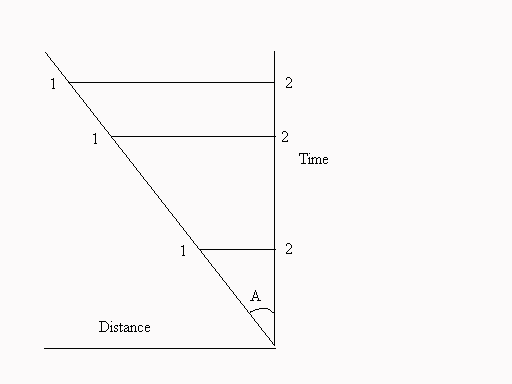
Suppose there are two objects, 1 and 2, which start together but gradually drift apart with time, as shown. There is an angle A between their respective courses. Now suppose there is a tiny inaccuracy in our measurement of A. When the distance between 1 and 2 is small, the inaccuracy will not be noticed, but as the distance gets larger, we will notice it. The distance between 1 and 2 that we calculate given our value for A will become more and more obviously too large or too small.
This is just what happens in weather forecasting, though there, of course, there are far more factors involved than just one angle. It is generally supposed that distance and time are infinitely divisible, so in order to determine the infinitely far future we would need an infinite amount of knowledge of precise values of distance, time, angles and so on. René Descartes imagined a "demon" calculating the determined future from the past: it seems that the demon would need an infinitely large memory capacity to do the job properly. Determining the future accurately would be impossible for finite creatures.
So the argument goes that determinism is harmless because nobody could actually do the calculations required to predict the future precisely. I must say that argument does not convince me. Surely the universe stays determined whether or not finite beings can really do the determinations. There is no freedom in that!
The term "butterfly effect" comes from an early example, that a butterfly flapping its wings in Brazil might be a cause of a tornado in Texas later on. A tiny cause may have huge effects, and of course tiny causes are likely to go unnoticed.
There is endless argument among physicists about whether quantum theory should be considered deterministic or indeterministic. I do not intend to go into such arguments, mainly because I don't understand them. However, the fact that scientists can't agree means that there is room for philosophical arguments as well as more mathematical ones. I shall be posting a version of one interesting argument by the mathematician John Conway and the theoretical physicist Simon Kochen, called the free will theorem, on my web site soon. It is entirely up to you whether you read it or not, however! The theorem suggests, but certainly does not prove, that the universe is not deterministic.
On the other hand, quantum theory in general suggests that the universe can only have a finite, though huge, number of different states. This undermines the "butterfly effect" argument, even if it was convincing to start with.