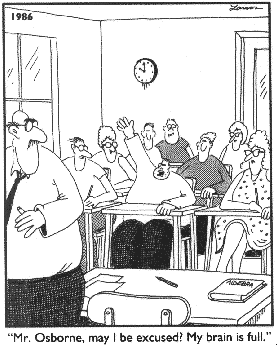
drawn by the brilliant cartoonist Gary Larson
in the 1980s and early 1990s.
He retired around 1995: apparently after
running out of inspiration and fearing boring repetition.)
What on earth is the point of bothering with memes? How can they help us solve any problem that we couldn't solve before? Surely they are just superfluous. Take Dawkins' favourite example of the "God meme". Quite obviously a belief in God will give many people comfort if their lives are unhappy, or if they are just troubled by the perplexing problems of existence. It would be utterly unsurprising if a person who had never heard of the God concept adopted it thankfully after hearing or reading about it. Why do we need to bother with the idea of a "meme" as a kind of replicator like the gene? Surely psychological factors explain the popularity of belief in God without need for anything else.
It seems to me likely that Dawkins developed the idea in order to tackle difficulties associated with "biological advantage". Another of his examples involves celibacy among Catholic priests. Clearly anyone who chooses celibacy as a lifestyle is acting against the interests of their genes, which require copies to be made. Celibacy is rather rare in human societies, but there are other lifestyles which are not right from the gene point of view. Many women in modern times might decide to put their careers ahead of having children. They may hear or read about other women who have had fulfilling lives without children, and they may decide to do just the same.
If brains are constructed for biological advantage, that is, the advantage of genes, then how could such brain states possibly arise? Surely it would be impossible for brains to entertain ideas of celibacy or happiness without children. Memes provide an easy way to understand this problem. If memes are replicators independent of genes, they may well make copies of themselves to the detriment of genes. Memes for celibacy or childless lifestyles will replicate as much as they can, and they sometimes succeed pretty well. The meme concept may not explain anything new, but using it may help us explain things more easily than we otherwise could.
Dawkins suggests that memes compete for space in our memories and for time to be considered in our brains. I feel rather doubtful about that. Our memory space seems to be huge, and certainly no human being ever gets the impression that it has been filled up, as the following cartoon illustrates:
|
|
(That cartoon is one of a series called The Far Side, drawn by the brilliant cartoonist Gary Larson in the 1980s and early 1990s. He retired around 1995: apparently after running out of inspiration and fearing boring repetition.) |
That would hardly be funny if our brains actually did fill up! It seems to me that the reason memes find a home in our brains or are rejected by them depends on the kind of brains we have together with the memes that are already there. Our brains presumably already have some kind of inherited structure when we are born, which may make it easier or more difficult to understand certain subjects. We may have an inborn ability to appreciate history, say, but not mathematics. In other words, memes about history will easily establish themselves in a particular brain, but not memes related to mathematics. Even if our brains have no specialised structure, a parent or a teacher may inspire us to study some things rather than others. As our knowledge grows, more and more memes about our favourite subjects will find a home in our brains, while others will not. This is not because our brains are full, but because we have no interest in certain memes, or the memes already there do not enable us to understand others of a different field. For instance, if you have never had any interest in literary criticism, say, then you may find a book about it quite incomprehensible. There are just no related memes already in your brain.
We should not underestimate the role played by our interest or lack of interest. When we visit a bookshop or a library looking for something interesting to read, we tend just to visit those shelves containing books on topics we are already familiar with, and never think of looking elsewhere. When I once lived in Libya, there was a foreign language bookshop whose owner knew just some Italian and rather less English apart from his native Arabic. As a result, books were placed on shelves in his shop almost at random. You just had to look at everything in order to pick out something you wanted. As a result I found myself buying and reading numbers of books on subjects I had never bothered with before. I especially remember a book on entomology that turned out to be fascinating. Maybe more bookshops should be organised or disorganised in a similar way!
Why have we spent so much time on the meme? Remember that our last topic was indeterminism, and the idea that there might be room for ethics and morality in an indeterministic universe, even one without free will. Perhaps the concept of the meme could help us develop that idea? What do you think?