The Magic Mirror
In a certain realm, in a certain land there once lived a merchant. His wife was dead, but he had a son and daughter, and a brother. One day he made ready to travel to foreign lands and purchase merchandise; he was taking his son with him, but leaving his daughter home. Calling his brother to him he said, "I entrust you, dear brother, with all my house and chattels and beg you earnestly to keep a strict eye on my daughter, teach her to read and write, but do not spoil her." Then the merchant bade farewell to his brother and daughter and set off on his way. Now, the mer-chant's daughter had already come of age and was fairer by far than any other maid in the whole wide world. Her uncle began to think evil thoughts that gave him no peace night or day. And he pestered the fair maid saying, "Give yourself to me, or you'll depart this world; I shall kill myself and you too!"
One day the fair maid went to the bath-house. Her uncle followed, but as he came through the door she took a bowl of boiling water and drenched him from head to toe. It took him three weeks to recover. A terrible hatred gnawed at his heart and he pondered on how to take his revenge. He thought and thought, then wrote a letter to his brother, telling him that his daughter was up to no good, traipsing round other yards, spending her nights away from home and never obeying her uncle. When the merchant received the letter, he read it and flew into a rage. "Your sister, has shamed our whole family!" he told his son. "I will not spare her: go back this minute, chop the hussy into small pieces and bring me her heart stuck on this knife. I will not have decent folk mocking our good name."
The son took the sharp knife and rode home. He came unnoticed to his home town, told no one of his errand, and began to make enquiries: how was a certain merchant's daughter disporting herself? Everyone had nothing but praise for her. She was quiet, modest and pious, and heeded the advice of good folk. On learning mis, he went to see his sister. She was overjoyed and ran to embrace and kiss him, saying, "Dear brother, what brings you here? How fares our own dear Father?" "Oh, dear sister, hasten not to rejoice. My journey does not bode well: Father has sent me to cut your white body into small pieces, stick your heart on this knife and take it to him."
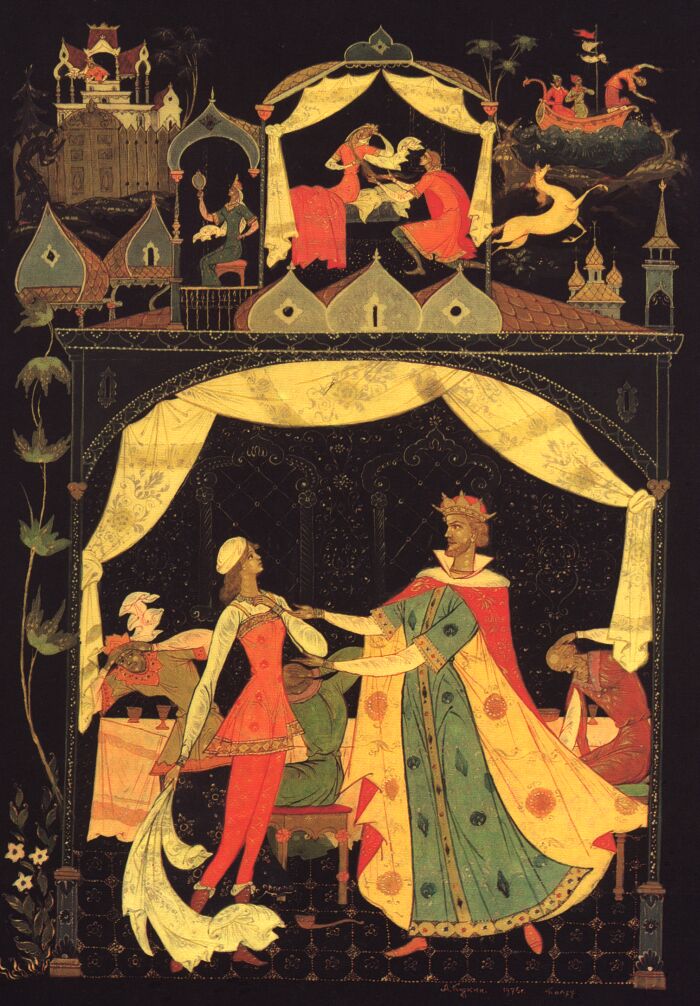
She burst into tears. "Dear Lord," she said, "but what for?" Thereupon her brother told her of their uncle's letter. "Oh, brother, I am innocent of all he says." And she recounted all that had happened. At last her brother said, "Do not cry, sister. I myself know you are innocent, and though our Father would allow no excuses I do not want to kill you. Make ready and leave our Father's house; go out into the wide world and the Lord will be with you." Without further ado the merchant's daughter made ready to go, bade farewell to her brother'and set off she knew not where. Then her brother killed a stray dog, cut out its heart, stuck it on his sharp knife and took it to his father. Handing over the dog's heart, he said, "I killed my own dear sister on your orders, Father." "Serves her right," his father said. "A dog's death is what she deserved."
The fair maid wandered far and wide and finally entered a dense, dark forest, with the sky barely visible above the tall trees. She began to walk through the forest and came to a big glade. And in the middle of the glade was a white marble palace surrounded by iron railings. "I will enter this palace," thought the girl. "Not all folk are wicked; no harm will come to me!" She went into the palace. There was not a soul to be seen. She was about to turn back when two stalwart young knights came riding into the courtyard, saw the girl, and said: "Hail, fair maiden!" "Hail, honest knights." "Well, brother," said one knight to the other, "we were sad that we had no one to keep house for us; now the Lord has sent us a sister." The knights let the merchant's daughter stay with them, called her their sister, gave her the keys and made her mistress of all the palace. Then they pulled out their sharp sabres, drew blood from each other's breast and took an oath: "If one of us dare harm the maid, the other will cut him down mercilessly with this very sabre."
So the fair maid lived with the two knights. Meanwhile her father purchased foreign wares, returned home and shortly after took another wife. This woman was of untold beauty. She possessed a magic mirror which, when you looked into it, would tell you what you wished to know. One day the two knights made ready to go hunting, and warned their sister, "See that you let no one in before our return." With that they rode off. At that moment the merchant's new wife glanced into her mirror to admire her own beauty and murmured, "I am the fairest of them all."
But the mirror answered, "You are fair indeed. But you have a step-daughter who lives with two knights in a dense wood. She is fairer still."
Not liking this reply at all, the stepmother summoned an old woman to her, saying, "Take this ring and go into the dense forest; there you will find a white marble palace in which lives my step-daughter. Give her this ring, saying that her brother sends it as a keepsake." The old woman took the ring and went where she was told. She arrived at the white marble palace. The fair young maid saw her and came running to greet her, hoping she had brought tidings from her father's home. "Welcome, Grannie! What brings you here? Is everyone at home alive and well?" "They're all alive and well," replied the old woman. "Your brother asked me to see how you were faring and sent this ring as a present. Here, put it on." The girl was happier than words could tell. She took the old woman into the palace, offered her all manner of tasty food and drink and bade her give her fondest wishes to her brother. Within the hour the old woman set off back. The fair maid admired the ring, put it on her finger, and fell down dead that very instant.
When the two knights came home there was no sister waiting to greet them. What could be the matter? They looked into her bedroom; she was lying there dead, not saying a word. How grieved they were. Sudden death had taken away the fairest of the fair. "We must clad her in new robes and lay her in a coffin," they said. But while they were doing so, one of them noticed the ring on the fair maid's finger and said: "Let's not bury her with that ring. I'll take it off as a keepsake." No sooner had he taken off the ring than the fair maid opened her eyes, sighed and came to life. "What happened to you, sister?" they asked. "Did you let someone in?" "An old woman came from home bringing a ring." "Why did you not heed our words? We had good reason to warn you not to let anyone in. Never do it again."
Some time later the merchant's wife looked into her mirror again and learned that her step-daughter was still alive and fairest of all. She called the old woman to her, gave her a ribbon and said, "Go to the white marble palace where my stepdaughter lives and give her this gift. Tell her it is from her brother." Again the old woman came to the fair maid, telling her tales and winning her confidence, and handed her the ribbon. The girl was delighted, tied the ribbon round her neck and fell lifeless upon the bed that very instant. When the two knights returned from hunting, they found their sister lying dead. They began to attire her for burial, untied the ribbon from her neck, and she at once opened her eyes, sighed and came to life. "What happened, sister? Was the old woman here again?" "Yes," she said, "the old woman came from home bringing me a ribbon." "Silly girl. Did we not tell you not to let anyone into the palace?" "Forgive me, dear brothers. I was so eager to have news from home."
A few more days passed by. Once again the merchant's wife looked into her mirror and learned that her step-daughter was alive and well. She summoned the old woman. "Now take this strand of hair, go to my step-daughter and make sure you get rid of her this time!" The old woman waited until the knights had gone hunting, then went to the palace. The fair maid saw her from a window and ran out eagerly to meet her. "Hello, Grannie. How do you fare?" "Still alive, my dove," said the woman. "I was roving around and came to see how you are keeping." The fair maid took her into the palace, offered her all manner of tasty food and drink, asked her about her family and bade her give her fondest wishes to her brother. "Very well," the woman said. "Now, my poor dove, you have no one to look for nits in your fair hair, have you? Then, let me do it for you before I go." "Thank you, Grannie." So the old woman began to look through the fair maid's hair, and wound the magic strand into her braid. The girl fell down dead that instant. With an evil cackle, the old woman hurried off before anyone could see and stop her.
When the knights came home and found their sister lying dead, they looked hard for something new on her. But there was nothing to be seen! So they made a crystal coffin—more wonderful than words can tell. And they attired the merchant's daughter in a glittering robe like a bride at her wedding, and laid her in the crystal coffin. They placed the coffin in a hall in the middle of the palace, and above it they put a red velvet canopy with diamond tassels and gold fringes; and hung twelve icon lamps from twelve crystal pillars. Their work done, the two knights wept bitter tears and grieved deeply. "What have we to live for?" they said. "Let us put an end to it all." They embraced, bade each other farewell, went onto a high balcony and jumped down hand-in-hand to death on the sharp stones below.
Many years passed by. One day a prince was out hunting: he rode into the dense forest, sent off his hounds in all directions, left his retinue and rode alone along an overgrown path. On and on he went until he reached a glade—the glade where the white marble palace stood. The prince dismounted from his horse, climbed the staircase and began to look round the palace. It was so rich and luxurious, yet bore no trace of human care. Everything had been deserted, untended for many a year! In one chamber stood a crystal coffin and in the coffin lay a dead maiden of untold beauty: her cheeks were rosy and her lips bore a smile as if she were alive.
The prince went up and looked at the maid, then stayed rooted to the spot as if held by some invisible force. He stood from dawn to dusk, unable to look away, his heart beating fast. He was captivated by the maiden's incomparable beauty. His huntsmen had long been searching for him, scouring the forest, blowing their horns and shouting—but the prince stood by the crystal coffin hearing nothing. The sun set, darkness fell, and only then did he come to his senses. Kissing the dead maiden he departed. "Where have you been, Your Highness?" the huntsmen enquired. "I was chasing a wild beast and lost my way." Next day at dawn the prince made ready for hunting. He rode into the forest, left the other huntsmen and took the same path to the white marble palace. Again he stood all day by the crystal coffin, unable to take his eyes off the lovely maiden. It was late at night when he returned home. "What has happened to our prince?" the huntsmen said. "We must follow him, lads, and make sure he comes to no harm."
The prince went off hunting next day, sent the hounds off into the forest, left his retinue and set off for the white marble palace. His men followed close behind him, reached the glade and went into the palace. There in a chamber was a crystal coffin, and in the coffin lay a dead maiden, and before the maiden stood the prince. "Ah, Your Highness, small wonder that you have tarried here all week! Now we too shall not leave here until nightfall." They stood in a ring about the crystal coffin, gazing at the maid, admiring her beauty, and stayed there from dawn to dusk. When it was quite dark, the prince turned to his huntsmen, saying, "I want you to do me a great service, brothers: take mis coffin with the dead maiden, bring it to my palace, and place it in my bedchamber, but secretly so that no one learns or hears of it. Do that and I shall reward each of you with gold and other treasure, so that none shall go short." "Reward us if you will," they said. "We are happy to serve you without it, Prince." They lifted up the crystal coffin, carried it into the yard and took it to the prince's palace. There they carried it into the palace and placed it in the prince's bedchamber.
From that day forth the prince gave no more thought to hunting; he would sit at home, never leaving his chamber, gazing upon the maiden. "What has happened to our son?" wondered the queen. "How long is it now that he has stayed home, never leaving his room or letting anyone in? He is pining and grieving, or perhaps he has taken sick. I must go and see him." As soon as the queen entered the prince's chamber she saw the crystal coffin. She learned the story, then straightway gave orders for the girl to be buried in mother earth, as custom befits.
The prince wept, went into the gardens, picked a bunch of fragrant flowers and began to brush the fair maid's hair, plaiting garlands in her braid. All of a sudden, the magic strand of hair fell from the maiden's braid—and she opened her eyes, sighed, rose from the crystal coffin and said, "Oh, how long I have slept!" The prince was overjoyed more than words could tell. Taking her by the hand he led her to his father and mother. "See what God has granted me," he said. "I cannot live a single minute without her. Allow me, dear Father and you, dear Mother, to wed this maid." "Marry, my son. We would not go against God's will; and such beauty cannot be found throughout the big wide world." A royal wish brooks no delay, and that very day they held a merry feast and wedding.
So the prince wed the merchant's daughter, and they lived together happily. Time passed and the young maid desired to visit her father and brother. The prince was not against it, nor, indeed, was the king. "Go," he said, "pay your respects, my dear children. You, Prince, travel on horseback and acquaint yourself with our lands and customs, while your wife shall sail straight home in a ship." So a ship was built for the voyage, sailors were hired and a captain appointed to the vessel. The princess boarded the ship and sailed out to sea, while the prince set off on horseback over land.
The ship's captain, seeing the lovely maid, was taken with her beauty and began to pester her with his attentions. "What is there to fear?" he thought. "She's in my hands now, and I'll do as I wish." "Give your love to me," he told the princess. "If you do not, I'll toss you into the sea." The princess turned away from him, giving him no reply, and burst into tears. Hearing the captain's threatening words, one of the sailors came to the princess in the evening and said, "Do not cry, Princess. Dress up in my sailor's clothes, and I will put on your dress; then go up on deck and I'll stay here in the cabin. Let the captain toss me into the sea—I'm not afraid. With any luck, I'll swim back to shore. Thank goodness land is close at hand." So they changed clothes, the princess went on deck and the sailor lay in her bed. In the night the captain appeared in her cabin, seized the sailor and threw him into the sea. At once the sailor struck out for shore and, by morning, had reached safety. When the boat reached its destination, the sailors went ashore and, with them, the princess; she went straight to the market, bought herself a cook's outfit, put it on and got a job in the kitchens at her father's house.
Not long after, the prince arrived at the merchant's. "Good-day, Father," he said. "Do you not know me? I am married to your daughter. Where is she? Surely she has arrived by now." The ship's captain appeared and gave the following account. "It's like this, Your Highness. An accident occurred: the princess was standing on deck, a storm blew up, the waves rose high, the princess grew dizzy and, before we could move a finger, she had tumbled into the sea and drowned." The prince grieved and pined: she would never return from her watery grave. Such, it seems, was her fate. So the prince stayed with his father-in-law for a while, then ordered his men to prepare for the journey home. The merchant prepared a grand farewell feast and invited other merchants, noblemen and all his relatives—among them was his brother, the evil old woman, his wicked wife and the ship's captain.
They ate, drank and made merry. Then one of the guests caled out, "Harken, you good and honest folk. It's all very well eating and drinking, but let's have a story. Is there no one here who can tell a good tale?" "Here, here!" resounded from all sides. "Who will begin?" One man could not, another would not, a third's memory was blurred by drink. What were they to do? So they turned to the merchant's steward. "We have a new cook in the kitchens," he said. "She's journeyed a lot in foreign parts, seen many wonders and can tell a tale or two. She'll do all right." The merchant called in the cook. "Entertain my guests," he said. And the cook-princess replied, "What shall I tell you? A fairy tale or a true story?" "A true story." "All right, I'll tell you a true story if you like, only on one condition: whoever interrupts willget the soup ladle on their head."
Everyone agreed. And the princess began to recount all that had happened to her. "Well, then," she said. "There was once a merchant's daughter. One day her father went abroad and left her in the charge of his brother. The uncle was led astray by her beauty and would not give her a moment's peace..." Hearing talk of himself, the uncle said, "That's a lie, friends." "A lie, is it? Well, take this." And the cook-princess banged him on the head with the soup ladle. On she went with her story about the stepmother, how she had looked into her magic mirror, and about the old woman, how she had come to the white marble palace of the two knights... And the stepmother and old woman shouted out, "Rubbish! That's impossible." So the prin-cess hit them both on the head with her ladle and continued her story: how she lay in a crystal coffin, how the prince had found her, brought her to life and wed her and how she had set out to see her father.
The sea-captain felt uneasy at this point and asked permission to go home. "I have a headache," he said. "Just wait for a while," said the prince. Then the princess came to the captain's wicked deeds. Of course, he could not stand it: "She's lying," he said. Giving him a good bang on the head with her ladle, she threw off her cook's apron and revealed her princess' robes. "I am not the cook," she cried to the prince, "I am your true wife!" The prince was overjoyed, and the merchant too. Together they rushed to embrace her. And then they held judgement. The old woman and the uncle were stood up against the gates and shot. The evil stepmother was tied to a stallion's tail and set loose across the open plain; her bones were strewn to the winds. As for the ship's captain, he was exiled and replaced by the sailor who had befriended the princess. From that time on the prince, his wife and the merchant lived together, long and happily.