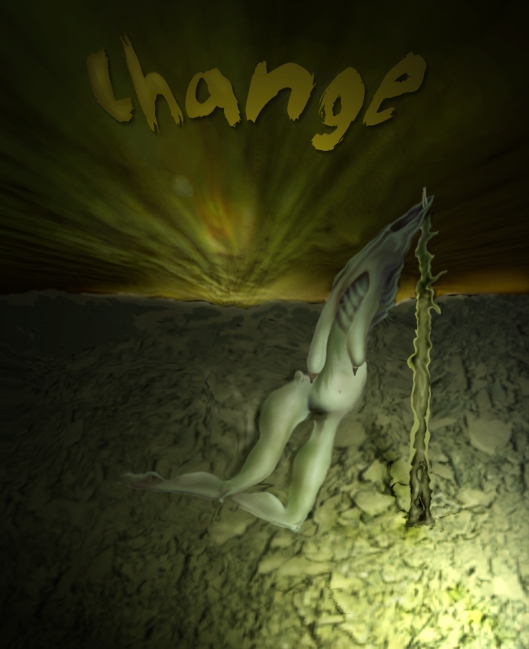
Dieter Grossmann, born in Frankfurt/Oder
in 1926, a voluntary citizen of Ulm, has already been awarded silver and
bronze metals several times for his graphic design, and has been praised
by critics as "poet of colors" and "lyric poet amongst surrealists" after
exhibitions abroad, e.g. in Milan, Bergamo, New York, Kansas City, Washington,
Toronto and Bangkok. What did this Grossmann do in order that this journalist
lost his balance? Has he mutated into an electronic magician who produces
an artistic patchwork of the highest virtuosity by means of high tech?
Not at all! What you can see here in the FAW are not digital phantom pictures.
You cannot obtain artistic importance by tricks, not even with a lot of
cunning craftiness.
Difference from the conventional
creation of paintings is indeed not basic. As in the old days when Grossmann
made bead lines with his under hidden behind abstract line webs with his
oil paintings, both critical and visionary, or with his landscape aquarelles
across which he laid with water drops quite curious veils as in monotypes,
as in those days he is also sitting today in his atelier, turning over
papers of the most different absorbent capacity or punch masks, selecting
among hundreds of brushes the most suitable one for the realization of
his ideas of a certain picture, mixing colors and hues, sketching with
a pencil, grounding, water-coloring, or varnishing five to ten different
layers, one above the other. The only difference: the substratum does not
lie on the drawing board or stand on an easel, but it appears on the screen.
Palette, color tube or sample, brush or anything else he needs, Grossmann
gets with the cursor format he "tool box" on the monitor.
A drawing and a painting tool,
he uses a pin, which is led over a pressure-sensitive plate the interface
between the artist and the machine. If he presses more strongly, the painting
tool gives more color as if he only presses slightly. And if the painting
tool reacts towards the paper structure selected, light pressure produces
a transparent effect whereas strong pressure creates a pastier stroke.
It is self understood that Grossmann could also on the screen turn the
picture always in such a way that as formerly on the drawing board
– the natural posture of arm, hand and wrist are not impaired while painting.
Another advantage is the possibility that the artist can zoom himself into
and out of the picture by a factor between 8,3 and 1200 percent. This makes
it possible to achieve the most delicate precision of the drawing and the
finest transitions of colors, which are known since the Renaissance as
"sfumato".
US-software makes all this
possible the developer of which have analyzed during more than twenty years
painting techniques translating them into an incredibly efficient diversity
of functions. How these pictures converted into a binary code get on canvas
or paper, this, too, is not magic. You only need a plotter on which four
cartouches with the colors cyan, magenta, yellow and black, all of course
absolutely resistant to light and non-fading, are running back and forth
like the sleigh on a knitting machine, producing that astronomic number
of suggestive, velvety veiled nuances which are characteristic for Grossmann's
pictures.
Craft, which Grossmann learnt
from scratch between 1948 and 1952 at the Academy of Arts in Berlin in
the professors' Tank and Speidel master-classes, is worth a lot to him.
This craft is an essential component of his pictures which he presents
particularly conspicuously on his self-portrait or in his paraphrase on
the "Birth of Venus" by the Florentine Renaissance painter Botticelli.
Like him, Grossmann undertakes journeys into man's consciousness, of course
into the contemporary human's who, driven from Paradise, ("Getaway" is
the title of the picture) is forced to struggle with various crisis phenomena
as shown in the growing gap between the poor and the rich, in the erosion
of social systems as well as in the overburdening of the environment visible
for example in the greenhouse effect.
The picture "Homo hominis lupus"
this shows as well in a vehement way. Grossmann finds it, too, in the gridiron
of the soul of an Internet Surfer who loses his balance on the data highway
of the World Wide Web, the reason for which this picture is called HYPERLINK
"http://www.de." www.de. Grossmann's perspective corresponds with Friedrich
Nietsche's who masterly formulated many truths and who called the world
"a door to thousand deserts, empty and cold". Accompanying our modern times
the outbreaks of research into the uninhabited. Outside, towards the inhumanly
far away galaxies, and into the interior, into the spooky, for a layman,
components of matter, have resulted in the loss of the cosmological centre,
wrongly thinking that we are still being in the womb. Man has been driven
from the old housings of harmonious illusions into the chill of freedom.
In many pictures space extending into the indefinite with its spells of
the cold is put on stage. And, continuously, drops and shell-like creations
emerge, reminiscences of a place, which – following an old tradition –
could also be called sphere – sphere as the inner, disclosed round inhabited
by men. Grossmann unmasks the dream of safety in a shell as a naïve
and re…belief. previously pointed out Grossmann is a surrealist who paints
against the nearly intentional non-observance of our ontological situation,
thereby always observing the rules of aesthetic balance which have been
requested from artists by Sigmund Freud, who has been as creator of psychoanalysis
the mentor for many surrealists. The weightless, rotating shell creations
and spheres, the glacier or desert-like landscapes, the views of inner
human worlds which look like anatomical cuts, the animalistic chimeras
taken from Hieronymos Bosch's "Garden of Lusts" repotted into his own world
of pictures – all you see on the approximately forty pictures has to do
with the Janus-headed Freudian term of antithesis, "discordia concors",
concordant discord.
Talks of the ambivalent conflict
of two basis instincts, Eros – the erotic moment can be seen on many pictures
– and Death Instinct. In the "eternal fight" of these instincts he sees
the basic pattern of three processes: namely, the conflicts of the individual,
then of cultural processes, and finally – as Freud calls it – "the secret
of organic life". All three processes can be seen in Grossmann's pictures:
the individual, sometimes from endoscopically near sight; culture in the
landscapes the technical culture represented by the symbol of a space ship
or a capsule; the secret of organic life emerges from the many biomorphically
shaped forms.
Freuds called death instinct
is neutralized by Grossmann through aesthetic distance. Looking at it this
way, his pictures are like a mirror in which the carrel freezes as the
serpent hair Medusa in the mythology of the reflecting shield of Perseus.
The first Duinese Elegy by Rainer Maria Rilke he talks about this discord
which is calmed by ambivalence, this frontier zone where the beautiful
and the terrible, life and death, lust and pain are experienced simultaneously.
The beautiful says Rilke, is
nothing but the beginning of the terrible, a beginning just tolerated by
us and we admire the terrible because it calmly conspires to destroy us.
A highly sophisticated way of
representation of the pictures of Hans-Dieter Grossmann keeps the beautiful
and the terrible, life and death in suspense.
Precisely this and not a highly
technified Beidermeier in 17 inch screen format to be seen elsewhere too,
has brought again two years ago the first prize in the "technical creative
inkjet award" as well as last year the exhibition in the renowned "Digital
Art Gallery in Frankfurt".
Order to decipher Grossmann's
work one must accept his request to participate aesthetically which can
only be useful.
Thank you for your attention.
© Eduard Ohm, April 2000 |