Home
About Us
Newsletter
Photos
Brewing 101
Links
Contacts
The Impalement Post
The Official eVersion of the Impaling Alers Newsletter

|
Next meeting: Thursday, June 21st
June 2001 Issue Summer has arrived! (Theoretically)
The Doppelbock's that were brewed this winter are now getting very drinkable (mine is almost gone). I was out to Dean Anderson’s to join him for part of a brew session yesterday, and a sample of his Doppelbock made me wish I could hitch a towing chain to his fridge and drag it home with me. Dean has several extremely quaffable beers on tap right now, including one made from all homegrown hops; some of mine, some of Eric‘s and some of Caroline‘s. This is one of the most refreshing brews I have tasted in a while. The combination of several different hop varieties (as well as several different growing locations for some of the same varieties) creates a beer unlike any other. These are usually impossible to duplicate, but they are great fun to drink!! Deans is a standard American-style pale ale. A good session beer with just enough hops to make it interesting. The homegrown hops don’t seem to impart as much bitterness, so it’s easy to get a nice hoppy flavor without over-bittering. May Meeting Recap
We spent most of the meeting discussing our in-club competition to be held sometime this month. We will judge all beers brewed from the Scottish Ale recipe on National Homebrew Day. Get those beers bottled and conditioned! This was a fun event last year as well as very informative for those who have not previously attempted beer-judging. Plan to attend and bring three bottles of your beer! I’m a warning ya, mine is conditioning quite nicely! We also discussed details of the coming club campout which will be July 20th, 21st, and 22nd at Buck Lake in Mason County. The work party (see below) produced a fine fire pit with permanent benches all around. Maps and updated directions to the site will be printed in next month’s newsletter.
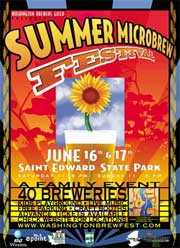
DATE AND TIME: Always Father’s Day Weekend
ADMISSION:
Advance tickets $12. Go on sale at local breweries starting May 1 check web site for outlets. (Larry's is selling tickets)
EVENT DETAILS:
Brewers Keg Toss The Keg toss happens at 2pm both days of the Festival at the Keg Toss and Coaster Championship Arena.
Coaster Championships Three public events will be going on all day long.
Come join in the fun and attempt to beat the Guinness world record of 111 beer coasters flipped and caught with one hand. Start practicing now so you can step up to the challenge!
Brewers:
Kids Lawn and Thomas Kemper Root Beer Float Garden:
Turn up the music on the Eastside: Craft booths and industry vendors form a community village. Children and those age 20 and under, will only be admitted with PARENTS. (Guardians, boyfriends, girlfriends, cousins, etc., are not acceptable substitutes.) Several food vendors are offering a variety of great food! You are also welcome to bring a picnic with you and spread out underneath a shady tree and enjoy!!
Beneficiary: Washington Brewer’s Guild
Sponsors: For additional information:
Your scribe will not be able to make it to the brewfest (damn! That’s two years in a row I will have missed it!) because I will be out of town Father’s Day weekend. I’m hoping one of you nice folks who attends the festival will exercise your writing skills for us!! If you WOULD like to write a short article about it, please send the results to myself or Nancy.
Thanks!  Bourbon for Breakfast Bourbon for Breakfast
By Richard Kinssies I never had bourbon for breakfast before and had not really intended to have it one recent morning when I agreed to meet with Fred Noe to taste his famous small-batch bourbons. Then I looked at the glasses of amber liquid and smelled the deliciously sweet heady aroma of whiskey and knew that was exactly what I was about to do. Fred Noe, actually Frederick Booker Noe III, is the seventh-generation descendant of Jacob Beam, who started the family distillery in Clermont, Ky., some 200 years ago, and great-grandson of Jim Beam, who restarted the distillery after Prohibition. He wants me to try his small-batch bourbons and answer any questions I might have. Small-batch bourbons have been a boon to bourbon producers since they were introduced about 10 years ago. They were meant to appeal to those who drink wine, single malt scotch and cognac and have accounted for most of the increase in sales of bourbons ever since. Noe is the quintessential Southern gentleman, soft-spoken, gracious and with a drawl the pace of honey in winter. Before we begin tasting, he tells me that it's important for me to know what a bourbon is. He says that all bourbons are whiskies but that all whiskies are not bourbons. Whiskies are spirits Bourbon is distilled from fermented grains and include Scotch, Irish, Canadian, Tennessee and bourbon. To qualify as a bourbon, the whiskey must be made in the United States from at least 51 percent corn (rye and malted barley are also used), be distilled at not more than 160 proof and aged in new charred American oak barrels for at least two years.
He goes on to say that bourbon is a true American original and every time we sip a glass of bourbon "we are doing our patriotic duty." Noe says that what makes one bourbon different from another is the choice of grains, the yeasts used to ferment the grains (mash) into alcohol, variances in the distillation process and aging.
His father is the company master distiller and has the last word as to which whiskies will qualify for small-batch status. In a company the size of Jim Beam, one might think that the decisions as to which whiskies make the cut are made in a boardroom or a lab. Not so, says Noe. "Every few months I collect a batch of samples (from different barrels), put them in my pickup and head over to daddy's house," he says, "then we sit around his kitchen table and we taste the whiskies." As we get ready to taste the four whiskies that represent what Jim Beam calls the Small-batch Bourbon Collection, Fred gives me a lesson in how to taste bourbon. First, smell the whiskey while leaving your lips parted, which gives the sensation of actually tasting the whiskey before it goes in your mouth. I try it and am amazed at how well it enhances the nose of the whiskey. He then grabs one of the glasses, takes a sip and begins smacking his tongue on the roof of his mouth while smacking his lips together. "We call that the Kentucky chew," he says with a smile, "it helps bring out the taste in the whiskey." I give it a try and find that it really works.
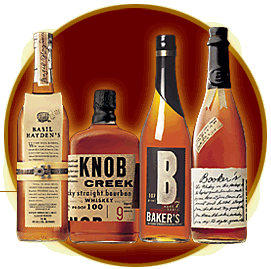
The Knob Creek (about $29) is the best seller in the lineup and it's easy to see why. It is dark and sweet with notes of caramel, vanilla and toasted nuts. It owes its character to the fact that there is more corn in the mash bill and it is aged for nine years in the most heavily charred barrels available. Bakers (about $39) is a dark whiskey with a strong and complex character and a very long finish. It drinks like a cognac and is my favorite of the four. Booker's (about $50) is, according to Noe, the first small-batch bourbon (made back in 1987) and it is Frederick Booker Noe II's pride and joy. It is very dark with strong, complex flavors and smells of wood and spice. It is aged for 12 years and is referred to as the "center cut." The term relates to the position of the barrels in the rack house where the barrels are stored. The "center cut" is less subject to the hot and cold extremes in weather and is believed to yield the finest whiskies. What's the best way to enjoy small-batch bourbons? Noe said many people drink them as they would a single-malt scotch or cognac. Others add a bit of water, some add ice and water or soda or mix it in a cocktail. All four small-batch bourbons are available in Washington liquor stores. 
Craft Brew? I heard a radio commercial a few weeks back that made me laugh out loud. It starts out with a narrator’s voice talking about all the choices we have in the Northwest. When we go into a pub, we are fortunate enough to have everything from craft-brewed light lager and ale all the way to porter, stout and barleywine (and every variety in between). It goes on to espouse the virtues of the craft-brewing industry and then says the next time you’re in a pub to order a fresh Henry Weinhard’s, one of the Northwest‘s best. Now I will admit that Henry’s is a highly drinkable beer but I do not consider it part of the craft-brewing revolution in the Northwest. Blitz-Weinhard (purchased by Miller Brewing in 1999) has been around for some time, but have never been known for leading the industry down new pathways. I think this is a very good indication for the craft-brewing industry in general.
To all microbreweries and brew-pubs in the region: As for myself, I will continue to support my local brewery, the smaller the better.
Congrats are due to our very own club president who garnered a few more awards than previously reported. Apparently, the report we got earlier last month only listed those who placed in the AHA Homebrew competition, and only those who would advance to the second round. It failed to tell us that, in addition to those that placed, two thirds of the rest will advance, too. Terry also received a Gold certificate, two Silvers, and a Bronze. Way to go, Prez! For those who are not familiar with the AHA award format, any beer scoring between 40 and 50 gets a Gold certificate. Between 30 and 40 is Silver. Between 25 and 30 is Bronze. Only the top three from each category advance, however. For example, there are beers in the round scoring 44, 43, 42, and 41 respectively. All will receive a gold certificate for placing in the first points category, but only the top three will advance to the second round. The 44 would receive a first place ribbon, the 43 a second place and the 42 a third place. Make sense? Terry’s Brown Ale and Maibock will move on to the second round as will several beers from Scott Douglas who placed 1st in light ale, a first in Belgian and French style ale, and 2nd for fruit beer. Also advancing to the second round will be Al Sullivan who placed 3rd in Barleywine and Imperial Stout and me, your own scribe, who placed second in American Premium Lager. Mine has a funny little story to go with it... I made this beer for a friend of mine who drinks macrobrew. He does not like strong ales (light or dark) and doesn’t like dark lagers. It tasted like Olympia. He had me brew it for him so he would have something to drink at my house on Superbowl Sunday. Then he failed to show up for the party or even for several weeks thereafter. I was stuck with two five-gallon kegs of beer that I did not want to drink. I felt it was one of my worst beers, but it DID fit the category. It never ceases to amaze me what will score in a contest. They didn’t even score my IPA which I thought was the finest bottle of beer that I have ever sent to a competition. Go figure! I haven’t had a chance to speak with Scott or Al so they may very well also have other certificates besides those that placed.
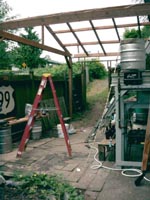
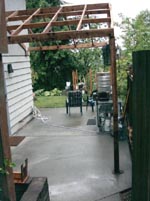
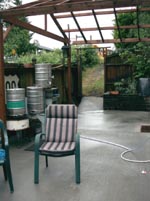
Good going guys!!! The Old Home Brewery Gets a Facelift I embarked a small construction project (or it seemed small when I began) this month, completely refurbishing my brewing area. I have never really had a good place to brew. My outdoor home brewery was a makeshift project with little things added as they were needed, usually in a haphazard manner. Half of it was a dirt floor with the other half split between a small concrete pad and a bunch of cinder blocks recessed into the ground to simulate a patio. Of course, all the water would run down between the blocks so they were never level and many is the unsuspecting friend who has stepped into the blocked-in area only to find his pants squirted with water from beneath the blocks. To top it all off, the roof was a make-shift lean-to with a green tarp strung off one end of it. Not your premium brewing zone. to say the least.
FOR SALE!! (2) 55-gallon stainless drums converted to brewpots. One boil pot, one mash tun) Both have 1 outlets with valves, welded seams and tops with handles. $250 each. (1) 15 1/2 gallon brewpot, (1) 15 1/2 gallon mash tun!! Great for your first venture into 10-gallons, all-grain brewing!! Includes strainer for mash tun to facilitate lautering, and hop back for brew pot. $225 takes both. Call Kevin, 206-246-8633 or e-mail. The, the, the, the, that’s all folks!!! |
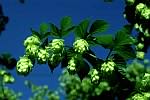 I was expecting a little more heat by now, but we’ll take whatever we can get. My hops are now 17’ tall and Eric’s are up to his gutters and crossing over the driveway. Tomatoes have kicked in and some even have fruits set already. My plum tree is going to have a bumper crop this year. Plum wine, anyone?
 The May meeting left me a little dazed the next morning. I was one of the last to leave for a change. The smoked turkey was wonderful once again (thanks, Jason) and the dog got his share, much to Caroline‘s distaste (largely because of the way Kevin fed it to him). As Munoz
said: There’s never a dull moment when the scribe is around. Some of us have the restraint not to act on our impulses all the time. Unfortunately, I am not one of those people.
The May meeting left me a little dazed the next morning. I was one of the last to leave for a change. The smoked turkey was wonderful once again (thanks, Jason) and the dog got his share, much to Caroline‘s distaste (largely because of the way Kevin fed it to him). As Munoz
said: There’s never a dull moment when the scribe is around. Some of us have the restraint not to act on our impulses all the time. Unfortunately, I am not one of those people.
 So what is a small-batch bourbon? These are bourbons made in smallerlots using the best ingredients and aged for extended periods in oak barrels. Noe claims that this is the way bourbon was made before Prohibition. His father, Frederick Booker Noe II, launched the small-batch bourbon category back in 1987 with the introduction of Booker's.