By mafia, I do not refer to an organized crime syndicate, but rather the familial structure that a college fraternity has. The following paragraphs will describe the Alpha Phi Omega service organization in the way it inevitably presents itself as a group of individuals with certain relationships. I will give generalizations of my experience with this fraternity, so I will not cite specific examples, since I do value my life somewhat.
A fraternity is a brotherhood. When I think of the brotherhood, I think of a monastery with bald-headed monks. I find it unusual to refer to other people as “brother,” even my own biological one. Nevertheless, it is the commonality that all members of a fraternity have. When one joins a fraternity, they become a brother to all other the members. In the case of Alpha Phi Omega, even female members can be brothers, since gender is not a requirement. Like all fraternities, Alpha Phi Omega is an exclusive club, but they have “rush” periods when they recruit more members, but they can only recruit members during their designated time. Otherwise, they would not be so exclusive and would not earn the “fraternity” in their title. Once a person joins, they become marked, whether they like it or not.
First, a would-be member must go through a pledging process. The goal of this is to train the rookie in the arts of being a good brother. This is essential to ensuring the bloodline of the organization. Usually, the membership committee appoints a particular person to train the rookies. This person is the pledgemaster, or Pledge Trainer as stated in the By-Laws of APO. This person is basically a godparent to the pledges. Pledges usually refer to that person as their papa or mama. The godfather or godmother really calls the shots to the pledge class and dictates what they are supposed to do. Anything major going on with the pledges must go through him or her first.
The pledges, in turn, have a special relationship with each other. Like high school students in the same grade level, each pledge class is in the same level of the organization. Consequently, members within each class have an acquired affinity for each other. They go to pledge meetings together, so feel like students in the same classroom. They study together; they learn together; they laugh together; they cry together; they work together; they play together. As they develop, so does the bond they have for each other. The pledges form a team of their own. They have pride for their class, and always insist their specialty over other classes. After the pledging process at the end of the semester, people refer to them as the __ Class (where “__” refers to the namesake of the class), as if they graduated like the class of ’01. And like the class of ’01, they keep with them memories of their greatest and private moments together. Some members of the same class refer to each other as “pledge brothers.” This class division spontaneously unites people, when the very mentioning of a particular class incites cheers from around the room. Class division is also convenient for the creation of teams during competitions. The classes establish seniority among the members of the fraternity. The elder classes have more wisdom than their successors. However, like all good things, they diminish with the passing of time with people retiring in order to move on with their lives. Maintaining the structure requires extensive upkeep. This is why the successors are so carefully screened. Meanwhile, the elders must take care of the new children, as it is their responsibility to ensure their progeny with the finest qualities of the trade.
 Each pledge class is a birth of a new generation. With each new
member comes new responsibility, and this responsibility is given to big
siblings. Big siblings are active members who willingly take a new child of the
fraternity into their loving care. These big siblings help guide their “little”
through their first steps in the fraternity. The relationship between “big” and
“little” siblings is mutual. At first, it is the bigger sibling’s job to provide
for their little. Then the positions can oscillate back and forth: the little
may take care of their big. The bigs usually inform their littles about upcoming
events and make sure they have good standing and cross over to become active.
They are also close friends with each other. These siblings can also help each
other in non-fraternal functions more often than most other members. In fact,
many expect that a big and little would always be in contact with each
other. With the introduction of siblings, more relations emerge: Grand bigs,
twins, grand littles, great-great relatives, etc. Everyone in the family feels a
relation with all the others. Even when a family member is not around, people
feel an intangible link towards that person, as if they were somehow knew them.
Each pledge class is a birth of a new generation. With each new
member comes new responsibility, and this responsibility is given to big
siblings. Big siblings are active members who willingly take a new child of the
fraternity into their loving care. These big siblings help guide their “little”
through their first steps in the fraternity. The relationship between “big” and
“little” siblings is mutual. At first, it is the bigger sibling’s job to provide
for their little. Then the positions can oscillate back and forth: the little
may take care of their big. The bigs usually inform their littles about upcoming
events and make sure they have good standing and cross over to become active.
They are also close friends with each other. These siblings can also help each
other in non-fraternal functions more often than most other members. In fact,
many expect that a big and little would always be in contact with each
other. With the introduction of siblings, more relations emerge: Grand bigs,
twins, grand littles, great-great relatives, etc. Everyone in the family feels a
relation with all the others. Even when a family member is not around, people
feel an intangible link towards that person, as if they were somehow knew them.With the active membership attending for the pledge class, a system of families have been developed to ensure a strong rooted foundation. Families in the club are assigned cliques. The pledgemaster and his of her team determine the fate in which the rookies can never escape (yet). Once one is in a family, they are branded for life, like cattle in a ranch. They can never escape this relationship no matter how hard they try. Everyone in a family considers each other as one of their own. The families form the greatest ties among their members. Like many establishments, there are good, bad, and ugly aspects. The family bonds are very strong and thus keep the people together. Without this family structure, it would be more difficult to maintain the larger body of the entire fraternity. Families keep their respective groups stable. The families grow as the fraternity grows, but at a much lower rate. It is easier to control the members if they are divided into smaller groups. Each family does their own activities, which strengthens the member’s ties and gives them a greater sense of belonging, and leads to a higher renewal rate. Some members gain friends that they would otherwise never have. Unfortunately, families can lead to the isolation at the same time, with each family being separated from the other. Members of one family may have no idea what another family is doing. Sometimes privacy is necessary to maintain a sense of uniqueness. Other times, it makes other families feel left out. When families compete in fun competitions, it tends to create side effects. These rivalries are a double-edged sword. On one hand, it motivates family members to come together and do something as a unit. On the other hand, sometimes animosity develops between members of other families. Some people want to strive to be rank higher than other families and members in a family may seclude themselves from other families as a result. When this happens, nobody wins the competition. This type of behavior is rare and discouraged by the vast majority. Most of the time, a member’s link to his or her family is their primary link to the fraternity.
The most common way that this fraternity grows is through pre-existing networks: friends. People who are close friends with each other tend to want to do the same activities together. Likewise, people may encourage their friends to join the same organization. These cliques are perhaps the most influential of any other subgroup in the fraternity. These people dismiss the any formalities and go straight to business, and have fun while doing it. They exhibit the same behavior before and after pledging. Friends tend to be closed within each other most of the time. Some may gain new friends from the fraternity. Unfortunately, the closer people get to each other, the further away they actually become. People who are not part of a friends’ circle may feel left out. This may cause feelings loneliness and rejection in some people and deter them from staying active in the fraternity. However, this type of grouping occurs by itself and the fraternity has no control over it. This grouping also facilitates the stability of the organization by pre-screening would-be members. Friends are motivated to be pro-active together and join committees to accomplish larger goals, and they do so with few complications and the greatest understanding. Sometimes these cliques do try to reach out to other individuals, but it does not always work. Some individuals are simply not accustomed to tightly knit groups and they may not feel that it is right to join or they may feel overwhelmed by such a friendly presence, or they may not have the time that the friendship requires. The concept of such close friendships must exist, for it is basic human nature.
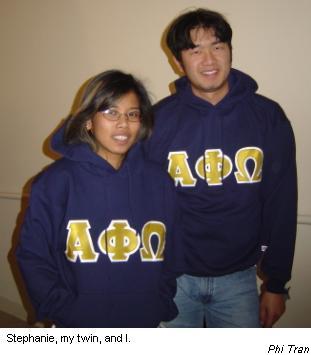
There are many things that the members of this fraternity keep with them. Some are tangible, some are not. Everyone receives letters from the fraternity and family. These Greek letters are labeled on items such as sweaters, t-shirts, jackets, necklaces, hats, paddles, plaques, pins pictures, toys, etc. While everyone earns a traditional blue and gold chapter sweater, individuals may give gifts to their siblings and close friends in the fraternity. There are no requirements for gift-giving: they give because they feel compelled to do so. The fraternity has given these people more than they could ever possibly repay. One way to give back to the fraternity is to serve the members with all their heart. The other way is to give meaningful gifts to those people they care about most. But most importantly, they embed in their minds among the most intimate and joyous experiences they ever had during their college life, and this is their life as a Greek. The Olive Garden principle applies the same to this fraternity; because when you’re here, you’re family.