At a time when it was held that the Earth was the centre of the world and that the Sun moved in relation to it, how could any one have failed to refer to the Sun's movement when talking of the sequence of night and day? This is not however referred to in the Qur'an and the subject is dealt with as follows:
--sura 7, verse 54: "(God) covers the day with the night which is in haste to follow it..."
--sura 36, verse 37: "And a sign for them (human beings) is the night. We strip it of the day and they are in darkness."
--sura 31, verse 29: "Hast thou not seen how God merges the night into the day and merges the day into the night."
--sura 39, verse 5:
"...He coils the night upon the day and He coils the day upon the night."
The first verse cited requires no comment. The second simply provides an image. It is mainly the third and fourth verses quoted above that provide interesting material on the process of interpenetration and especially of winding the night upon the day and the day upon the night. (sura 39, verse 5)
'To coil' or 'to wind' seems, as in the French translation by R. Blachere, to be the best way of translating the Arabic verb kawwara. The original meaning of the verb is to 'coil' a turban around the head; the
 notion
of coiling is preserved in all the other senses of the word. What
actually happens however in space? American astronautshave seen and
photographed what happens from their spaceships, especially at a great
distance from Earth, e.g. from the Moon. They saw how the Sun permanently
lights up (except in the caseof an eclipse) the half of the Earth's
surface that is facing it, while the other half of the globe is in darkness.
The Earth turnson its own axis and the lighting remains the same, so
that an area in the form of a half-sphere makes one revolution around
the Earth in twenty-four hours while the other half-sphere, thathas
remained in darkness, makes the same revolution in the same time. This
perpetual rotation of night and day is quite clearlydescribed in the
Qur'an. It is easy for the human understanding to grasp this notion
nowadays because we have the idea of theSun's (relative) immobility
and the Earth's rotation. This process of perpetual coiling, including
the interpenetration of one sector by another is expressed in the Qur'an
just as if the concept of the Earth's roundness had already been
notion
of coiling is preserved in all the other senses of the word. What
actually happens however in space? American astronautshave seen and
photographed what happens from their spaceships, especially at a great
distance from Earth, e.g. from the Moon. They saw how the Sun permanently
lights up (except in the caseof an eclipse) the half of the Earth's
surface that is facing it, while the other half of the globe is in darkness.
The Earth turnson its own axis and the lighting remains the same, so
that an area in the form of a half-sphere makes one revolution around
the Earth in twenty-four hours while the other half-sphere, thathas
remained in darkness, makes the same revolution in the same time. This
perpetual rotation of night and day is quite clearlydescribed in the
Qur'an. It is easy for the human understanding to grasp this notion
nowadays because we have the idea of theSun's (relative) immobility
and the Earth's rotation. This process of perpetual coiling, including
the interpenetration of one sector by another is expressed in the Qur'an
just as if the concept of the Earth's roundness had already been 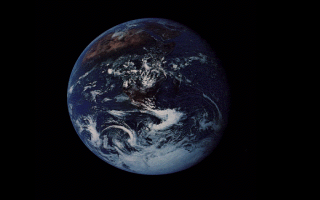 conceived
at the time-which was obviously not the case. Further to the above
reflections on the sequence of day andnight, one must also mention,
with a quotation of some verses from the Qur'an, the idea that there
is more than one Orient and one Occident. This is of purely descriptive
interest becausethese phenomena rely on the most commonplace observations.
The idea is mentioned here with the aim of reproducing as faithfully
as possible all that the Qur'an has to say on this subject.
The following are examples: --In sura 70 verse 40, the expression 'Lord
of Orients andOccidents'.
conceived
at the time-which was obviously not the case. Further to the above
reflections on the sequence of day andnight, one must also mention,
with a quotation of some verses from the Qur'an, the idea that there
is more than one Orient and one Occident. This is of purely descriptive
interest becausethese phenomena rely on the most commonplace observations.
The idea is mentioned here with the aim of reproducing as faithfully
as possible all that the Qur'an has to say on this subject.
The following are examples: --In sura 70 verse 40, the expression 'Lord
of Orients andOccidents'. --In sura 55, verse 17, the expression 'Lord of the two Orients and the two Occidents'.
--In sura 43, verse 38, a reference to the 'distance between the two Orients', an image intended to express the immense size ofthe distance separating the two points. Anyone who carefully watches the sunrise and sunset knowsthat the Sun rises at different point of the Orient and sets at different points of the Occident, according to season. Bearings taken on each of the horizons define the extreme limits that markthe two
 Orients
and Occidents, and between these there are points marked off throughout
the year. The phenomenon described here is rather commonplace, but what
mainly deserves attention in this chapter are the other topics dealt
with, where the description of astronomical phenomena referred to in
theQur'an is in keeping with modern data.
Orients
and Occidents, and between these there are points marked off throughout
the year. The phenomenon described here is rather commonplace, but what
mainly deserves attention in this chapter are the other topics dealt
with, where the description of astronomical phenomena referred to in
theQur'an is in keeping with modern data.