|
|
|
|
|
|
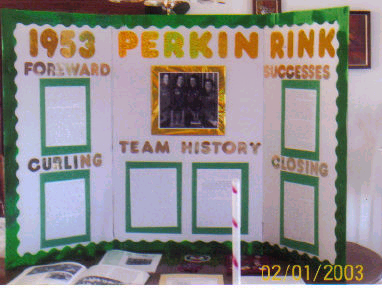
Introduction: With the NHL lockout, Canadians have to turn to their other favorite winter sport, curling. The Scott Tournament of Hearts, for women, and the Nokia (now Tim Hortons) Brier, for men, are just two of the many curling competitions, these are probably the most well known in Canada. Although, back in 1953, they didn’t have an all Canadian curling playoff. In 1953, was the first year that the Western Canadian curling playoffs took place in Regina. The team that ended up winning was the Janet Perkin rink from the Caledonian curling club in Regina. This is their unsung story.
Questions: 1. Where was curling first played, and what are some basic rules? 2. What is some background information on the Caledonian curling club in Regina? (Membership, team arrangements) 3. How did the team advance to Provincials, and then onto Westerns? 4. What is some background information about the Westerns? (Sponsors, where they were held) 5. What happened at the Westerns? (Teams, Standings) 6. What were some accomplishments of the members on the team, and the team as a whole?
There is evidence that curling was first played in Scotland and/or Holland in the 1600s. The game was played on frozen marshes in Scotland. They used ‘channel stones,’ which were stones worn smooth by water, the Dutch played much the same way. The oldest to date curling stone was found in Scotland, the date read 1511. The rules to curling are really basic. There are two teams of four players each. They deliver stones across a measured length of ice, to a marked target area, or ‘house’. One point is scored for each stone inside the house, and closer to its center, or ‘button’, than any opponent’s stone. Each game consists of 10 ends, unless the score is tied at the end of the 10th end, then the game goes into extra ends until there is a winner. The players are the lead, the second, the third and the skip. The lead throws the first rocks, the second throws after the lead, the third throws after the second, and the skip throws the last rocks, and is the team captain. Each person throws two rocks, and the two teams alternate throwing stones. For example, if Team White’s lead was throwing first, after the lead has finished throwing, then Team Green’s lead would then throw their rock.
The Caledonian curling club is now by the airport in Regina. Janet Perkin, Phyllis Day, Jean Graham, and Joyce Miller were all members of the club in Regina. The ladies curling took place in the evenings after supper, because that was the only time slot the male curlers would give to them. The ladies club created a rule that you had to be a “working girl”, or have school age children to play. There was only enough ice for 12 teams, so that’s why the rule above was put into effect. The Janet Perkin rink members, Joyce Miller, Phyllis Day, and Jean Graham all met through curling in the same club. Sometimes they were on the same team, and some times they were not. You see, players weren’t always on the same teams because the teams were drawn from a hat, so no one would be left out. The road to the Westerns was anything but easy. First of all, there was the club playoffs. Then there was city playoffs. Before the club play downs came, Janet Perkin got to pick who she would like to play with her. Mrs. Perkin asked Phyllis Day, Jean Graham, and Joyce Miller. They all gladly accepted and the Janet Perkin rink was born. In a March 2005 interview, Joyce Miller stated, ”Your grandmother could spot good curlers.” Boy, was she right! So, the team began with the club play downs, and they won, they moved onto cities, and they won. Now, the newly picked team had some experience together, and they went on to win the Southern title. They did not lose a single game!
For the provincials, the southern and northern teams played the best of three games to determine the provincial champs. At the provincial championship in North Battleford, Perkin’s rink ended up beating Mrs. Anderson’s rink from Nipawin to advance onto the Westerns in Regina. The Western Canadian play downs were held in Regina, in March, 1953, at the Regina curling club, which today, no longer stands. The main sponsor was the T. Eaton’s Company, who would award a gift certificate prize of $400 for the team, so $100 per person. (The T. Eaton’s Company also sponsored the provincials, but only gave $25 gift certificates to each person.) Joyce and Janet were very pleased, excited and proud to be representing Saskatchewan at the Westerns. Janet was very glad that they were getting to play other provinces. She was also looking forward to an all Canadian playoff, but that didn’t happen until much later. The first game for the Janet Perkin rink was their first game on artificial ice. The result was not very flattering. The Perkin rink lost 22-4. After getting to know the ice conditions, the team made a rebound, to make the first game they played, their only loss. There would be no final, because the tournament was a double round robin knockout. So, every team played against the other teams twice, for a total of four games. The final game that the Regina four played, they had to win. Picture this: It’s 11-11 at the end of the 10th end. You’re going into an extra end. You are Janet Perkin, and you need to make your last shot for the win, and a three and one record.
“I never went for a shot that I didn’t think I could make. I had to be positive you know,” Janet Perkin, March 5th, 2005. “I wasn’t nervous because I knew she (Janet) would make it,” Joyce Miller, March 5th, 2005. Joyce had every confidence in Janet’s shot making, and she was right. Janet Perkin made her final shot for the three and one record, and the Western title, plus $100 for each member on the team. And still, to this day, Joyce calls Janet’s last shot her ‘$400 dollar shot,’ because of the prize money they won. After the tournament, Janet’s team record was 3 and 1(3 wins, 1 loss). Mrs. Close’s rink (Alberta) record was 2 and 2, and Mrs. Dick’s team (Manitoba) was 1 and 3. (British Columbia would later join the Westerns in 1954.) Mrs. Dick’s only win was a crucial one, because they beat the Alberta entry, and Alberta did not get to play an extra game against the Regina rink, like they were hoping to. Janet Perkin and Joyce Miller did not only win the cities, southern title, provincials and westerns in that one season in 1952-1953. They did much more in their lifetimes. Joyce Miller joined the Callie curling club in 1949. Janet Perkin joined in 1948. Together, Janet and Joyce won 7 aggregates together (Regina Bonspiel). They curled together at the Westerns in 1959 in Brandon, Manitoba. In 1964, they also won provincials. Joyce, by herself, won another aggregate with Jean Graham. Joyce was also a very accomplished tennis player.
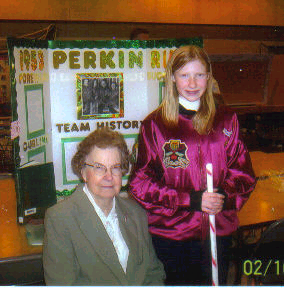
Janet, with a team of four girls, at the age of 12 and in grade 8, won the Bethune Aggregate. Her team played against grade 12 boys, and Janet was the only female skip. In her days of curling, Janet skipped three teams to the provincials. She won 9 Regina Ladies Bonspiel Grand Aggregates. Janet also played in the All American Girls Professional Baseball League for one year. As a team, Janet Perkin, Phyllis Day, Jean Graham and Joyce Miller were inducted into the Inaugural Saskatchewan Curling Association Legends of Curling Honor Roll. Conclusion Many years have passed since the 1953 Janet Perkin rink won the first Westerns. Some of the members of the team have since passed on, but two still remain. But even today, they are being remembered. By this report being written, and they are being inducted into the Saskatchewan Sports Hall of Fame in June, 2005. Sure, many people may eventually forget that Janet Perkin’s rink curled out of the Caledonian curling club, or that the first Westerns for curling were held in 1953. But I know that I, for one, will never forget how my grandma, Janet Perkin, was one of the four classy lassies from Regina who won the first Westerns in 1953.
|
|
|
|
|
|
1. http://www.hickoksports.com/history/curling.shtml. ©November 16, 2004. Viewed February 18, 2005. 2. The Diagram Group. Rules of the Game. Diagram Visual Information Ltd., United States of America, ©1974 3. Regina Leader Post. February 2005 4. Saskatchewan Curling. “They Made History!” T-Line Review. February 2005 Volume 8 Issue 1. 5. Regina Leader Post. February 12, 1953. 6. Saskatchewan Curling Association. Saskatchewan Curling-Heartland Tradition. ©1991 7. 1952-1954 SCA Yearbook 8. Team Nomination Form for the 1953 Janet Perkin rink. 9. Regina Leader Post. March 1953. 10. Perkin, Janet. Personal Interview. February and March 2005. 11. Miller, Joyce. Personal Interview. 5 March 2005.
|
||
|
This is the site where I found information about the history of curling. |
|
|
This is a link where you can access the induction dinner program. |