38 out of 52 cars
surveyed at River Road are estimated to carry loan payments of RM150-650 per
month
Cheah Kah Seng Nov 15, 2001
1. Main estimations
- There are 52 cars surveyed, and their years of made range from 1971 to 2000
- 38 of the 52 cars (73%) are estimated to be worth RM10,000-RM35,000 each, therefore likely to carry some loan financing. All 38 are 1985 or newer.
- The values are estimated from offer prices in classified ads placed at www.thestar.com.my and www.cari.com.my
- The classified ads also indicated market loan margins of 70%-90%, loan lives of 5-7 years, and interest rates of 4.75%-6%.
- This estimate assumes 5.5% interest rates. However, the River Road owners have likely committed to higher rates at higher original value from a few years back, since no car is newer than 2000.
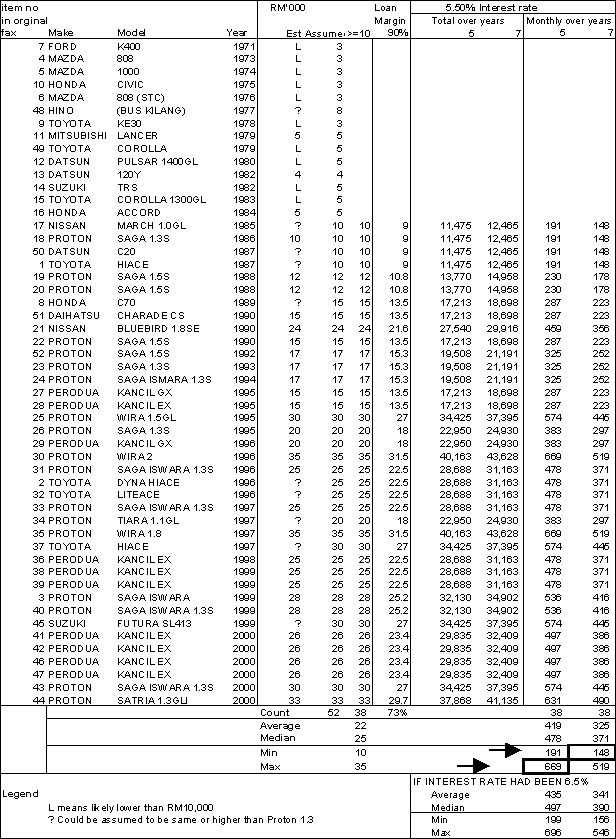
- For an owner of a RM10,000 car, assuming loan margin of 90% for 7 years, he or she would borrow RM9,000, and pay RM148 per month of interest and principal. If loan life is shortened to 5 years, monthly payment would be RM191.
- For an owner of a RM35,000 car, assuming loan margin of 90% for 7 years, he or she would borrow RM31,500, and pay RM519 per month. If loan is shortened to 5 years, monthly payments would be RM669.
- Together,
these mean 38, or 73% of the 52 car owners, assuming they borrow 90%, at
5.5%, for 5-7 years, would likely be paying RM148-RM669 per month or more.
·
Because finance companies often require that
a borrower prove an adequate income level (we assume income must be 3 times
monthly loan payment), we can deduce the minimal implied incomes for the 38
owners. Following this logic and assuming 5-year loans, we estimate there are 9
owners with monthly income above RM1,500, or 24 with income above RM1,000, or
32 with income above RM750.
2. Background
- Ong Boon Keong of Save Our Selves surveyed the cars parked at low-cost housing project at the River Road one evening in November 2001
- The River Road tenants are supposed to have been fully investigated by the State government of Penang to ensure that they fall below stringent income criteria
- After rental decontrol, the State government purportedly would further ensure the River Road units are allocated to the hardcore poor and extremely needy.
- After OBK submitted the surveyed list, instead of conducting an investigation, the State only passed back a JPJ print-out of vehicle details for OBK to analyse.
- If indeed at least 38 tenant have been inappropriately allocated these low cost housing units, it could imply negligence or worse at the State government.
- At the very least, it implies a lack of disclosure and transparent review process.
3. Discussion
· Assuming finance companies require borrowers to prove a certain income relative to loan payments, we can deduce the implied incomes of the 38 car owners
· For example, finance companies may require that an owner must generate RM1,000 monthly income to be considered capable of paying RM333 monthly loan and interest payments, a 33.3% affordability ratio.
· At and above monthly loan payment of RM600, eg, the owner would have to show an income of over RM1,800/mo., while for RM250 payment RM750 income
· Given the various monthly loan payments estimated for the 38 owners, we can deduce that - had all adopted 7-year loans, there would be (cumulatively)
· 2 owners with income above RM1,500
· 21 owners with income above RM1,000
· 27 owners with income above RM750
· If they had opted for 5-year term to save interest, we can deduce that cumulatively
· 9 owners have income above RM1,500
· 24 owners have income above RM1,000
· 32 owners have income above RM750

Deduction of implied income based on estimated car loan and affordability ratio
(last two columns here filtered from the data in the last two columns of Appendix 1)
- Other discussion points:
- Although in general residents should not be faulted for working hard to own cars, the ability to afford RM150-650/month of payment is clearly contradictory to the spirit and likely written rules and regulations regarding the River Road units
- What are the poverty-defining levels of income in the State allocation process for the River Road units, in consideration that an estimated 32 owners have income over RM750/mo, 24 with income over RM1,000/mo, 9 with income over RM1,500/mo?
- Although the residents may need private cars to get to work and become productive, it only reflects the general failure of the State to provide affordable, comprehensive and efficient public transportation (not just a few freebies).
- The Rifle Range low-cost housing residents are known to possess large numbers of private cars. But there is a major difference. Many the Rifle Range residents have owned or rented the units for decades, and have since built up family means to own cars. The River Road residents have only been vetted a few months ago.
- Some of the cars surveyed may be visitors. But such number is likely small, and can be verified with further investigation through the JPJ.
- Some of the cars may belong to company, proprietorship, employers, etc. In any of these cases, the user would have to have an adequately high level of income or responsibility to justify the fringe benefit of the apparent exclusive use of a car
- Some of the cars may belong to civil servants or special groups of residents allocated to particular sections of the River Road apartments. If that is the case the State government should come clean and explain the number of units and percentages allocated to those above the poverty criteria. The State government should disclose the criteria applied to this group, the groups’ general profile, how the groups have received a fair allocation among themselves, and who have made the allocation decisions.
4. Calculation
- Refer to Appendix 1
- Most older cars before 1985, including the bas kilang are either estimated or assumed to be worth less than RM10,000. These are marked as “L” in the “Est” column in Appendix 1.
- For cars from 1985, values are estimated by referring to offer prices from classified ads, taking the lowest in the range.
- Cars from 1985 where comparable values cannot be obtained from classified ads, are assumed to have the same value as the lowest-priced proton (1300cc) of the same year. These are marked “?” in the “Est” column in Appendix 1. Two examples are Toyota Hiace 1987 (estimated ? and assumed RM10,000) and 1996 (estimated ? and assumed RM25,000).
- Only cars over RM10,000 estimated values are included in further calculation
- Loan margin and amount are estimated at 90% of car value
- Interest rate is assumed to be 5.5%
- Loan lives are assumed to range from 5-7 years
- Total repayments for principal and interest are calculated for both 5 and 7 years
- Per month payments are calculated for both 5 and 7 year loans
- Actual payments are likely higher. Loan payments are underestimated because of:
o Use of the lowest, rounded-down, price from classified ads
o Use of 5.5% interest rate, when 1996-2000 rates were likely higher
o When buyers committed in prior years, total interest and payment would be based on old, higher, prices, not today’s classified-ad, depreciated prices. For example, when a buyer bought the 1999 proton, the loan repayments and interest would be based on a new proton price of perhaps Rm35,000, rather than the RM28,000 estimated now for a 2-year old
- Other notes:
- The 38 are mostly Proton (18 cars), Perodua (10), plus Toyotas (4 newer than 1985), Nissan (2), Datsun (1), Daihatsu (1), Honda (1), Suzuki (1)
- There are no new cars purchased in 2001
- The newer cars are lower-priced cars, especially in 1999-2000 (Perodua Kancil and Proton 1.3).
- The weight of the car values are skewed toward the low side. While median price is RM25,000, average price is RM22,000.
- The highest-priced cars are likely the Suzuki 1999, Toyota 1997, Wiras 95, 96, 97, and the two Proton 2000.
5. Sources of classified ads and price information
http://www.star-motoring.com/
http://classifieds.thestar.com.my/class.asp?cat=Autos~and~Motorcycles
http://www.cari.com.my/classified/newcar/
Appendix 1: Estimation of value, margin,
total and monthly repayments (5-7 years)
Appendix 2: Tabulation by Year and Make

Appendix 3: Prices according
to classified ads
