
There is much information out on the web concerning PCOS. Here is just a tiny bit of information which could help you with your journey of PCOS. For some people the journey is quick and simple and others its long and very stressful.
What is PCOS?
What does PCOS look like in pictures and ultrasounds?
How to treat PCOS?
What medications do dr's use?
Polycystic ovarian syndrome is a condition in which there is a hormonal imbalance within the ovaries. Normally the ovary produces estrogen (E) (the female hormone), testosterone (T) (the male hormone) and progesterone (P) (the pregnancy hormone). P is only produced after ovulation or an egg has been released. In this condition, E may be produced in normal amounts, T may sometimes be produced in excess and P may not be produced every month because the woman may not ovulate every month. There may be an imbalance in the amounts of E versus T that may prevent ovulation. We are still unsure as to why women develop PCOS. In some women it may run in families, in other women it may only occur if they are overweight and will then correct itself once they lose weight.
Women who have PCOS may have the following problems: 1) infertility due to lack of ovulation, 2) excessive or male pattern hair growth (hirsutism) due to imbalance between E and T, 3) irregular menstrual cycles and heavy bleeding (cycles which are either less than 21 days or more than 35 days apart) due to lack of ovulation, and 4) obesity. Most women will present with the problems of abnormal bleeding, hirsutism, infertility or less commonly with obesity. Some women with PCOS may have a higher than normal miscarriage rate if they become pregnant.
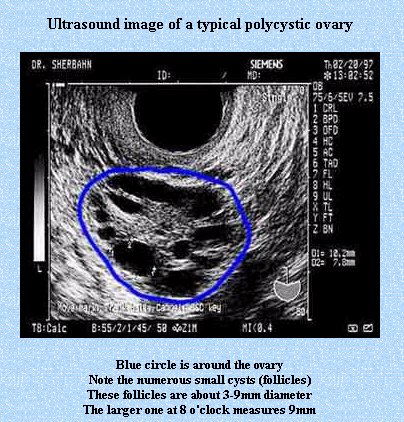
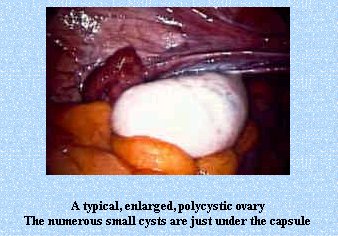
The diagnosis of PCOS is made primarily on the woman's presenting history and examination. The diagnosis can be confirmed on ultrasound or by measuring the woman's hormonal levels. If the ultrasound and the blood tests are normal it does not mean that the woman does not have the condition. However, it has also been found that women who do not have problems with their periods or of excessive hair growth can have ovaries which on ultrasound have the appearance of being polycystic.
The treatment of a woman with PCOS will depend on the presenting problems. For example, the problem of hirsutism will prevent treatment for infertility.
If a woman presents with irregular heavy bleeding, the oral contraceptive pill (OCP) is the treatment of choice, both to regulate the cycle and to prevent over growth of the endometrium (lining of the womb). P can also be given to replace what is not being produced monthly. If hirsutism is the problem it can be treated using the OCP as well as with drugs that act against T. If these drugs are used it is most important that the woman use a reliable form of contraception as they may cause genital abnormalities in a male baby if the woman becomes pregnant.
If infertility is the problem then clomiphene citrate (CC) (Clomid or Serophene) given orally for 5 days early in the menstrual cycle may induce ovulation. Ovulation can be induced in 80% of women using CC and pregnancy rates approach those seen in the normal population (20-25% per month) provided that there are no other factors affecting fertility. The commonest side-effect with CC is hot flushes. The multiple pregnancy rate with CC is 5% and the majority of these multiple pregnancies are twin pregnancies.
If CC fails to induce ovulation at maximal doses or if the woman has tried CC for up to 6 cycles in which she has ovulated but has not become pregnant, follicle stimulating hormone (FSH) at low doses may be given. Prior to using these drugs the treating doctor will want to (if she/he has not already done so) make sure that the woman's Fallopian tubes are open and that her pelvis is normal, by performing a laparoscopy and hysteroscopy. These drugs are given by injection and when the woman uses these drugs she needs to be monitored using blood tests and ultrasounds to make sure that the drugs are not causing her to develop too many eggs. The aim when these drugs are used is to cause only one egg to develop (similar to in a natural cycle).
Nevertheless, the multiple pregnancy rate may be 20-30% with 80% of these multiple pregnancies being twin pregnancies.
Weight loss is also of paramount importance. The disease process may be reversed with loss of weight and there is also evidence that the higher miscarriage rate may decrease to that in the general population with weight loss. A dietician may be required.
An operation called ovarian drilling, performed at laparoscopy, can also be used to treat women with PCOS. This operation is usually reserved for women who want to be pregnant, and who have not ovulated on CC. In these women it may be used as an alternative to HMG or follicle stimulating hormone (FSH). During this procedure the ovary is cauterized by drilling into it in a number of spots. We do not know exactly why this procedure works. If the operation is successful the effect may be long lasting.
In a small number of women, PCOS can be a very severe disease in that it can lead to the development of diabetes with all its complications. If the doctor suspects that the woman has this type of illness, she may need to undergo testing to make sure that she is not currently a diabetic. If diabetes is diagnosed weight loss, diet and the possible use of tablets may be necessary.
Taken from Monash IVF web site here
Also, to make this harder to help women, is the fact that women can go in and out of PCOS symptoms. However, if looked hard enough (through internal scans and the woman's history), you can tell if she's had/has PCOS. I was always under the impression that once you had it you've always had it and will always have it. However, upon talking to my specialist, she informed me you can slip in and out of having it. It just depends on what your homones and ovaries are doing.

Treating PCOS is one that can work, but the person who has it must be persistant and have faith that it will work. I've always been one of those people who does loose weight on a diet, but once I go off of the diet, the weight comes rushing back plus the amount I've lost. It gets to be a real yo yo after awhile. However, with the help of my fertility specialist, a dietician, and a gym or exercise I'm slowing getting to look and feel like we can really get pregnant and have the family we want.
Diet
It seems like everyone is always harping on diet and how everyone must loose weight. I know I've heard it many times over the years and just said yep and rolled my eyes because I'm just over it and how the doctor's harp on it. However, when you are having a problem getting pregnant, the one main thing that everyone looks at is your diet because what you eat and do have a big impact on how successful you are with getting and maintaining a pregnancy.
It has been found that if you eat nothing but junk foods, not only will you have more problems with your overall health, but you will have a higher and harder chance of having problems conceiving and maintaining a pregnancy. It has been found in more than one study and in more than one country.
My dietican even told me that if you just change what you are eating, inside you will be better and that will be better for conceiving. Usually in changing what you eat, will also help you loose weight. Sometimes, however, you have to couple the diet with some exercise.
Also, with PCOS, you have a harder time to loose weight because of the sugars that are in foods. In order to loose weight, a Low GI diet is what you need. This kind of diet has very little sugars and you ration your foods. That means no pototoes, eating multigrain or rye breads, eating a certain type of rice, and limiting your pasta intake. To take a look at what my diet was like, click here. At first it was hard to do, but as you get used to it, you do get used to it. I now even bake my own snacks, but use wholemeal flours instead of the typical wheat flour. We substitute the wheat flour wherever possible.
I am one of the laziest people around...I admit it. I love nothing better than to sit in front of the computer or in front of the TV and do nothing all day. However, the one thing that was pressed upon me, was that the inactivity is not good. Firstly, having all the wrong things to eat will increase your blood pressure, which will increase your likelihood of other health problems. Also, it will tax your body and make the body keep the weight on and will cause your body to be preoccupied with keeping you living and not giving you a chance to actually make another living thing. When this was expressed to me, I got concerned and asked what could I do. The doctor's said that I could do the following:
Get out and go for a walk. Not only is this good for exercise, but the sun actually helps you with one of your vitimins (I think its vitimin D). It does not have to be for an extended amount of time. You can just go on 3 20 minute walks a day. Then work your way into 2 30 minute walks and so forth until you can take one walk 1 or 2 times a day for an hour. Usually an hour or two will give you the needed excercise that a healthy person needs.
By a step counter and make sure you do 10,000 steps a day. That is a goal to reach everyday to every other day. Usually at any pharmacy or chemist you can buy one. You don't need one that's expensive just one that says how many steps you do. If you clip that onto your waist when you get up with a zero (0) count, then as the day goes on, it counts just how many steps you do do. When you get off from work or in the early afternoon, take a glance at it to see how many steps you've done. If its not near the steps you need, then go for a walk. The length of the walk depends on how active you been during the day. Over time, you will notice that you will be feeling better and have more energy.
Join a gym. Some people don't like the other two options because its too easy to get out of making a commitment to doing them. However, if you join a gym, they usually keep tabs on you and will ask questions when you haven't been for awhile. Some gyms even have programs that are done just for you, so you can target problem areas. I did the other two options (step counter and walking) but found with the rain, I was slacking off exercising, and I needed something more. I did join a gym, and have now lost, after 6 months, about 5 kilos (about 11 pounds). That is going 5 days a week, doing weights and cardio machines for about 1 1/2 hours a go 3 times a week and cardio machines for 1 hour 2 times a week. Its gotten me toner and I'm now down from a size 18 to a size 14 in pants!
Some doctor's handle the syndrome different ways. One doctor look at certain blood tests and then decide which medications to use. Other's just say that this is the way that they've read that the syndrome is to be treated and treat it that way. Then you have other's which have studied the syndrome and treat it on many fronts. To read about drugs that can be used, used click here.
Some doctor's handle the syndrome different ways. One doctor look at certain blood tests and then decide which medications to use. Other's just say that this is the way that they've read that the syndrome is to be treated and treat it that way. Then you have other's which have studied the syndrome and treat it on many fronts.
Some of the medications that are used can vary. Some use a combination and some they have to get the dosage just right. Keep in mind, with PCOS, your hormones can work with some drugs and not work with others. Also, the drugs could be working but be at the wrong levels, so checking the levels and how they are working with your hormones is very important.
clomiphene citrate (CC) (Clomid or Serophene) (make sure that you are closely monitored by your doctor and that you take a break over 6 cycles) - This is used on two fronts. One is to get better quality eggs, and another is to help get you to ovulate. They are taken on two different days (2-6 or 5-9).
Met or Metformin- This is usually given to people who have insulin problems. Sometimes doctor's like to give this with the use of Clomid for ovulation problems as well.
Gon F injections- Usually given on its own with a "trigger" shot. These are injections which require you to be trained in how to give them to yourself. Also, using this, you may be monitored with ultrasounds and blood work. These are usually used in IUI's and IVF cycles to help the multiple eggs get bigger.
Other - There are new drugs that are out on the market or are being tested. See a proper fertility specialist for a medication and investigations that can help you. There are many trials being done at the moment to try and give more alternatives for people suffering with problems with PCOS and other infertility problems.
Exercise
Drugs
What medications do dr's use?
The most common drugs that are used are:
Diane 35ED (Birth control pills) -helps to keep the symptoms of PCOS on a level.
Last updated 1 Dec 2004
© Copyright by Jo Ann & Brett Fitzgerald
Created using Notepad