
|
|
| Report | Pictures | Bibliography | Web Links |
|
Introduction The CFL is a great league and has an even better story. It’s the only Canadian professional sport with only Canadian teams. It is a very exciting form of football because the field is wider than in the NFL and you have more players and fewer downs. It is the best sport in Canada and The Grey Cup is the oldest trophy for a professional sport in North America. Questions for Research
2. How did football get started in Canada?
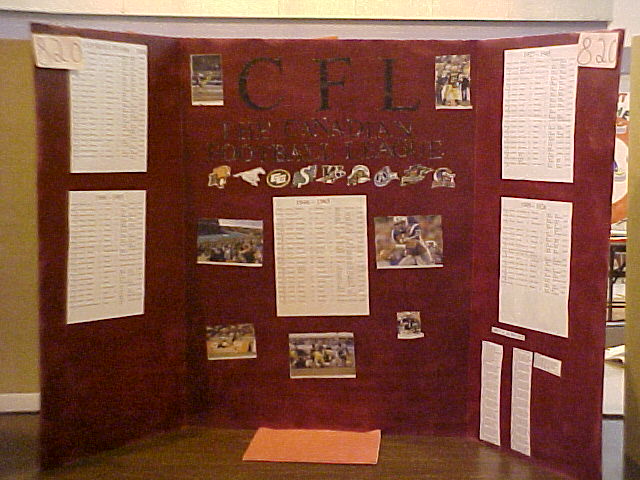
4. What is the CFL today? 1. William Webs Ellis first created football in England in 1823 when he picked up the soccer ball and started to run with it, he was tackled by an opponent. The game consists of two teams; with 24 players on the field at one time. There are twelve players from each team. The two sets of twelve players are called offence and defense. On each offence and defense there are 12 different positions. On offence there are 5 players that which are called the offensive line, their duty is to protect the quarterback. The quarterbacks job is to get the ball from his centre (part of the offensive line) and either hand it off to his fullback or halfback or throw it to his wide receiver or slot-back. On defense different people have different roles just like on offence. The defensive line lines up 1 yard away (facing the offensive line), their job is to tackle the quarterback or whoever has the ball. There is also corner backs that cover the wide receivers and try to prevent them from catching the ball. The offence’s job is to move the ball 10 yards and score the points. They can do this by running with the ball or throwing the ball to their eligible receivers. The defense's job is to tackle the ball carrier, knock down or catch the offences passes to prevent them from scoring points. If the defense is successful in catching the ball it is called an interception. On an interception the defense and offence switch roles. The offence would have to tackle the defense. When they do the other offence comes on. The object of football is to out score your opponent. You can score by getting touchdowns (getting the ball into the end of the opponents side of the field), worth 6 points. You can also get field goals (kick the ball off the ground and through the uprights), worth 3 points. You can also get extra points after the touchdown. You can do this by either kicking the ball through the uprights from 5 yards away from the end zone (the opponent’s end of the field), worth 1 point. Or you can run/throw the ball from 5 yards into the end zone for 2 extra points. If you get tackled in your end zone the opposing team gets 2 points and possession of the ball. You can also get one point by getting the ball dead in the opponents end-zone, either by punting the ball through the end-zone or having the opposing team intercept the ball and have them get tackled or run out of bounds. This is worth 1 point and the opposing offence starts at their 20-yard line. Each team (when their offence is on the field) gets three downs/try’s to move the ball ten yards. If successful in their first 1-2 try’s they get another 3 downs to get the ball another 10 yards. On their 3rd down they can choose to punt/kick the ball down the field so the opposing team isn’t so close to the end zone. Or they can choose “to go for it” and try to pick up their yards 10 yards. However if they are unsuccessful in their three downs the opposing team gets the ball. The field is 110 yards long; when they get to the end it’s called a touchdown. 2. Football first got introduced in Canada by the British army garrison in Montreal. McGill University discovered the game and in 1874 they arranged to play a series of games at Harvard. Harvard liked the new game so much that it became a feature of the Ivy League. The game soon spread throughout North America. In 1884 the Canadian Rugby Football Union was created as the sports governing body. And by 1890 the game was being played throughout Canada. The inter-provincial Rugby Football Union had been organized in 1907 with teams from Montreal, Ottawa, Toronto and Hamilton. This league became known was the big four. The western inter-provincial football union was organized in 1936 with teams in Winnipeg, Regina and Calgary. Edmonton joined in 1936. In 1939 World War II interrupted and the WIFU (western inter-provincial Football union) withdrew for the duration. The big four did the same. Service teams filled the void during the war. Both leagues resumed competition in 1946 with the same four teams from the east and 3 teams from the west. The Regina team changed its name to the Saskatchewan Roughriders. And Edmonton rejoined in 1949. The British Columbia Lions were admitted in 1954. In 1956 the IRFU and WIFU were acting under the jurisdiction of the CRU, so they decided to create the Canadian Football Council to govern professional football in Canada. The council recommended the appointment of a commissioner to oversee the two divisions which changed their name to the east and west conference. The name Canadian Football league was officially adopted in 1958. Later that year G.Sydney Harter of Winnipeg was appointed the first commissioner. The CFL then withdrew from the CRU, which changed its name to the Canadian Amateur Football Association. In 1986 Montreal withdrew from the CFL. In 1993 the CFL expanded to the USA with Sacramento in the West Division. In 1994 Baltimore and Shreveport joined the east division, and Las Vegas joined the west division. Las Vegas pulled out after only one season do to poor popularity but Baltimore won the Grey Cup. In 1995 the Sacramento team relocated to San Antonio and Memphis and Birmingham joined the CFL. Due to lack of a major television contract the U.S owners pulled Birmingham, San Antonio and Shreveport from the league. Baltimore relocated to Montreal. In 1996 the Ottawa roughriders were terminated but came back in 2002 as the Ottawa Renegades. 3. The Grey Cup dates back to 1909 when the Governor General of Canada, Lord Albert Henry Earl Grey, donated the trophy to be awarded to the winners of the senior Amateur Football Championship. Since that time it has survived two world wars, thefts, fires and misplacements. These days the top team from the east division and the top team from the west division play for it. But back in the day only universities and amateur teams could play for it that’s why some of the inscriptions on the trophy read University of Toronto and the RCAF Hurricanes. Teams from the west division weren’t allowed to challenge for the cup until 1921, when the Edmonton Eskimos made their first of 22 Grey Cup appearances. By 1955 the universities and other leagues such as the Ontario Rugby Football Union and the Quebec Rugby Football union withdrew from Grey Cup competition. 4. In the CFL today there are a total of nine teams. Five of these teams are in the west division, which consists of the British Columbia Lions, Calgary Stampedes, Edmonton Eskimo, Saskatchewan Roughriders and The Winnipeg Blue Bombers. The other four teams make up the east the division, which has The Hamilton Tiger Cats, Toronto Argonauts, Ottawa Renegades and The Montreal Alouettes. The field is 110 yards long without the end zones and the uprights are at the front of the end zones. Every team gets two pre-season games and eighteen regular season games. They also can play in a total of 5 post games, if they’re good enough. The CFL has a total of 80 games each season (not including post season or pre). It is also the only professional sport in Canada that has only Canadian teams. An average of 30,000 people turn out in stadiums across Canada to watch their favorite team with thousands more watching on television at home. The CFL also gives Canadian and American players a chance to turn pro after their College or University football career is over. This gives them a chance to make a name for themselves. NFL scouts then can take them to their camp and either sign them or drop them. If they get dropped they can come back to the CFL. The CFL produces some of the best players that go on to the NFL, like Warren Moon, Doug Flutie, and Sam Etcheverry. Conclusion So the CFL is pretty interesting and is uniquely Canadian. It is one of the most exciting things to watch and brings up some of the best professional football players. It is unlike any other sport and has a great story. It gives people entertainment and something to talk about. |
|
 |
| Bibliography "A Short History Of The CFL" March.2/05. Author Greg Fulture. Revised April 11/03. http://www.cfl.ca/CFLHistory/ShortHistory.html "Canadian Football League" March.10/05. Author Frank Cosentino. http://www.thecanadianencyclopedia.com/index.cfm?PgNm=TCE&Params=J1ARTA0001287 "Football" March.10/05 http://www.thecanadianencyclopedia.com/index.cfm?PgNm=TCE&Params=J1ARTA0002887 "CFL Team Logo's" March.11/05http://www.ravensnest1.com/CFL%20Logo's.htm |
 |
| The Home Page of the CFL | This is a link to the CFL home page. Unfortunately when I got my information on March.2/05 they created a new CFL site and didn't include the page I got my info from. |
| Football | I got a ton of information on the history of football from this great article. |
| Canadian Football League | This is another Canadian encyclopedia page that was very useful in finding the history of the CFL. |
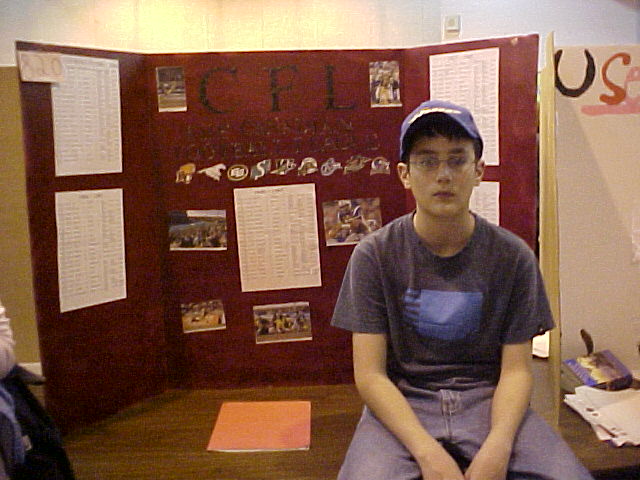
| CFL logos | I got all the logos from my backboard from this site. There is also some cool links to CFL team sites. |