What is a Vasectomy?
A vasectomy is a minor operation that is designed as a permanent method
of birth control. The doctor is able to cut and block off the small tubes
that carry sperm from the testicles to the seminal vesicles that produce
the major portion of the ejaculate. Once successful, the man is sterile and
can no longer father children.

Making The Decision To Undergo Vasectomy
Vasectomy must always be considered as a permanent and irreversible
procedure. Having stated that, it is technically possible to reverse the
procedure, but this is a much more involved operation with lower success
rates and no guarantee that the reversal will work. Again, consider
vasectomy to be permanent.
It is also important to remember that a vasectomy does not work
immediately. There is a period of time required after vasectomy before
the semen contains no more sperm. For most men, this period averages 4
months. Until you have had a follow-up sperm count which shows no
sperm at all, you should continue with another form of birth control.
One must also remember that vasectomy does not always work. There is a
failure rate to this procedure, no matter who performs it or what
technique is used. The usual failure, if there is such a thing, happens less
than 1% of the time. In this case, the man’s sperm count decreases but
does not quite reach zero before it then begins to increase. If two
successive sperm counts show an increase in numbers of active sperm,
then the procedure has likely failed and should be repeated.
The more uncommon failure is the late failure, which happens in about
1:5,000 to 1:10,000 times. In these men, who have had a completely
negative sperm count after vasectomy, the body will somehow manage to
again produce semen containing active sperm. This could occur years
after the original vasectomy. Why this happens we do not know and to
whom it happens we cannot predict, yet we know that , statistically, it will
happen with that frequency. Unfortunately, the way that these failures
are detected is with an unexpected and, usually, unwanted pregnancy.
How is a Vasectomy Done?
A vasectomy is performed in the doctor’s office under a local anesthetic.
The doctor may first have to shave a small area of skin on the front part
of the scrotum to prevent hair from entering the surgical site. The skin is
then cleansed with an antibacterial solution to reduce the chance of
infection.
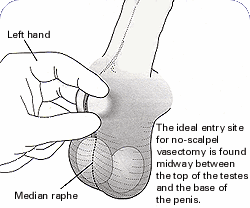
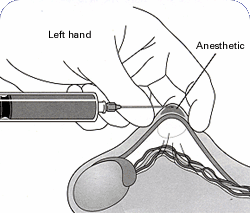
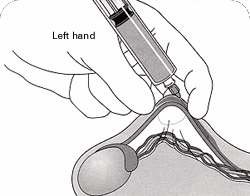
The doctor then feels for the vas deferens in the scrotum, locates it and
brings it close to the surface of the skin in the midline. Some local
anesthetic is then injected first
into the skin and then around the
vas itself. This anesthetic takes
effect very quickly so that any
discomfort is minimal.
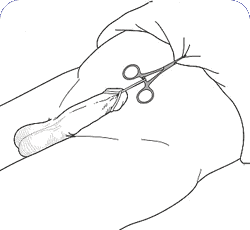
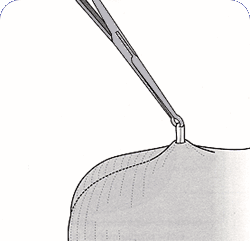
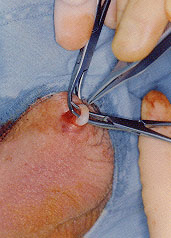
Once the
area is numb, a special instrument
is used to make a small opening in
the scrotum. A loop of the vas
deferens is then lifted out through
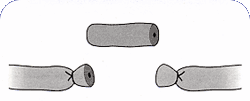
this small opening, is clamped in
two spots, and a portion of the
tube removed.
The cut ends are
then sealed with cautery and are
tied off with suture material.
Exactly the same procedure is then performed
on the vas deferens coming from the other testicle, using the same
puncture site as for the first side. In unusual cases this may not be easily
done and a second puncture site may be necessary.
At the conclusion of the procedure, the area is again cleansed, the skin
edges come together, usually without the need for sutures, and the wound
is dressed with a small gauze pad. A snug fitting pair of jockey style shorts
will keep the dressing in place without the need for adhesive tape. The procedure takes only about 20 to 25 minutes.
After the vasectomy you should go home to bed and lie flat. Apply ice
packs intermittently to the scrotum for the remainder of the day and rest
as much as possible over the next 48 hours. Most men are then able to
return to office type work, but you should avoid heavy lifting and
sporting activities for about 5 to 7 days. Showering is allowed on the next
day, but you should avoid soaking in a tub for about a week.
What Complications Can Occur?
Complications of vasectomy are few and when they occur are usually
mild. Most, if not all, complications relate to bleeding so it is important to
follow your doctor’s instructions in order to minimize bleeding. A small
amount of oozing from the operative site is quite common. This can be
stopped with direct pressure by pinching the skin edges together for 3
minutes.
Bleeding into the scrotum may result in a hematoma (collection of
blood inside the scrotum). This may lead to increased pain after the
procedure, an increased risk of infection, and a prolonged recovery time.
If you suspect this is happening, or if your scrotum enlarges in the first
few hours after your procedure, you should go to the emergency room at
the hospital to have this checked.
Infection may also occur, often related to internal bleeding, and may
occur up to two weeks after the procedure. If you notice an increase in
pain, together with a red, hot, or very tender scrotum, with or without
discharge from the puncture site, you should contact your doctor, as
antibiotics may be necessary.
Epididymitis is an inflammatory response in which the tissue around the
testicle(s) may become inflamed, making one or both testicles extra
sensitive to pressure and quite tender. Treatment with regular doses of
anti-inflammatory medication, such as ibuprofen, for a few days will
usually resolve this problem. Occasionally, a short course of antibiotics is
required as well if there is infection.
Sperm granuloma formation can also occur. This is a tender nodule in the
scrotum at the site where the vas has been interrupted and where the
body is working to reabsorb the sperm that are trapped at that point.
Usually no treatment is required and this nodule shrinks and disappears
with time. Very rarely, surgery may be necessary to remove this area.
Rarely, some men will experience discomfort long after the procedure,
relating to irritation of a nerve running along the vas deferens. This, too,
is usually self-limited and diminishes with time. For extremely
bothersome cases, referral to a urologist for surgical removal of a
neuroma is required.
Allergic reactions to the prep solutions or medications are unusual and are
rarely life threatening.
 |
Complications of Vasectomy
|
Complication
|
Rate of occurrence (%)
|
| Surgical complications |
|
| Bleeding or hematoma |
1.6 to 4.6 |
| Incisional infection |
2.2 to 6.0 |
| Sperm granuloma |
15
to 40 |
| Congestive epididymitis |
0.4 to 6.1 |
| Other complications |
|
| Hospitalization |
0.2 to 0.8 |
| Psychogenic impotence |
Rare |
| Vasourinary fistula |
Rare |
Raspa RF. "Complications of vasectomy." Am Fam Physician 1993;48:1264-8. |
|
What To Do Before Your Vasectomy
• Avoid any products containing aspirin (ASA) for two weeks before
the procedure. These include such things as some over-the-counter
cough and cold remedies and antacid preparations. Aspirin acts as a
blood thinner and could lead to increased risk of bleeding after the
procedure.
• Avoid other anti-inflammatories for one to two days before the
procedure. These drugs have a similar effect to aspirin but are shorter
acting.
• Wash the scrotal area with an antibacterial skin wash such as
Tersaseptic on both the night before and the day of the procedure.
This reduces the number of bacteria on the skin and lowers your risk
of infection.
• Shave the area between the penis and scrotum the night before coming in.
• Eat your usual meal before the procedure. If you come in without
having eaten, you may be more prone to experience some queasiness
or nausea.
• If you are extremely anxious about the procedure, ask your doctor for
a prescription for a minor tranquilizer to take before the procedure.
Most men do not require any sedation before the procedure.
• If you have an extreme fear of needles, you may apply a topical
anesthetic cream such as EMLA to the operative site 1—2 hours before
the procedure. Your doctor will show you where the skin puncture site
is likely to be when you come in for your consultation.
• Bring two snug fitting pairs of underwear (jockey style) with you to act
as a scrotal support after the procedure. This will hold the dressing in
place and support the scrotum to minimize discomfort and swelling. A
cold pack fits nicely between the two pairs of shorts.
• Arrange for someone to drive you home. The anesthetic may begin to
wear off on your drive home and it is best if you are not behind the
wheel when this happens. When the freezing wears off, you will
experience a heavy, aching sensation in the groin.
After Your Vasectomy
• The most important thing to remember is to go home to bed and lie
flat immediately after vasectomy. This reduces the blood pressure in
the tiny vessels in the scrotum and lessens any tendency to bleed.
• Keep an ice pack on the scrotum intermittently for the first few hours,
again to shrink blood vessels and reduce swelling.
• Limit your activity for the first two days. This will reduce any swelling,
discomfort and bleeding.
• Avoid strenuous activity such as heavy lifting and sports for five to
seven days. After this time, your comfort level can dictate your
activity.
• Wear your athletic support or snug fitting shorts for 24 hours or as
long as it feels comfortable.
• You may shower on the day after the procedure and may continue
using the antibacterial skin wash. Do not soak in a tub or go swimming
until the incision is healed.
• You may return to office type work in 48-72 hours or as your comfort
level dictates.
• A prescription for pain medication will be provided before you leave
the office. If you require additional medication or if the medication
provided is ineffective, let your doctor know, as you may need to be
seen again.
• Bring a follow-up semen sample to the laboratory as instructed by your
doctor approximately four months after the procedure. The doctor will
inform you when the results are available, usually in about six or seven
days from when the sample was delivered to the lab.
Remember: the procedure has not worked until your sperm
count is zero!
Common Questions
What are the benefits of vasectomy?
Vasectomy is safer, simpler, and less expensive than tubal sterilization (getting your tubes tied) for a woman. The procedure has never caused a death in the United States and has a less than 1% complication rate. The operation is most commonly done in a doctor's office using local anesthetic (numbing medicine) and the man can go home afterwards. The time to recovery is usually a few days of rest before resuming normal activities.
Is vasectomy very painful?
No, vasectomies do not cause much pain. Most men report that they experience the sharp stinging of the needle giving the anesthetic and not much more. Most often, an over-the-counter pain medicine is enough to relieve the discomfort. Ice packs can help to limit swelling.
Is vasectomy reversible?
Technically, yes, but with varying success. A general anesthetic is
required and a skilled and experienced urologist will do the procedure.
Success rates rarely exceed 50%.
Will I still ejaculate?
Yes. Only the sperm component of the seminal fluid is eliminated. The
remaining 98% of seminal fluid is unchanged so that you will not likely
notice any change in the volume of the ejaculate.
What happens to the sperm?
Your testicles continue to produce sperm that move down the vas to the
point at which it has been tied off. This stretches the vas enough to
trigger a response by the body in which white blood cells are sent in to
investigate and eventually break down the sperm. The broken down
products can then be reabsorbed and used for other purposes by the
body.
When can I have intercourse afterwards?
Try to wait at least 3-4 days to allow some healing to take place. You may have some pain with intercourse initially but this should quickly disappear.
How soon after a vasectomy can a couple stop using birth control?
A man will not be sterile right after the operation. Sperm will stay in the male reproductive system for about 6 more weeks. Couples need to use another method of birth control for 12 weeks or about 20 ejaculations. Several weeks after a vasectomy, the man will need to have his semen checked to make sure no sperm are left (azoospermia). When the test shows that no sperm are left, the man can have sex without additional birth control.
Do I need to continue to have sperm levels checked?
This is usually not necessary because of the extremely low chance of a late
failure as was described earlier. However, if you require ongoing
reassurance, you may be able to arrange for periodic testing of the semen
through your regular physician.
Are there different kinds of vasectomies?
Yes. A common type is done by making two small incisions (cuts) in the scrotum to reach the vas deferens tubes. Another approach is called the "no-scalpel" vasectomy. The no-scalpel approach does not make a cut in the skin; it uses a special instrument to make one small puncture. The no-scalpel vasectomy was invented in China in 1974 and has been used in North America for over 10 years. In North America, about 30% of vasectomies are the no-scalpel type.
Are there advantages to the no-scalpel vasectomy?
Yes, the technique is less traumatic, causes less pain and swelling and results in a shorter recovery time.
What about Laser Vasectomy?
Currently there is no laser vasectomy and if there were it would be
unlikely to provide any advantage because a small hole in the skin is still
required. Many men hear “no scalpel” vasectomy and assume this means
laser.
Will vasectomy affect my male hormones or sex life?
Vasectomy does not affect the production of male hormones, nor does it affect a man's ability to get an erection, have sex, or ejaculate. The male hormones made by the testicle are released directly into the blood stream and are not affected by cutting the vas deferens.
Vasectomy does not:
- make a man more feminine
- cause lower sex drive
- cause a higher voice
- affect male hormones
- interfere with the ability to get an erection
Are there any long-term complications?
The most recent data show that vasectomy does not increase a man's risk of testicular cancer, prostate cancer, or heart disease. Organizations such as the World Health Organization and the United States National Institutes of Health consider vasectomy very safe.
Is there a charge for the procedure?
Alberta Health Care does cover the cost of the vasectomy operation but
there are certain services that Alberta Health does not insure. At our
facility we recognize the value of your time and do our utmost to see that
your follow-up care does not inconvenience you unnecessarily or make
you miss time from work. We charge an all inclusive fee that covers
telephone prescriptions, if necessary, arranging laboratory testing,
phoning you with your laboratory results, patient counseling, as well as
numerous enhanced services until you test "clear". The uninsured
services portion of the procedure is $125. This is payable by cash or debit only at the time of your visit.
How do I know if a vasectomy is right for me?
Vasectomy may be a good choice for a man who:
- is in a long-term relationship where both partners agree they never want another child
- knows that even if his relationship ends and he had another partner he still would not want another child
Video of Vasectomy
Vasectomy Compared to Tubal Ligation